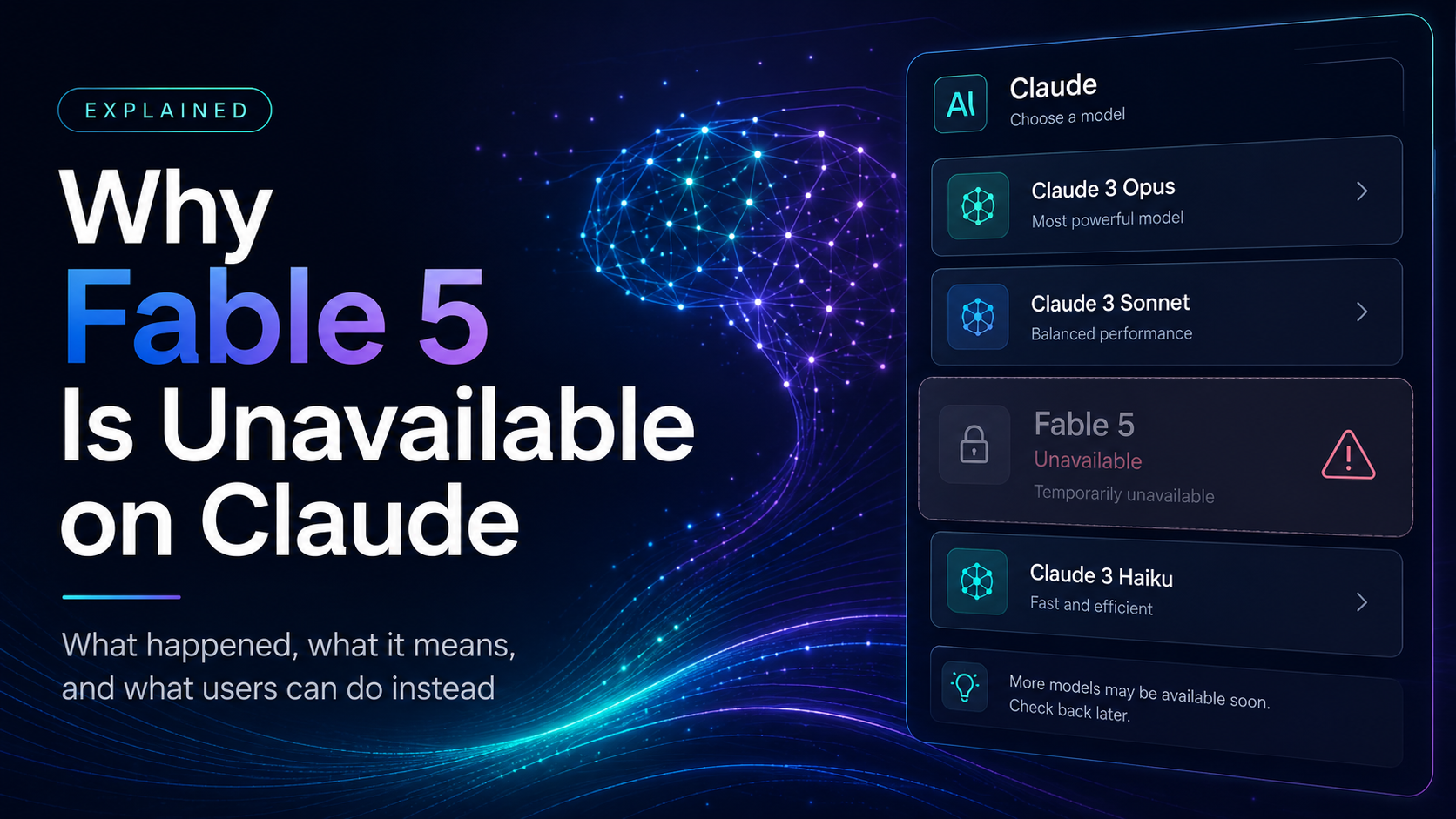
Fable 5 was suspended, not broken. Days after launch, a U.S. government export-control directive forced Anthropic to disable it worldwide because it couldn’t reliably restrict access to eligible users only. Access has since been restored, but the episode is a lesson in why frontier-model availability depends on more than uptime.
Claude Fable 5 briefly became one of the most talked-about AI models of 2026. Anthropic introduced it as its most capable widely released model — designed for advanced coding, complex reasoning, research, document analysis, and long-running AI agent workflows.
Shortly after its release, though, Fable 5 disappeared from Claude. Users who tried to select the model found it unavailable, and developers could no longer reach it through the Claude API or supported cloud platforms.
The interruption wasn’t a normal technical outage or a problem with individual subscriptions. Anthropic suspended the model globally in response to a directive from the United States government.
Fable 5 timeline at a glance
Released as Anthropic’s most powerful generally available model, with a one-million-token context window.
A U.S. export-control directive requires restricting access for foreign nationals. Unable to verify eligibility reliably, Anthropic disables it for everyone.
Coverage suggests the government is moving closer to letting Anthropic reactivate the model, though terms remain unclear.
With controls lifted on June 30, Fable 5 begins rolling back out across Claude products and the API.
When was Claude Fable 5 released?
Claude Fable 5 launched on June 9, 2026, presented as Anthropic’s most powerful generally available model and a major step up over previous Claude releases. It was built for demanding tasks requiring extended reasoning and greater autonomy. Its main capabilities included:
- Complex software development
- Long-running agentic workflows
- Large codebase analysis
- Advanced research and knowledge work
- Document, chart, and table understanding
- Computer use and tool calling
- High-quality application prototyping
- A one-million-token context window
The model was available through Claude, the Claude API, and several cloud AI platforms — but its initial public availability lasted only a few days.
Why did Anthropic disable Fable 5?
On June 12, 2026, the U.S. government issued an export-control directive requiring Anthropic to suspend access to Fable 5 and Mythos 5 for foreign nationals. Because the company couldn’t reliably guarantee that only eligible users and employees would reach the models, it disabled them for all customers worldwide.
The directive reportedly followed concerns that Fable 5’s safety protections could be bypassed through a technique commonly known as a jailbreak — an attempt to manipulate an AI model into ignoring its restrictions. Fable 5 had particularly advanced capabilities in sensitive areas such as cybersecurity, biology, and chemistry, so Anthropic had added safety classifiers that could block certain requests or redirect them to Claude Opus 4.8.
According to Anthropic, the reported bypass didn’t demonstrate a universal jailbreak capable of unlocking the model’s full restricted capabilities. The company argued the identified technique produced results other publicly available models could also provide. Even so, Anthropic complied with the directive and removed access.
Was Fable 5 unavailable only to certain users?
No — the suspension was global. Fable 5 wasn’t simply missing from free accounts or locked behind a pricier subscription. It was disabled for individual users, organizations, and API customers alike.
Changing a subscription, creating a new account, using a VPN, or switching cloud providers would not have provided legitimate access while the suspension was active. The restriction also affected integrations using the claude-fable-5 API model, which could return an unavailable-model or access error unless configured to switch automatically to another model. Other Claude models stayed available, because the directive specifically targeted Fable 5 and Mythos 5.
What can Claude users use instead?
Claude Opus 4.8 is the closest alternative within Anthropic’s family. Even before the full suspension, Fable 5 already redirected some sensitive requests to Opus 4.8 when its safety classifiers activated. Beyond that, the right choice depends on the job:
| Model | Best for | Trade-off |
|---|---|---|
| Claude Opus 4.8 | Complex reasoning, coding, research, professional knowledge work | May not match Fable 5 on the longest, most demanding agentic tasks |
| Claude Sonnet | Everyday coding, content generation, document analysis, business workflows | Balanced performance, speed, and cost rather than frontier depth |
| Claude Haiku | Classification, summarization, high-volume automated responses | Lighter and cheaper, not built for heavy reasoning |
The broader takeaway for developers: configure model fallbacks rather than building critical applications around a single model. A fallback lets an application keep running by switching to another supported model when its preferred one becomes unavailable.
When will Claude Fable 5 return?
At the time the original concern surfaced, Anthropic said it was working to restore access but hadn’t announced a confirmed public return date. Reports on June 27 suggested the U.S. government was moving closer to allowing reactivation, with discussions still ongoing. Access has since been restored (see the status note at the top), but the episode left several questions that are worth watching whenever a frontier model is pulled and reinstated:
- Will it return to every country?
- Will identity or location verification be required?
- Will it stay included with existing subscriptions?
- Will API customers face additional compliance requirements?
- Will the provider introduce stronger safety filters?
- Will access initially be limited to approved organizations?
Until an official availability page confirms status, treat any model-picker appearance or third-party access claim carefully. Seeing the name “Fable 5” inside an application doesn’t always mean the underlying model is actually processing your requests.
What the Fable 5 suspension means for AI users
The sudden removal of Fable 5 shows that access to cloud-based AI models can depend on far more than technical performance or subscription pricing. Government regulations, national-security concerns, safety evaluations, and provider policies can all determine whether a model stays available — and businesses that lean on a single frontier model may face interrupted workflows when access changes without warning.
Organizations adopting advanced AI should consider a few precautions:
- Maintain fallback models for essential workflows
- Avoid making one model a single point of failure
- Store prompts and workflow configurations independently
- Test applications across multiple providers
- Monitor official model availability announcements
- Prepare migration procedures before a disruption occurs
The case may also shape how future frontier models launch. Providers could lean toward staged rollouts, regional restrictions, identity verification, stronger monitoring, or limited access for the most powerful capabilities.
Final thoughts
Fable 5 was pulled because Anthropic suspended access after a U.S. government directive — a restriction that applied globally and couldn’t be solved by upgrading a plan or changing account settings. Access has since been restored, but the situation moved quickly, which is exactly why any article or product listing discussing Fable 5 should clearly state the date its availability was checked.
If Fable 5 ever looks unavailable again, the practical playbook is the same: fall back to Opus, Sonnet, or Haiku depending on the task, and wait for an official announcement rather than trusting a third-party workaround.
Frequently asked questions
Is Claude Fable 5 available right now?
Yes, as of July 8, 2026. Anthropic restored global access on July 1 after the U.S. lifted the export controls. Rollout can still vary by account, plan, region, and cloud provider.
Why was Fable 5 suspended in the first place?
A U.S. export-control directive on June 12 required restricting access for foreign nationals. Because Anthropic couldn’t verify eligibility reliably in real time, it disabled the model for everyone.
Could I get around the suspension with a VPN or new account?
No. The restriction was global and applied to individuals, organizations, and API customers. Changing plans, accounts, VPNs, or cloud providers did not grant legitimate access while it was active.
What should I use if Fable 5 is unavailable?
Claude Opus 4.8 is the closest alternative for complex work; Sonnet suits balanced everyday tasks; Haiku handles fast, high-volume, low-cost jobs. Developers should configure automatic fallbacks.
Does seeing “Fable 5” in an app mean it’s really running?
Not necessarily. Until official availability is confirmed, a model name in a picker or a third-party claim doesn’t guarantee the underlying model is processing requests.
Keep this Fable 5 guide bookmarked
Model access, availability, and provider rules can change quickly. Check AISetApp for the latest status and alternatives.
Explore more on AISetApp →