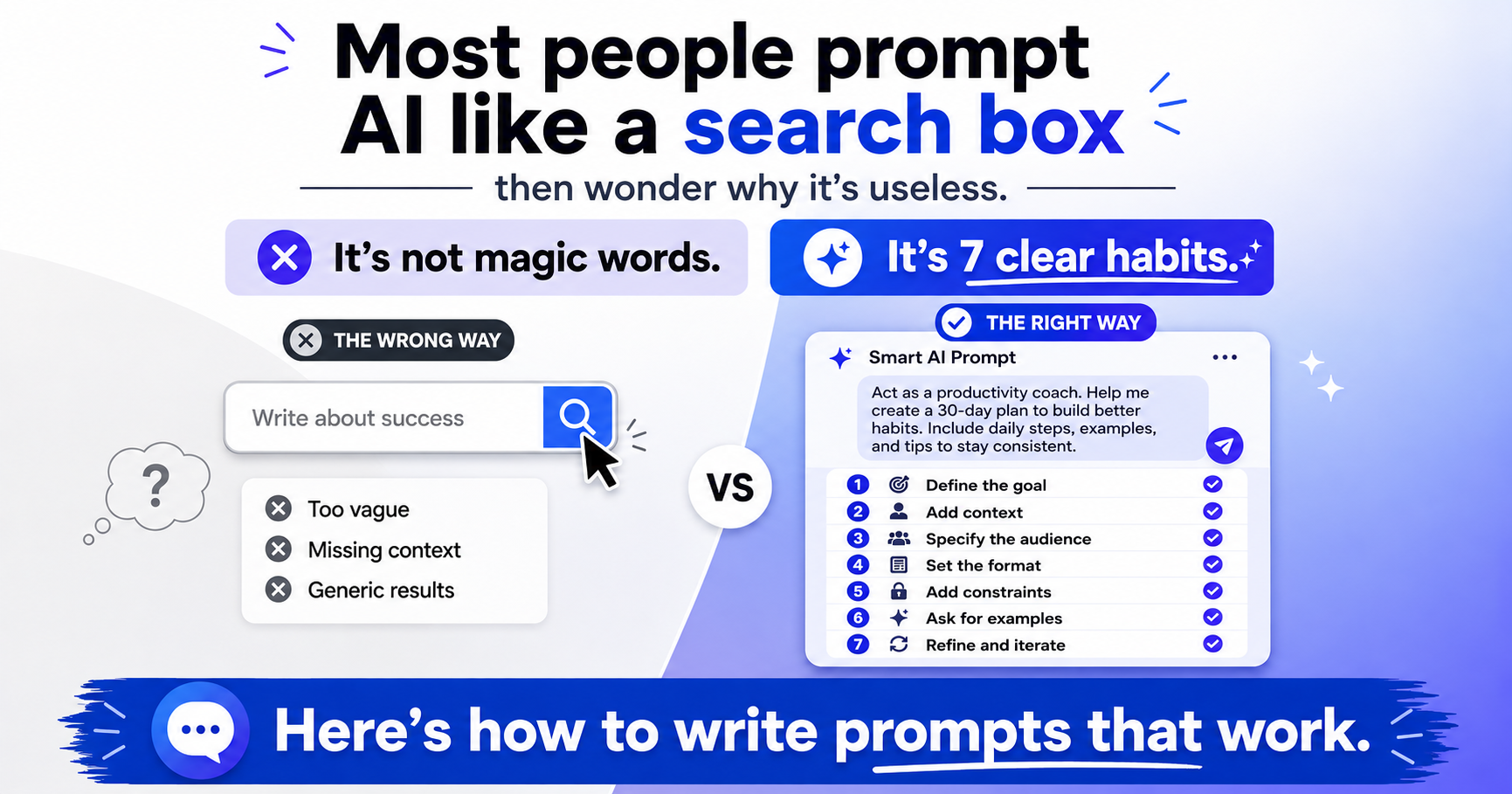
Most people write prompts the way they type into a search box: a few keywords, hit enter, hope for the best. Then they conclude the AI is not that useful. The truth is usually simpler and more fixable, the prompt was vague, so the answer was vague. Writing a good prompt is not about secret phrases or magic formulas, whatever the "prompt hacks" crowd tells you. It is about briefing the model clearly, the way you would brief a sharp but literal-minded assistant who knows a lot but cannot read your mind. This guide covers the handful of habits that actually work, with a before-and-after for each, so you can get dramatically better results from any AI, starting today.
One thing worth saying up front, because it changes how much this is worth learning: these habits are not tied to any single tool. A specific model comes and goes, but knowing how to instruct one clearly transfers to whatever you use next. That is why prompting is a genuine skill rather than a trick, and why an hour spent getting good at it pays off across every AI tool you will ever touch.
1. Be specific about what you want
Vagueness in, vagueness out. The most common mistake is asking for something broad and leaving the model to guess the details, which it will, usually not the way you wanted. Tell it the audience, the length, the format, and the tone. Compare a weak prompt, "write about our new app," with a specific one: "Write a 100-word announcement for our new budgeting app, aimed at busy parents, friendly and reassuring in tone, ending with a call to download." The first gives you something generic you will rewrite. The second gives you something you can nearly use as-is. The specificity is the work, and it is the single biggest lever you have.
2. Give it context
The model does not know who you are, what you are working on, or what you already know, unless you tell it. Supplying context narrows its answer from generic to relevant. Instead of "how do I improve my website," try "I run a small bakery with a one-page website that gets little traffic. I am not technical. What are the three highest-impact changes I could make myself?" The context, small business, non-technical, wants doable steps, transforms the response from a generic listicle into advice you can actually act on.
3. Show an example, do not just describe
Describing the style you want is good; showing it is far better. If you want output in a particular voice or format, paste an example and say "match this style." Giving the model one or two samples of what good looks like, sometimes called few-shot prompting, is one of the most reliable ways to get consistent output, because the model is excellent at pattern-matching but poor at guessing an unstated standard. This is especially powerful for things like tone of voice, formatting, or a specific structure you need repeated.
4. Assign it a role
Telling the model who to be focuses its response. "Act as an experienced copywriter reviewing this landing page for clarity" produces sharper feedback than "is this landing page good?" The role sets the perspective, the vocabulary, and the standard the model applies. It works because it narrows a vast general model down to the specific frame you need, whether that is an editor, a skeptical customer, a subject expert, or a patient teacher.
5. Break big requests into steps
For anything complex, asking for the whole thing at once produces a shallow result. Instead, ask the model to work in stages, or to think through its reasoning before answering. "First outline the structure, then we will write each section" gives you control and a better result than "write the whole report." For problems with a right answer, asking it to reason step by step genuinely improves accuracy, because it stops the model from jumping to a fast, confident, wrong conclusion.
6. Say what to avoid
Negative constraints are as useful as positive instructions, and people forget them. If you do not want jargon, say "no jargon." If you keep getting long preambles, say "skip the introduction, start with the answer." If the output keeps including something unhelpful, name it and exclude it. Telling the model what not to do closes off the failure modes you have already seen, and it is often faster than trying to describe the perfect output positively.
7. Iterate, do not restart
The first answer is a starting point, not a verdict on the tool. Instead of scrapping a near-miss and rewriting your whole prompt, refine in conversation: "good, but make it shorter and more direct," or "keep the structure, change the tone to formal." Treating it as a dialogue, steering with small corrections, gets you to a great result faster than trying to write one perfect prompt from cold. Most people give up one instruction too early.
When you are not sure how to structure a prompt, this order works for almost anything: Role (who the model should be), Task (what you want done), Context (the background it needs), Format (length, structure, tone), and Constraints (what to avoid). You do not need all five every time, but running through them catches the details that turn a vague prompt into a precise one.
What matters less than people claim
A lot of prompt advice is noise, so here is what you can safely ignore. Magic phrases and secret keywords do not have special power; clarity does. You do not need to be elaborately polite for quality reasons, though there is no harm in it. Extremely long prompts are not automatically better, past a point they add confusion rather than precision, and a tight, specific prompt usually beats a sprawling one. And you do not need to memorise a giant library of "prompt engineering" formulas. The habits above cover the vast majority of real use. The skill is clarity of thought, not incantation.
Text prompts versus image prompts
These principles are for text prompts, chatbots and writing assistants, and while the mindset carries over, image generation has its own distinct vocabulary and rules. Describing a visual, subject, style, lighting, composition, camera, works differently from instructing a language model. If you also create images with AI, the same clarity-first approach applies but the specific techniques differ, and we cover them fully in our companion guide to writing AI image prompts.
A worked example, start to finish
Watch the method turn a weak prompt into a strong one. You start with "write a cover letter." The result is generic filler. So you add specificity and context: "Write a cover letter for a junior marketing role at a small nonprofit. I am a recent graduate with one internship in social media. Keep it under 250 words, warm but professional, and emphasise enthusiasm over experience." Better already. Then you iterate: "Good. Now cut the clichés, no 'I am passionate about,' and open with a specific reason I want to work in the nonprofit sector." In three moves, guided by specificity, context, and iteration, you have gone from filler to something genuinely usable. That is the whole method in miniature.
Frequently asked questions
Do I need to be polite to AI for better results?
Not for quality reasons. Please and thank you do not measurably improve output, clarity and specificity do. There is no harm in being polite, and some people prefer it, but do not mistake courtesy for an effective prompting technique. Spend your effort on being clear about what you want instead.
Does prompt length matter?
Up to a point. Too short and you starve the model of the detail it needs; too long and you bury the actual request in noise. The goal is not length but precision: include everything that shapes the answer, audience, format, constraints, and cut everything that does not. A tight, specific prompt usually beats a long, rambling one.
Do these techniques work on every AI model?
Yes, largely. The habits in this guide, specificity, context, examples, roles, iteration, are about clear instruction, which every capable model responds to. Individual models have quirks, but the fundamentals transfer, which is exactly why they are worth learning rather than memorising tricks for one specific tool.
Should I learn "prompt engineering"?
The core of it, yes, and this guide is most of what you need. The elaborate, jargon-heavy version marketed as a specialised discipline is overkill for most people. The genuinely useful part is the handful of clear-instruction habits here. Master those and you are ahead of the vast majority of AI users.
What is the single most important prompting habit?
Being specific. Almost every weak prompt is weak because it is vague, and almost every improvement comes from adding the detail the model was left to guess: who it is for, how long, what format, what tone, what to avoid. If you do only one thing, replace vagueness with specifics.
Now master image prompts too
Prompting text is half the skill. Creating great images with AI uses the same clarity-first mindset but a different vocabulary of style, light, and composition. Our complete guide walks you through it step by step.
Read the AI image prompt guideThis is a practical, model-agnostic guide based on widely established prompting principles that apply across current AI assistants. Techniques are general and transferable rather than specific to any one tool. Reviewed August 2026.