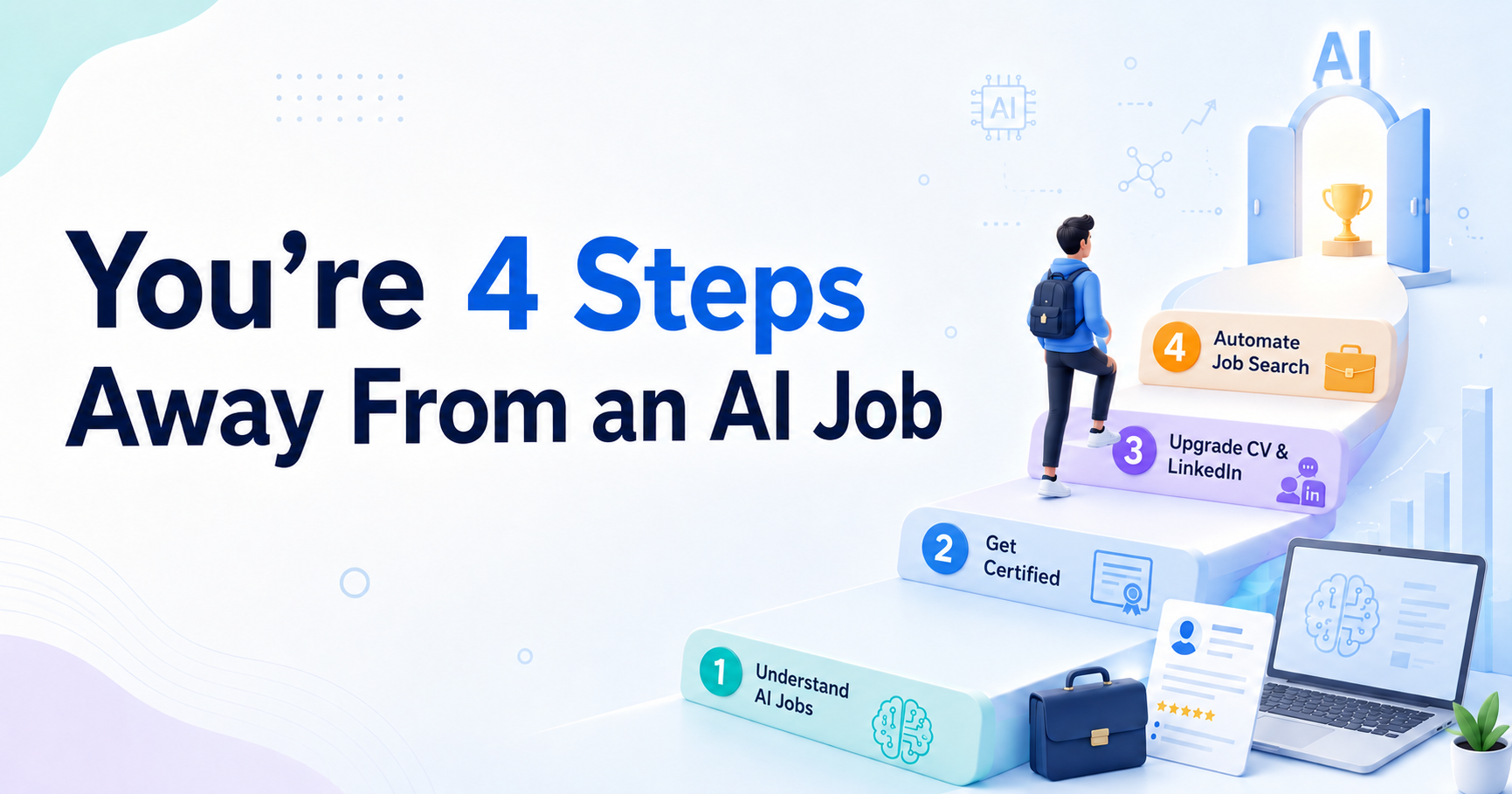
Here is something that surprises almost everyone: you do not need to be a programmer, a data scientist, or a tech graduate to land a job working with AI. The fastest-growing demand is not for people who build AI, but for people who can use it well inside ordinary roles, marketing, operations, finance, HR, support, and more. If you have watched the rise of AI jobs and assumed the door was closed because you cannot code, this guide is for you. It lays out the exact path from where you are now to landing an AI-related role, in four clear steps, none of which require a technical background.
The path is simple to describe and very doable: understand what these jobs actually want, prove you have those skills, package yourself so employers can see it, and then search smart instead of hard. Let us walk through each step, with the concrete action to take at every stage.
Step 1: Understand what AI jobs really want
Start by throwing out the biggest myth. The vast majority of AI-related jobs are not asking you to build models or write code. Surveys of employers are consistent: what they want is people who can use AI tools effectively, judge the output, and apply it to real business results. More than half of AI-related job postings are now outside traditional IT, in exactly the everyday business functions most people already work in.
So the skills that actually get you hired are practical ones: AI literacy (understanding what these tools can and cannot do, and when to trust them), prompt writing (getting good results from AI), using AI for everyday analysis and content, and knowing how to apply it responsibly. These are learnable by anyone, in weeks to months, not years. The realisation to hold onto is this: your existing experience in your field, plus AI fluency, is exactly the combination employers are struggling to find. You are not starting from zero; you are adding a high-value layer to what you already know.
Step 2: Get certified to prove your skills
Once you know which skills matter, the next move is to actually build them and, crucially, to get a credential that proves it. When you are changing fields and cannot point to years of AI experience, a recognised certificate does a specific job: it gives an employer concrete evidence that you have the skills, and it gives you the confidence and structure to learn them properly rather than picking things up at random.
This is the single highest-leverage step for a career changer. Structured training takes you from scattered knowledge to demonstrable competence, and a certificate turns that into something you can put on a CV and a LinkedIn profile. The good news is that a great deal of quality AI training is free, so the barrier is effort, not money. If you do one thing this week, make it this: start a proper AI course and work toward a certificate.
Get AI certified, most of it free
The right training turns "interested in AI" into "certified and job-ready." AISetApp gathers AI courses, bootcamps, and certifications in one place, many of them free, so you can build the skills employers actually screen for and prove them with a credential.
Explore AISetApp TrainingStep 3: Rebuild your CV and LinkedIn to show your AI skills
Having the skills is not enough if an employer cannot see them at a glance. Hiring is shifting from job titles to demonstrated skills, and recruiters increasingly search directly for AI capabilities, so your CV and LinkedIn profile need to surface them clearly and specifically. This is where many career changers lose out, not because they lack ability, but because their CV still reads like their old role.
Rewrite both around what you can now do with AI, and be concrete. Not "familiar with AI," but "automated a monthly reporting workflow" or "used AI to cut research time in half." Name the certificate you earned. Put an AI-skills section where a recruiter will see it. Mirror the language that appears in the job postings you want, because that is often what recruiters and their tools search for. Modern AI-powered CV and resume builders make this far easier: they help you structure, phrase, and target your CV to specific roles, and align your LinkedIn to match, so your new skills are visible and searchable rather than buried.
Rebuild your CV to show your AI skills
A career change needs a CV that reflects the new you, not the old role. Explore AI-powered resume and CV builders on AISetApp to structure, phrase, and target your CV and LinkedIn so recruiters can actually see your AI skills.
Explore CV and resume buildersStep 4: Automate your job search so you apply smarter
With skills proven and your profile sharpened, the final step is the search itself, and this is where most people burn out. Applying to jobs one by one, retyping the same details, losing track of who you contacted and when, is exhausting and inefficient. The people who land roles fastest are not necessarily applying to more jobs; they are applying smarter, with a system.
This is exactly what AI job-search and application-tracking tools are built for. They help you find relevant openings, tailor applications quickly, track every application and its status in one place, and follow up at the right time, so nothing slips and your energy goes into the applications that matter. For a career changer sending out many applications, this organisation is the difference between a scattered, discouraging search and a focused, momentum-building one. Automating the busywork frees you to focus on what actually wins interviews: a sharp application and genuine preparation.
Automate and track your job search
Applying smarter beats applying more. Explore AI job-search and application-tracking tools on AISetApp to find roles, tailor applications, and keep every opportunity organised in one place, so your search builds momentum instead of burning you out.
Explore job-search toolsThe mindset that ties it together
The reason this path works is that it plays to your strength rather than your gap. You are not trying to out-code computer science graduates; you are combining real experience in your field with practical AI fluency, which is a rarer and more valuable mix than most people realise. The four steps build on each other: learn what matters, prove it with a certificate, make it visible on your CV and LinkedIn, and search with a system. None of them require a technical background, and each one moves you measurably closer. Start with step two this week, a proper course, and let the rest follow.
Frequently asked questions
Can I get an AI job without a technical or coding background?
Yes. Most AI-related roles want people who can use AI tools well and apply them to real work, not people who build AI. More than half of AI job postings are now outside traditional IT. Your existing experience in your field, combined with practical AI skills, is exactly the mix employers are looking for.
Do I really need an AI certificate to change careers?
It is not legally required, but it is the single most useful step for a career changer. When you cannot point to years of AI experience, a recognised certificate gives employers concrete proof of your skills and gives you a structured way to learn them properly. Much quality AI training is free, so the main cost is your effort.
How should I present AI skills on my CV and LinkedIn?
Be specific and visible. Instead of "familiar with AI," describe concrete results like automating a workflow or cutting research time. Name your certificate, add a clear AI-skills section, and mirror the language in the job postings you want, since recruiters search for those terms. AI-powered CV builders make structuring and targeting this much easier.
How long does it take to become job-ready?
For practical, non-technical AI skills, most people can build a solid foundation in weeks to a few months, not years. The timeline depends on the depth of the role, but because these skills are about using AI rather than building it, they are far faster to acquire than a traditional technical qualification.
How can I make my job search less exhausting?
Use a system instead of applying one by one from scratch. AI job-search and application-tracking tools help you find relevant roles, tailor applications quickly, and track every application and follow-up in one place. Applying smarter, not just more, is what helps career changers build momentum and land interviews faster.
- World Economic Forum and Lightcast 2026 data on AI skill demand and the share of AI roles outside traditional IT
- 2026 hiring analyses on skills-based recruiting and the shift from job titles to demonstrated skills
- Practitioner guides on presenting AI skills on CVs and LinkedIn for career changers, 2026
Reviewed August 2026. Career outcomes vary; this is general guidance, not a guarantee of employment.