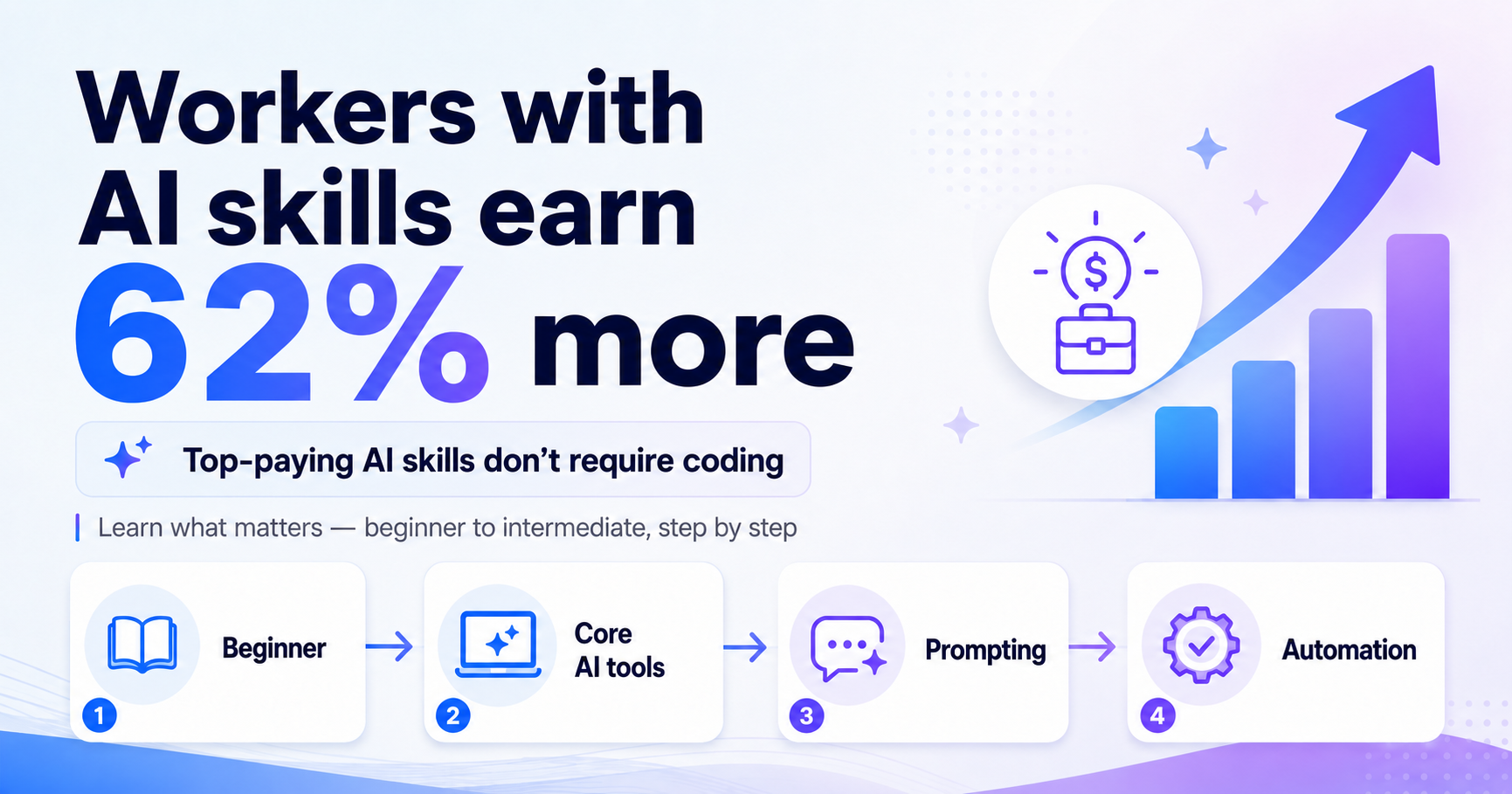
There is a number worth starting with. According to PwC's 2026 Global AI Jobs Barometer, workers with AI skills earn on average 62 percent more than people in the same roles without them, and job postings asking for AI skills have grown roughly eight times faster than the job market overall. Whatever your field, learning to work with AI has stopped being optional and started being one of the highest-return things you can do for your career. The good news, and the part most people get wrong, is that the most valuable AI skills are not the ones that require coding. This guide lays out what is actually worth learning, in what order, whether you are a complete beginner or already comfortable with the basics.
The plan below is split into two tiers. The beginner tier is where everyone should start, foundational AI skills you can build in one to three months, none of which need programming. The intermediate tier is where you deepen that foundation into something that genuinely sets you apart at work. You do not need to rush to the second tier. Most of the career benefit comes from getting genuinely good at the first.
Why this is worth your time
AI has crossed from experiment to everyday workplace tool. Companies now use it to draft content, analyse data, handle customer questions, and automate the repetitive tasks that used to eat your week. That shift is why AI learning has become, in the words of more than one 2026 analysis, as essential to a career as internet proficiency was two decades ago. The professionals pulling ahead are not the ones who consumed the most information about AI. They are the ones who can actually apply it to real problems in their own job. That is a learnable skill, and the roadmap below is how you build it.
The beginner tier: start here
These four AI skills are the foundation. They are beginner-friendly, require no coding, and can be built in roughly one to three months of consistent practice. Together they cover the vast majority of what most professionals actually need.
Writing effective prompts
This is the single fastest, highest-return AI skill, and it underpins everything else. The quality of what you get out of an AI tool depends almost entirely on the quality of what you put in. Learning to instruct a model clearly, with the right context, format, and constraints, is the difference between output you rewrite and output you use. It needs no code and improves everything else you do with AI immediately. If you learn one thing first, learn this.
Using AI for content and daily work
The practical, everyday application: using AI to draft emails, reports, social posts, summaries, and first drafts of almost anything. The valuable version of this skill is not letting AI write for you unchecked, but combining AI speed with your own editing and judgment to produce good work far faster. This is where most people see an immediate productivity jump, and it is highly marketable for freelancing and everyday roles alike.
Basic automation
Automation connects your tools so repetitive tasks happen without you, moving data between apps, triggering actions, handling routine documentation and scheduling. Modern no-code automation platforms make this accessible without programming, and it is consistently rated one of the highest-ROI skills because it directly removes hours of manual work each week. Learn to spot a repetitive task and automate it, and you free your time for the work that actually matters.
AI literacy: judging the output
Knowing how to use AI is not enough; you need to know when to trust it. AI literacy is the skill of evaluating AI answers critically, spotting confident-sounding mistakes, verifying facts, and understanding what these tools cannot reliably do. As AI enters more of your work, this judgment becomes essential, and it is what separates people who use AI safely from people who get burned by it. We cover this in depth in our guide to AI literacy skills.
The intermediate tier: set yourself apart
Once the foundation is solid, these skills deepen your value and open more specialised, higher-paying roles. They take longer, expect three to twelve months, and some touch lightly on technical territory, but most remain accessible to non-programmers willing to practise.
Working with your own data (RAG)
Retrieval-augmented generation, or RAG, means connecting an AI to your own documents so it can answer questions using your specific information rather than only its general training. In practice this is "chat with your files," and it is one of the most useful business applications of AI. Understanding how to set this up, even with no-code tools, is a genuinely differentiating intermediate skill.
Working with AI agents
Agents are AI systems that do multi-step tasks rather than just answering questions. Learning to set up, direct, and supervise them, knowing which tasks to hand over and which to keep a human hand on, is a fast-rising skill as agents move into everyday business workflows. This is where a lot of the 2026 hiring demand is heading.
Data literacy
Most valuable AI work comes down to making sense of data. You do not need to become a data scientist, but understanding how to read data, spot patterns, ask good analytical questions, and use AI to help you do it makes your decisions sharper and your work more credible. A short course on data basics goes a long way here.
Applying AI to your specific field
This is the one that actually makes you valuable, and the sources are unanimous on it. The most sought-after people are not AI generalists; they are professionals who combine AI skill with deep knowledge of their own industry, marketing, finance, healthcare, law, operations. AI plus your domain expertise turns a general tool into a strategic advantage nobody can easily replace. Learn how AI applies to your specific job, not just AI in the abstract.
Ethics, bias, and governance awareness
As regulation like the EU AI Act tightens, companies are holding individuals accountable for how they deploy AI, and ignorance is no longer a defence. Understanding bias, data protection, and the basics of responsible AI use is becoming part of professional competence, not an optional extra. Our guide to AI governance covers what this means in practice.
Notice how few of these require coding. The sources are unanimous on this point, the skill that matters is not programming, it is problem-solving with AI as your enhanced capability. A marketing manager who generates and tests ten campaign variations in minutes, or an analyst who spots a trend before it hits the headlines, is winning on judgment and application, not on writing Python. That is genuinely good news, because it means AI skills are within reach for almost everyone, in almost every role.
A simple roadmap to actually learn this
The biggest mistake beginners make is trying to learn everything at once and burning out. Do this instead. In your first week or two, just play: sign up for a major AI assistant and experiment with prompts until you have a feel for what it can and cannot do. In weeks three and four, automate one boring, repetitive task from your actual work, using a no-code tool if needed, so you feel the productivity gain firsthand. In your second month, learn the basics of data through a short free course, and start applying AI deliberately to problems in your own field. Keep sessions short and consistent, even 30 minutes a day beats occasional marathons. Foundational skills come together in one to three months this way; the more advanced ones follow over the rest of the year.
The bottom line
You do not need a computer science degree to benefit from AI, and you do not need to learn everything. You need a plan, the discipline to practise a little consistently, and the willingness to apply AI to the real problems in your own work. Start with prompting and everyday use, add automation and judgment, then deepen into your specific field. The 62 percent wage premium is not for the people who know the most about AI in theory. It is for the ones who can actually put it to work.
Frequently asked questions
Which AI skills should a beginner learn first?
Start with writing effective prompts, because it improves everything else immediately and needs no coding. Then add using AI for everyday content and work, basic no-code automation, and AI literacy, the ability to judge and verify AI output. These four foundational skills can be built in one to three months and cover most of what professionals actually need.
Do I need to know how to code to learn AI skills?
For most valuable AI skills, no. Prompt writing, content creation, automation, and applying AI to your field all require no programming. Coding helps for deeper technical roles, but the sources agree the skill that matters most is problem-solving with AI, not writing code. The majority of career-boosting AI skills are accessible to non-technical professionals.
How long does it take to learn AI skills?
Foundational, beginner-friendly skills typically take one to three months of consistent practice. More advanced skills like automation, working with agents, or RAG can take six to twelve months depending on how consistently you practise and whether you apply them to real projects. Short, regular sessions work far better than occasional long ones.
Are AI skills actually worth it for my career?
The data is striking. Workers with AI skills earn an average wage premium of around 62 percent over those without, and demand for AI skills has grown far faster than the overall job market. As AI becomes standard across industries, AI proficiency is becoming as fundamental to a career as internet skills once were.
What is the most valuable AI skill in 2026?
Applying AI to your specific field. General AI ability is useful, but the most sought-after professionals combine AI skill with deep knowledge of their own industry, whether that is marketing, finance, healthcare, or operations. AI plus domain expertise is the combination that turns a general tool into a genuine career advantage.
Start building these skills today
Reading about AI skills is the first step. Practising them with structured guidance is how they turn into real capability, and real career advantage. AISetApp's training walks you through the skills that matter, on real tasks, so you finish able to put AI to work in your own job.
Explore AISetApp Training- PwC, 2026 Global AI Jobs Barometer, on the AI skills wage premium and job-posting growth
- Upwork and NASSCOM AI Adoption Index 2.0, on rising demand for AI skills
- Tredence, Futurense, and Hirist 2026 guides to in-demand AI skills
- 2026 career analyses on beginner-to-intermediate AI learning roadmaps and no-code skills
Reviewed August 2026. Figures are drawn from cited 2026 industry reports.