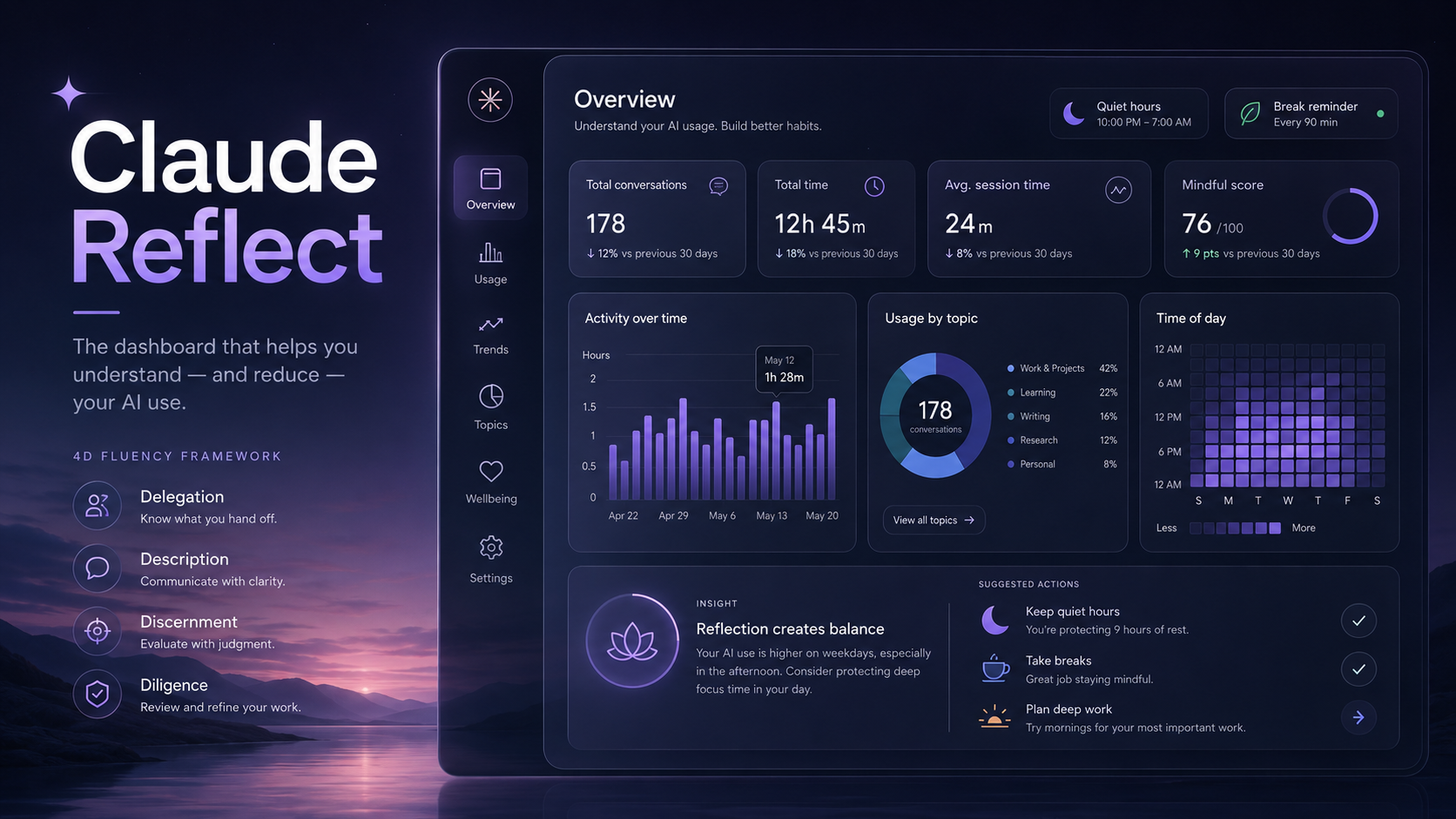
Reflect is Claude's "Wrapped", with a twist: it nudges you to use AI less. The new in-app dashboard shows your top topics, when you use Claude most, and how you tend to collaborate with it, then adds self-management controls like quiet hours and break reminders. Unusually for an AI company, it periodically asks what you'd rather keep doing yourself. It's in beta for Free, Pro, and Max users who have Memory enabled.
Anthropic has introduced Reflect, a built-in dashboard that lets you review how you use Claude over time. Reviewers have compared it to a cross between Spotify Wrapped and a phone's screen-time tool, but its more interesting quality is that it's built to encourage mindful use rather than maximize engagement. It launched in beta on July 9, 2026, and you'll find it in Settings on Claude for web and the desktop app.
What Reflect shows you
Open the Reflect tab and you get a short written summary of your recent Claude activity: the key topics you discuss, your usage patterns, and the kinds of tasks you tend to work through. You can look back over the past 1, 3, 6, or 12 months. Below the summary, the dashboard lists your most active day, peak hour, and total conversations, with a simple visualization, followed by a percentage breakdown of the topics you raise most often.
What a Reflect report contains
Illustrative view of the sections in the dashboard, not your actual data.
The 4D fluency layer
What sets Reflect apart from a plain analytics screen is how it categorizes your interactions using Anthropic's 4D AI Fluency Framework: delegation, description, discernment, and diligence. Rather than a raw count of chats, the report describes how you tend to collaborate with Claude, for example, noting that you often rework email drafts in your own voice, or that you delegate tasks only after settling the strategy yourself. It can also suggest concrete improvements, like using the Projects feature if you keep re-establishing the same context.
How you hand off work
Reflect looks at what you choose to give Claude and how clearly you brief it, surfacing patterns like delegating only after you've settled the plan yourself, so you can decide whether that split still matches your goals.
How you judge and own the output
It reflects how you assess Claude's responses and take responsibility for the result, for instance, reworking drafts in your own voice rather than shipping them as-is. The aim is skill-building, not a productivity score.
The part that nudges you to log off
The second half of Reflect is closer to a digital-wellbeing tool. You can set quiet hours during which Claude won't prompt or nudge you, and schedule a reminder to take a break after a chosen amount of use. Both are framed as reminders of your own preferences and can be dismissed. Periodically, Reflect surfaces a reflective question. The one Anthropic keeps citing is "What's one thing you want to keep doing yourself, even if Claude could do it faster?" It then gives you space to think it through.
According to Anthropic's head of wellbeing policy, Ryn Linthicum, Reflect grew out of a Societal Impacts study in which participants expressed a mix of optimism and anxiety about Claude and other AI products. Notably, the dashboard doesn't yet show exactly how much time you've spent in Claude, Linthicum said time-in-app wasn't a metric the company had tracked internally because it wasn't something the product team wanted to maximize. A time-spent view is planned for later.
Privacy and limits
Anthropic says the insights stay inside the Reflect experience and aren't used for other purposes. The report doesn't draw from incognito chats, doesn't pull underlying files from connected tools, and entirely excludes conversations linked to health-integration tools. More sensitive conversations may still appear, but only at a high level. Reflect requires Memory to be enabled, if you can't generate a report, that's the usual reason.
| Detail | Status |
|---|---|
| Where to find it | Settings → Reflect (web & desktop) |
| Who has access | Free, Pro, Max (Memory on) |
| Time ranges | 1, 3, 6, or 12 months |
| Excluded data | Incognito & health-integration chats |
| Mobile app | Coming later |
| Cowork & time-spent view | Coming soon |
Some observers note Reflect can cut two ways: while it nudges you toward mindful use, laying out everything Claude helped with can also quietly reinforce how much of your daily work now runs through it, and its improvement suggestions, like Projects, deepen that integration. In workplaces, aggregate usage data could eventually tell employers a lot about how teams use AI, which raises separate governance questions. For now, the individual-facing version is a genuinely unusual move for an AI company: prompting people to ask whether they're using the product too much.
The bottom line
Reflect is a thoughtful, slightly self-conscious attempt to give users real visibility into their AI habits, part usage recap, part fluency coach, part digital-wellbeing tool. In an industry that mostly optimizes for more engagement, an AI company nudging you to occasionally step back is worth noting. If you're on Free, Pro, or Max with Memory on, open Settings and generate a report; Cowork insights, a mobile version, and a time-spent view are on the roadmap.
Frequently asked questions
What is Claude Reflect?
It's a usage dashboard inside Claude that summarizes how you've used the assistant over the past 1, 3, 6, or 12 months, your top topics, usage patterns, and how you collaborate with it, plus self-management controls. It launched in beta on July 9, 2026.
Where do I find it, and who can use it?
It's in Settings on Claude for web and the desktop app, under a "Reflect" tab. It's available in beta to Free, Pro, and Max users who have Memory turned on. A mobile version is planned for later.
Why can't I generate a report?
The most common reason is that Memory isn't enabled. Reflect needs Memory on to build your summary. Enable it in Settings and try again.
What is the 4D AI Fluency Framework?
It's Anthropic's model for working well with AI across four dimensions, delegation, description, discernment, and diligence. Reflect summarizes your activity across each, with examples of how you tend to collaborate with Claude.
Is my data private?
Anthropic says the insights stay within Reflect and aren't used for other purposes. It excludes incognito chats and health-integration conversations entirely, and doesn't pull files from connected tools. Sensitive chats may appear, but only at a high level.
Can it help me use Claude less?
Yes. You can set quiet hours and schedule break nudges, and Reflect periodically asks reflective questions about what you'd rather keep doing yourself. Both nudges are dismissible.
Stay on top of every Claude update
New features and settings are landing fast. Bookmark AISetApp for clear, practical breakdowns as they ship.
Explore more on AISetApp →