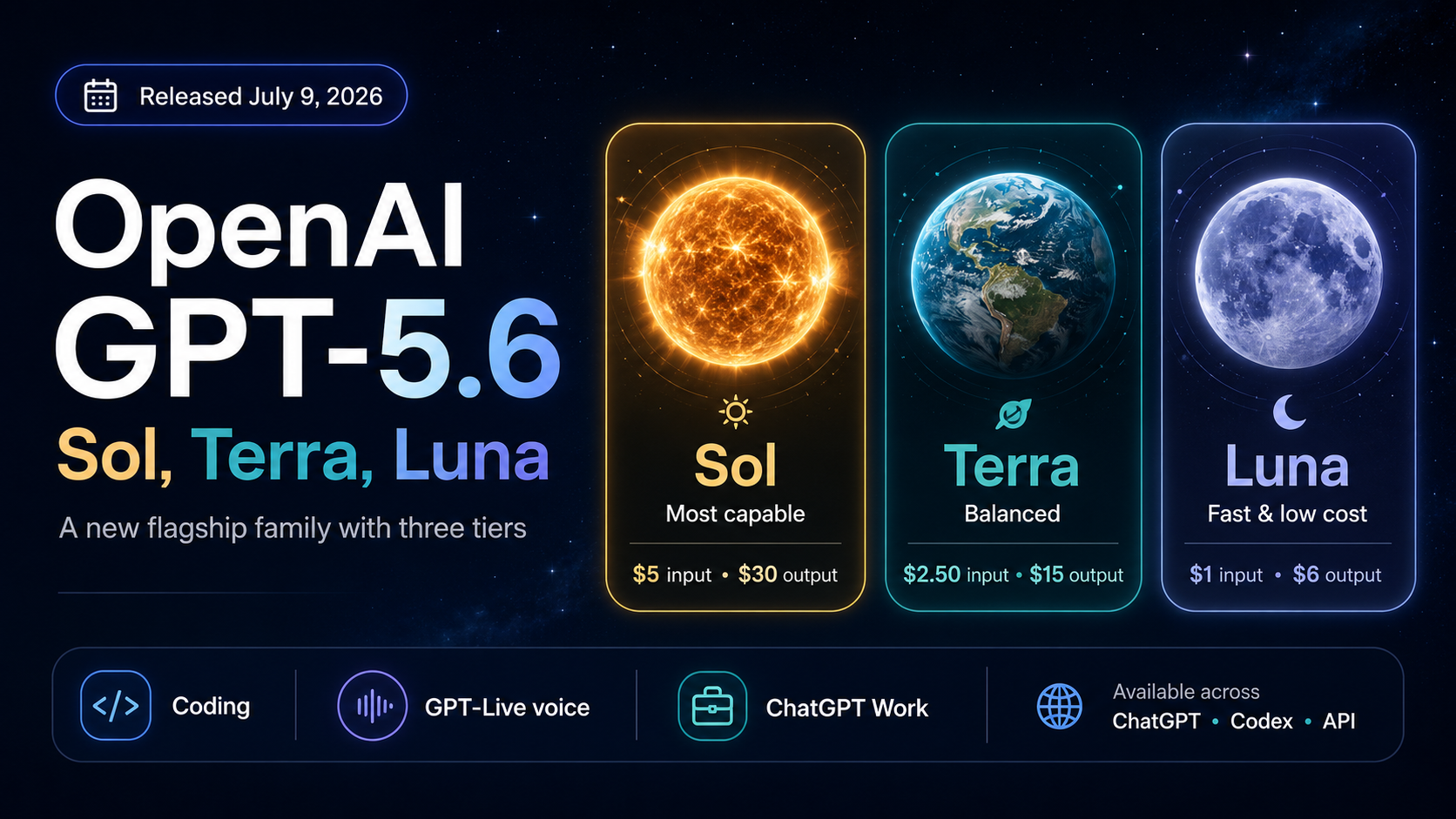
GPT-5.6 is OpenAI's new flagship family, and it dropped names for numbers. Instead of one model, you now pick a tier: Sol for the hardest work, Terra for everyday tasks, and Luna for speed and low cost. OpenAI positions it directly against Anthropic's Fable, claiming state-of-the-art coding with far fewer tokens, though early testers are split on whether it actually beats Fable. It arrived after a rare US government review delayed the public launch.
OpenAI has broadly released GPT-5.6, its newest family of models, after staggering the rollout at the request of the US government. The launch caps a remarkably busy week in AI: Meta shipped Muse Spark 1.1 and Muse Image, and Anthropic restored access to Fable 5 and Mythos 5 after its own clash with regulators. Here is a clear, practical breakdown of what GPT-5.6 is and how it fits.
Sol, Terra, Luna: a new naming system
The most visible change is how OpenAI names its models. Instead of using only model numbers, the company now uses Sol, Terra, and Luna to separate its models by capability, speed, and cost. The number shows the model generation, while the name shows the capability tier. Sol is the flagship for complex tasks, Terra is the balanced everyday option, and Luna is the faster, more affordable choice. A new "ultra" mode within Sol lets the system work even harder on a task and delegate work to various submodels.
The flagship for the hardest work
OpenAI's most capable tier, aimed at complex coding, science, and cybersecurity. Sam Altman told CNBC that Sol is 54% more token efficient on agentic coding tasks, a stat aimed squarely at enterprises weighing cost against value.
The balanced everyday model
Positioned as the middle option for general work. Reporting notes Terra is competitive with the previous GPT-5.5 while being roughly half the cost, making it the likely default for most users.
Built for speed and low cost
The budget-friendly, fastest tier. On some coding comparisons OpenAI says Luna outperforms Anthropic's Opus 4.8, positioning even its cheapest model against rival flagships.
Pricing across the family
The three tiers are priced to cover a wide range of budgets, from flagship down to high-volume use. Here is how the API pricing breaks down per million tokens.
GPT-5.6 API pricing (per million tokens)
Input and output rates by tier. Output is always priced higher than input.
The Fable comparison
OpenAI aimed GPT-5.6 squarely at Anthropic's Fable 5. It calls Sol its best coding model yet and, using the Coding Agent Index, claims Sol sets a new state of the art at 80, about 2.8 points above Fable 5, while using less than half the output tokens, taking less than half the time, and costing about one-third less. The company adds that the advantage extends across the family, with Terra performing just above Fable 5 and Luna outperforming Opus 4.8.
The reviews are mixed, and not uniformly in OpenAI's favor. Some who tested both models preferred Anthropic's: investor Matt Shumer wrote that while GPT-5.6 is an amazing model, Fable was quite a bit better for nearly every task he tried. Every's CEO Dan Shipper offered a memorable analogy, likening GPT-5 to a Porsche while saying Fable offers the equivalent of a warp drive for crossing the galaxy. As always, benchmark claims come from the vendor, so test both on your own tasks before deciding.
Why the launch was delayed
GPT-5.6 was first made available as a limited preview on June 26, 2026, before the wide release on July 9. The Trump administration pushed OpenAI to conduct a staggered release last month, limiting initial access to government-approved entities. Testing was done by the Center for AI Standards and Innovation within the Department of Commerce, with OpenAI sending technical experts to Washington to answer questions. OpenAI said the staggered rollout was not its preferred approach and that it does not believe this kind of government access process should become the long-term default.
The context is a broader shift in how powerful models reach the public. The delay traces to a June executive order, and the same review dynamic recently affected Anthropic, which had to disable access to Fable 5 and Mythos 5 to comply with an export-control directive before the Department of Commerce lifted it. Altman said OpenAI made many changes after a collaborative back-and-forth with the administration and called the government's technical capabilities impressive.
| Detail | GPT-5.6 |
|---|---|
| Maker | OpenAI |
| Public release | July 9, 2026 |
| Tiers | Sol, Terra, Luna (+ Sol "ultra" mode) |
| Where | ChatGPT, Codex, OpenAI API |
| Launched with | GPT-Live voice models, ChatGPT Work |
| Positioned against | Anthropic Fable 5 and Opus 4.8 |
GPT-Live and ChatGPT Work
GPT-5.6 did not arrive alone. OpenAI also announced GPT-Live, a new generation of voice models for more natural voice interaction, and ChatGPT Work, a new tool with an agent powered by 5.6 that can gather context across connected apps and files to create documents, spreadsheets, and presentations. The agent can work across web, phones, and computers, first rolling out to the Mac and Windows apps for all tiers, with web to follow. It is a clear signal that OpenAI, like Meta and Anthropic, is pushing agents into everyday office work rather than just chat.
The bottom line
GPT-5.6 is both a capability jump and a repackaging: a three-tier family that lets you trade cost for power, launched with voice models and an office agent, and aimed directly at Anthropic's Fable. OpenAI's own numbers look strong, especially on coding efficiency, but independent testers are genuinely split between GPT-5.6 and Fable, so the honest advice is to trial both on your real workload. If you use ChatGPT, Codex, or the API, the models are rolling out now; pick Sol, Terra, or Luna based on how much power the task actually needs.
Frequently asked questions
What is GPT-5.6?
It is OpenAI's newest family of large language models, publicly released on July 9, 2026, across ChatGPT, Codex, and the OpenAI API. It comes in three tiers: Sol, Terra, and Luna.
What is the difference between Sol, Terra, and Luna?
Sol is the most capable tier for complex work, Terra is the balanced everyday option, and Luna is the fastest and cheapest. The number marks the generation, and the name marks the capability tier. Sol also has an "ultra" mode that works harder and delegates to submodels.
How much does GPT-5.6 cost?
Per million tokens: Sol is $5 input and $30 output, Terra is $2.50 input and $15 output, and Luna is $1 input and $6 output.
Is GPT-5.6 better than Claude Fable 5?
OpenAI claims Sol beats Fable 5 on coding while using fewer tokens and costing less. But several early testers preferred Fable across many tasks, so the comparison is contested. Independent testing on your own use case is the reliable signal.
Why was the release delayed?
The US government asked OpenAI to stagger the rollout, limiting early access to approved entities while the Department of Commerce reviewed the model's capabilities, particularly in cybersecurity. OpenAI said this was not its preferred approach.
What else launched with GPT-5.6?
OpenAI also released GPT-Live, a new generation of voice models, and ChatGPT Work, an agentic tool powered by 5.6 that works across apps, files, web, phones, and computers.
Stay on top of every major AI release
New models, tiers, and pricing shifts are landing fast. Bookmark AISetApp for clear, practical breakdowns as they ship.
Explore more on AISetApp →