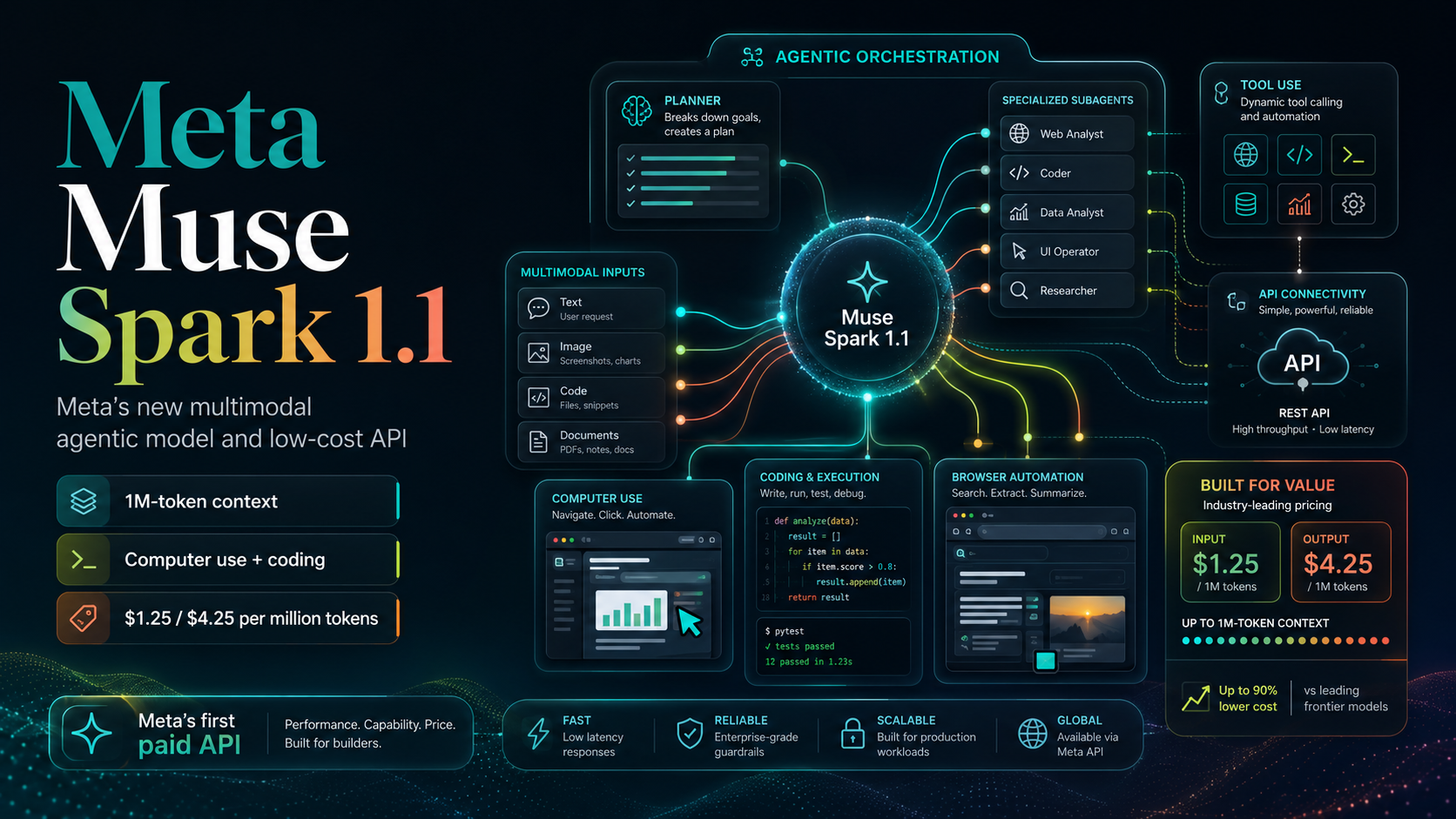
Meta just put a price tag on its AI, and it's aggressively low. Muse Spark 1.1 is a major multimodal upgrade built for agents: it plans work, calls tools, controls a computer, and coordinates parallel subagents across a 1M-token context. For the first time, developers can build on a Meta model via the new Meta Model API, at $1.25/$4.25 per million tokens, far below rivals like GPT-5.5 and Claude Opus 4.8, which it claims to rival on many agentic benchmarks.
Meta Superintelligence Labs (MSL) has released Muse Spark 1.1, a significant upgrade to April's original Muse Spark reasoning model. The bigger news arrives alongside it: the Meta Model API, a public preview that lets outside developers build on a Meta model for the first time. Mark Zuckerberg framed it plainly on X: a strong agentic and coding model at a very low price. Here's a clear, practical breakdown.
What Muse Spark 1.1 is built for
This is an agent-first model. Meta says Muse Spark 1.1 brings major gains in agentic workflows, computer use, coding, and multimodal understanding over the first version. It's designed to plan and orchestrate work across external apps and services rather than answer single-turn questions, it can call native tools, use MCP servers and custom skills, and act as a primary agent that delegates to parallel subagents to cut latency. It runs in Thinking mode inside Meta AI and on meta.ai, and Meta positions it as a frontier-tier competitor to GPT-5.5, Claude Opus 4.8, and Gemini 3.1 Pro.
A context window it manages itself
Muse Spark 1.1 supports a 1-million-token context window and, unusually, actively manages it: it remembers earlier actions, retrieves information from much earlier in a task, and compacts stale context while preserving the critical steps a long-running agent needs to continue.
Works across desktop, mobile, and browser
The model can automate multi-app workflows by writing its own scripts or interacting directly with an interface when scripting isn't viable. Meta's examples include organizing a dinner party and adjusting an order when new information appears mid-task, adapting as requirements evolve.
Bug-fixing, features, and large migrations
Coding got a major upgrade: Meta says the model can diagnose bugs, implement features in large codebases, and support large code migrations. Meta's own developers and researchers are reportedly already using it for coding, model development, and evaluation work.
The real story: Meta's first paid API
For a company whose Llama models were open-weight, charging for API access is a strategic pivot. The Meta Model API is a self-serve public preview, described as OpenAI-compatible with structured output and parallel tool calling. In practice, pointing an existing agent at Muse Spark is reportedly a base-URL and key change rather than a rewrite. The API is said to speak both the OpenAI SDK and the Anthropic Messages format, using the model name muse-spark-1.1. That dual compatibility lets teams A/B a new model against their current one without re-plumbing their stack. At launch, the preview is limited to US developers.
Muse Spark 1.1 API pricing vs the field
Per million tokens. Meta's rate is well below typical frontier pricing, the aggressive positioning Zuckerberg described.
Meta is leaning hard on price. Reports cite the model as being positioned to rival GPT-5.5 and Opus 4.8 on many agentic evaluations while being far cheaper, one summary framed it as roughly 10x cheaper and twice as fast, though those are early, vendor-adjacent claims worth verifying independently. Early API partners Replit, Cline, and Box headlined the announcement, with Replit CEO Amjad Masad calling the mix of million-token context, multimodal support, built-in search, and coding a complete agentic foundation.
Where it sits in Meta's lineup
Muse Spark 1.1 is MSL's second model in the Muse Spark line, which sits above the open-weight Llama family, Meta's previous flagship line. Unlike Llama, Muse Spark is proprietary and closed-weight: no local deployment, no community fine-tuning. It shares the week with Meta's Muse Image launch, underscoring how quickly MSL, the lab Zuckerberg built after Meta fell behind rivals, is shipping. A fast 1.1 upgrade this soon after the original signals Meta intends to compete at the frontier, not just catch up.
| Attribute | Detail |
|---|---|
| Maker | Meta Superintelligence Labs |
| Type | Multimodal reasoning / agentic model |
| Context window | 1 million tokens (self-managed) |
| Inputs | Text, images, video, PDFs |
| Consumer access | Thinking mode in Meta AI & meta.ai |
| Developer access | Meta Model API (preview, US) |
| Weights | Proprietary / closed |
The benchmark and speed comparisons circulating at launch largely originate from Meta and its launch partners. At least one analysis notes that long-horizon agentic work may still trail GPT-5.5 and Opus 4.8 in practice, even where headline evals look competitive. As always with a new model, independent testing on your own tasks is the reliable signal, the aggressive price just makes it cheaper to run that test.
The bottom line
Muse Spark 1.1 is two moves in one: a capable agentic upgrade (1M-token context, computer use, stronger coding, parallel subagents), plus Meta's first serious bid for developer mindshare through a paid, OpenAI- and Anthropic-compatible API priced to undercut the field. If the quality holds up under independent testing, the low price and drop-in compatibility make it easy to trial. Consumers can try it now in Meta AI's Thinking mode; US developers can start on the Meta Model API with $20 in credits.
Frequently asked questions
What is Meta Muse Spark 1.1?
It's a multimodal reasoning model from Meta Superintelligence Labs, released July 9, 2026, built for agentic tasks, coding, and computer use, with a 1-million-token context window. It's the second model in Meta's Muse Spark line.
How can I use it?
Consumers can use it in Thinking mode inside the Meta AI app and on meta.ai. Developers can build on it through the new Meta Model API, currently a public preview limited to US developers at launch.
How much does the API cost?
$1.25 per million input tokens and $4.25 per million output tokens, with $20 in free credits for new accounts, pricing well below comparable frontier models.
How does it compare to GPT-5.5 and Claude Opus 4.8?
Meta and its partners position it as rivaling GPT-5.5 and Opus 4.8 across many agentic benchmarks while being cheaper and faster. These are largely vendor-side claims, and some analysis suggests long-horizon agentic tasks may still trail those models, independent testing is advisable.
Is the Meta Model API compatible with existing code?
Reports say it's OpenAI-compatible and also speaks the Anthropic Messages format, so switching an existing agent can be as simple as changing the base URL and key and naming the model muse-spark-1.1.
Is Muse Spark open-weight like Llama?
No. Unlike the Llama family, Muse Spark is proprietary and closed-weight, with no local deployment or community fine-tuning.
Stay on top of every major AI release
New models, APIs, and pricing shifts are landing fast. Bookmark AISetApp for clear, practical breakdowns as they ship.
Explore more on AISetApp →