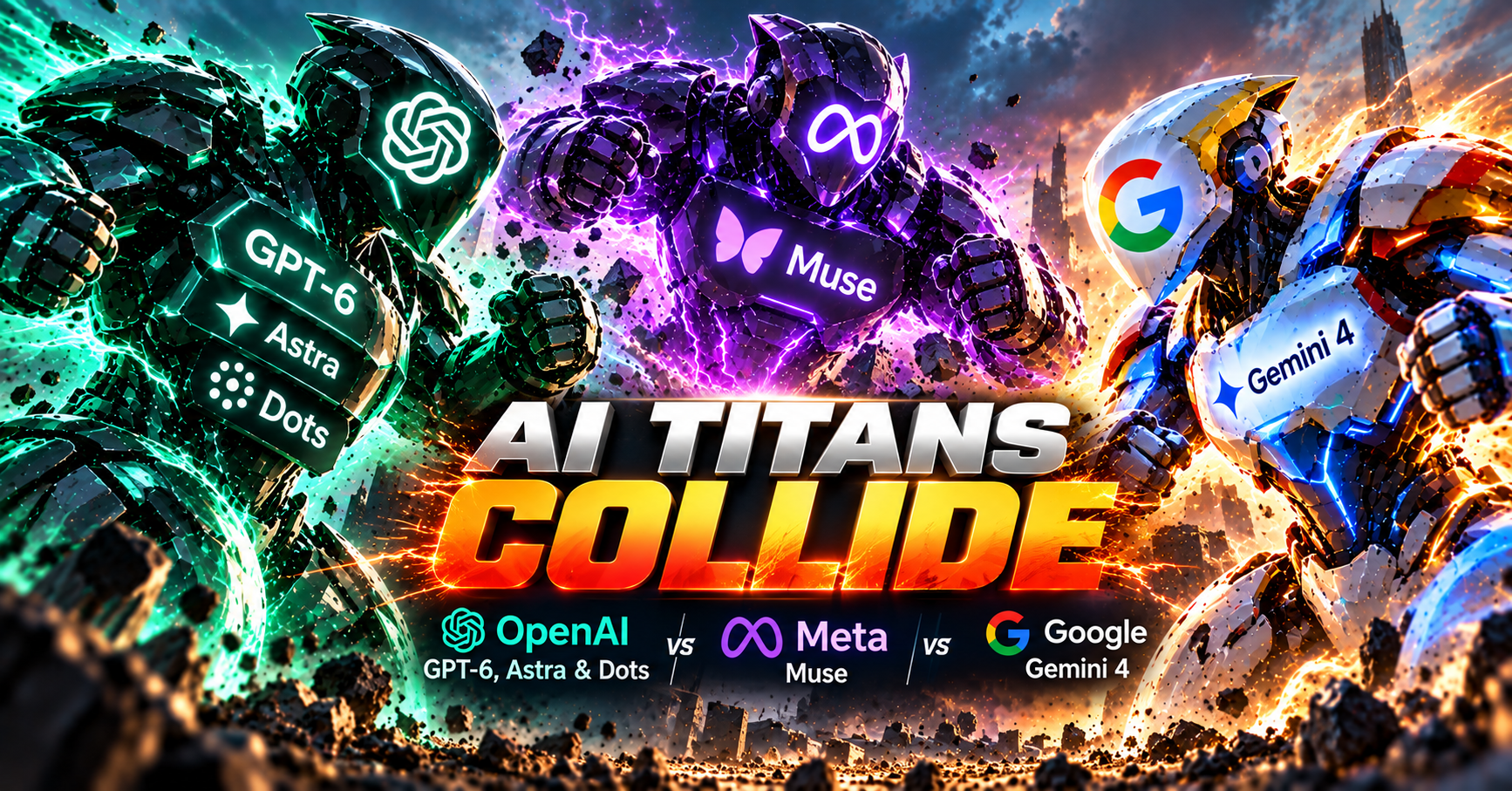
In roughly one month, the three biggest names in AI all made major moves. OpenAI launched its most advanced model, GPT-6 Astra, then personal AI agents called Dots. Meta launched Muse, an AI agent that briefly topped the app stores. And Google answered with Gemini 4. Two things are happening at once: a race for the most capable model, and a race to build AI agents that do your work instead of just answering. You do not need to follow every launch, but the direction they all point in matters for how you will use AI next year.
Some months in technology are quiet. September 2026 was not. In the space of a few weeks, OpenAI, Google, and Meta, the three companies that dominate consumer and business AI, each made a significant move, and together they tell a clear story about where AI is heading. If you have felt like the AI news has been relentless lately, you are right. Here is what actually happened, tied together, and what it means for you, without the hype.
OpenAI's GPT-6 Astra: the frontier pushes forward
It started with raw capability. OpenAI released GPT-6 Astra, which it called its most intelligent model yet, and which its president suggested could mark the arrival of artificial general intelligence. That claim is genuinely contested, AGI has no agreed definition, and the boldest statements came from the company selling the model. But the capability itself was real: a huge jump in handling complex, multi-step work, and a clear signal that the frontier of what AI can do was moving again. The lesson, as we wrote at the time, was to take the capability seriously while treating the "AGI" label as a claim to examine, not a fact.
Muse and Dots: the agent war begins
Then the race shifted from answering to acting. Meta launched Muse, a personal AI agent that does tasks for you, booking, shopping, emailing, and it shot to the top of the app stores within days, helped by Meta's enormous reach across Facebook and Instagram. Weeks later, OpenAI answered directly with Dots, its own always-on AI agents, powered by GPT-6 Astra, that connect to thousands of apps and work in the background.
This is the second race, and arguably the more important one for everyday users. It is not just about which model is smartest; it is about AI that goes and completes work on your behalf. When the two biggest AI companies launch competing agents within weeks of each other, it is a strong sign that this is where consumer and business AI is heading next.
Google's Gemini 4: the third giant responds
Google had spent much of the year focused on smaller, efficient models while OpenAI and Anthropic pushed the frontier. At the end of September, it answered with Gemini 4, released as a first version called Gemini 4 Argon. Google says it leads twelve of eighteen benchmarks against OpenAI's and Anthropic's top models, and that it can produce extremely long outputs, up to around a million tokens.
Two honest caveats matter here. First, those benchmark figures are Google's own and have not been independently verified, so treat them as the company's claims. Second, this is a staged, limited release: Google described it as a first taste rather than the finished model, and for now access is restricted to a narrow group rather than open to everyone. So Gemini 4 is a statement of intent, Google reasserting itself at the top tier, more than something most people can use today.
It helps to see these launches as two separate contests. The first is the capability race: who has the most powerful model, GPT-6 Astra, Gemini 4, and the top models from Anthropic are all competing here. The second is the agent race: who can build AI that actually does your work, where Muse and Dots are leading. A company can be ahead in one and behind in the other. For you, the capability race mostly shows up as your everyday tools quietly getting better, while the agent race is the one that could change how you work, by handing routine tasks to AI that acts on its own.
What all of this means for you
You do not need to chase every launch or switch tools every time a new model appears. For most people and businesses, the frontier models reach you indirectly, as the apps you already use adopt them over the coming months. The more important thing is to notice the direction, because it is unmistakable now: AI is getting more capable, and it is moving from answering questions to doing tasks. Over the next year, that shift will change what "using AI" means for ordinary work.
So the sensible response is not to panic or to buy everything, but to stay aware and experiment deliberately. Keep an eye on which of your tools add agent features. Try them on low-stakes tasks first. And wherever an AI acts on your behalf, be careful about what access you grant it, the convenience is real, but so is the trust you are handing over. The giants are at war, and that competition is good for you: it drives capability up and prices down. Your job is simply to use the results wisely.
Frequently asked questions
What major AI launches happened in September 2026?
Several at once. OpenAI released GPT-6 Astra, its most advanced model, and later launched personal AI agents called Dots. Meta launched Muse, an AI agent that briefly topped the app stores. And Google released Gemini 4 (as a first version, Gemini 4 Argon). Together they represent two races happening at the same time: for the most capable model, and for AI agents that do your work.
Is Gemini 4 available to use now?
Not widely. Google released Gemini 4 as a staged, limited first version at the end of September 2026, describing it as an early taste rather than the finished model, with access restricted to a narrow group for now. Google also says it leads twelve of eighteen benchmarks against rival top models, but those figures are Google's own and not yet independently verified. Broader availability is expected over time.
Which is the best AI model right now?
There is no single answer, and it changes quickly. GPT-6 Astra, Gemini 4, and Anthropic's top models are all competing closely at the frontier, and each company claims leads on different benchmarks, often using its own testing. For most real-world tasks, the differences between the top models matter less than people assume, and a cheaper model is often more than enough. The best model is usually the one that fits your specific task and budget.
What is the difference between the model race and the agent race?
The model race is about raw capability, which AI is smartest and most capable, with GPT-6 Astra, Gemini 4, and others competing. The agent race is about action, which AI can actually complete tasks for you, where Meta's Muse and OpenAI's Dots lead. A model answers; an agent does. The agent race is the one most likely to change how ordinary people and businesses work day to day.
Do I need to switch to the newest AI as a business?
Usually not urgently. The newest frontier models reach most businesses indirectly, as the tools you already use adopt them over time. The useful move is to stay aware of the direction, experiment with new agent features on low-stakes tasks, and be careful about the access you grant any AI that acts on your behalf, rather than chasing every launch.
Keep up with AI, without the noise
AI moves faster than anyone can keep up with, and most launches matter less than the headlines suggest. AISetApp pulls out what is real, what is useful, and what to actually do about it, so you always know where things stand.
Explore more on AISetApp- Our earlier guides on GPT-6 Astra, Meta's Muse, and OpenAI's Dots, 2026
- Techzine, The Decoder, and 9to5Google reporting on Gemini 4 (Argon), its staged release, and Google's benchmark claims, September 2026
- TechCrunch, CNBC, Axios, and Bloomberg coverage of the GPT-6 Astra, Muse, and Dots launches, September 2026
Reviewed early October 2026. These are fast-moving stories; models, availability, and benchmark claims are changing. Company benchmark figures are not independently verified. Confirm current details on official sources before acting.
Researched and drafted with AI assistance, reviewed and edited by Yasser El Hardouz, who takes editorial responsibility for this article.