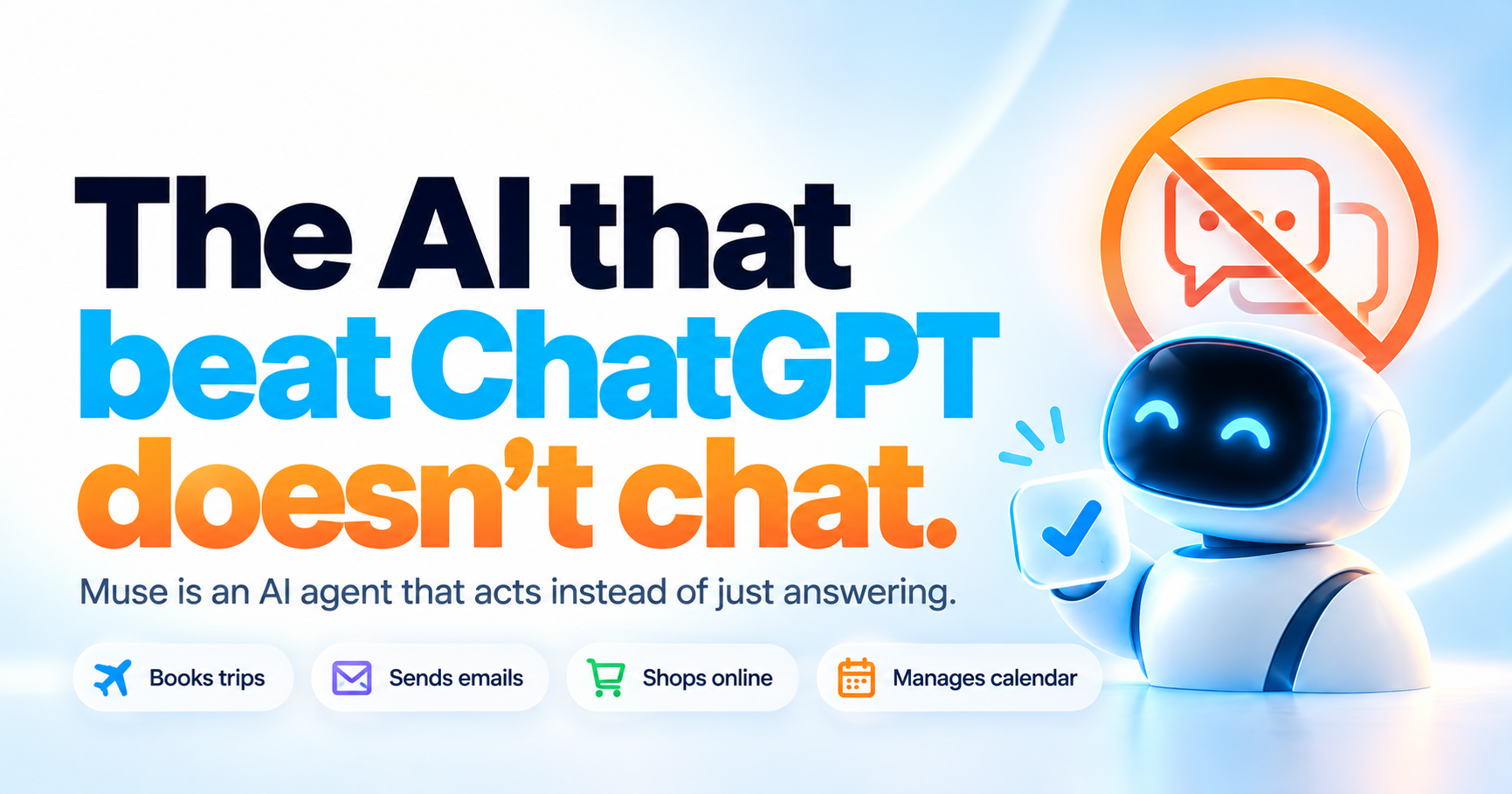
Meta's new app, Muse, briefly became the No. 1 free app in the US, ahead of ChatGPT, by doing something ChatGPT is not built to do: acting on your behalf instead of just answering. Muse is an AI agent. Once you connect it to your accounts, it can send emails, book travel, shop, and manage your calendar, and keep working in the background after you close it. That is genuinely new and useful. It also raises real questions about what you are handing it access to, questions worth understanding before you connect your accounts.
Every so often an app takes off fast enough that it is worth understanding why. Meta's Muse is one of those. It climbed to the top of the US App Store in about ten days, past ChatGPT, Gemini, and Claude. The headlines say it "beat ChatGPT," which is partly true and partly overstated. But the reason it took off points to a real shift in how AI is heading, so let us look at what Muse actually is, why it caught on, and what to weigh before using it.
What Muse actually is
The key thing to understand is that Muse is not a chatbot. A chatbot, like ChatGPT in its classic form, waits for your question and gives you an answer. Muse is an AI agent, which means it does not just answer, it acts. You give it a task, and it goes and completes it.
In practice, once you connect it to your apps and accounts, Muse can send emails, book travel and reservations, shop online, manage your calendar, find discount codes, and follow up with people, all on your behalf. Meta says each Muse agent runs on its own cloud-based virtual computer, which lets it keep working in the background even after you close the app, and come back to you when it needs approval before, say, sending an email or making a purchase.
Muse hit No. 1 by doing the thing a classic chatbot will not: taking real action across your digital life instead of just talking about it. That is the whole pitch, and it is why it resonated. People are increasingly less interested in an AI that explains how to book a flight, and more interested in one that just books it. Whether or not you use Muse specifically, this is the direction the entire AI industry is moving: from tools that answer to tools that do.
Why it took off so fast
Two things drove Muse's rapid climb. The first is the appeal of agents themselves: the idea of an AI that completes tasks is genuinely attractive, and Muse made it feel real for ordinary users. The second, and this is important context, is Meta's distribution. Meta can put a new app in front of billions of people through Facebook, Instagram, WhatsApp, and Threads, so it did not have to earn its way to the top purely on merit. That cross-promotion is exactly how Meta made Threads a hit.
This is also where the "beat ChatGPT" claim needs a caveat. Muse topped the download chart, which counts new downloads over a short window, not total users. ChatGPT still has vastly more users overall, and in its own launch actually recorded more early downloads than Muse. So the honest version is: Muse had a remarkable launch and briefly led the download chart, not that it has overtaken ChatGPT as a product.
The part worth pausing on
Here is the honest caution, and it matters more with an agent than with a chatbot. To act on your behalf, Muse needs access to your accounts, your email, calendar, shopping, and payment connections. That is a lot of trust to hand to any app. The good news is that Meta lets you choose which apps Muse can access and revoke that access at any time, and it asks for approval before consequential actions like purchases. Use those controls deliberately.
The concern is real enough that others have acted on it. Amazon has blocked Muse from accessing its shopping site, citing privacy and security risks and saying the agent appeared to capture and store customer credentials. One industry analyst put the worry plainly: the bigger question with a data-hungry agent is not just security, but privacy, what is collected, and where it goes. None of this means Muse is unsafe, but it does mean that connecting an agent to your accounts is a decision to make carefully, not automatically.
What it means for you
Whether or not you try Muse, the takeaway is the shift it represents. AI is moving from answering questions to doing tasks, and over the next year that will change what "using AI" means for most people and businesses. Agents that book, buy, and email on your behalf can save real time. They also concentrate real access and real risk, so the sensible approach is to embrace the capability while being deliberate about permissions: connect only what you need, keep approval steps on, and treat access to your email and payments as something to grant carefully. The future of AI is agents that act. Getting comfortable with that, thoughtfully, is the useful move.
Frequently asked questions
What is Meta's Muse?
Muse is Meta's new AI agent app, launched September 8, 2026. Unlike a chatbot that only answers questions, Muse completes tasks on your behalf, sending emails, booking travel, shopping, and managing your calendar, once you connect it to your accounts. It reached No. 1 on the US App Store within about ten days. It is available on iOS, Android, WhatsApp, and the web, for users 18 and older.
Did Muse really beat ChatGPT?
Partly. Muse briefly topped the US App Store download chart, ahead of ChatGPT, which is real and impressive. But that chart counts new downloads over a short period, not total users, and ChatGPT still has far more users overall and actually had more downloads in its own launch window. So Muse had a remarkable debut and led the chart, but has not overtaken ChatGPT as a product.
What is the difference between an AI agent and a chatbot?
A chatbot answers your questions. An AI agent takes a task and completes it. Ask a chatbot how to book a flight and it explains the steps; ask an agent like Muse and, once connected to your accounts, it books the flight for you. Agents can also work in the background and return when they need your approval. This shift from answering to acting is the wider direction of AI right now.
Is Muse safe to use?
It comes down to what you connect and how carefully. To act for you, Muse needs access to accounts like your email, calendar, and payments, which is significant trust. Meta lets you choose what it can access, revoke access anytime, and requires approval before purchases. But the risk is real enough that Amazon blocked Muse from its site over privacy and security concerns. Connect only what you need, and keep approval steps on.
Should my business care about this?
Yes, for the trend more than the app. Muse's success signals that AI is shifting from answering questions to completing tasks, which will reshape how people and businesses use AI over the next year. Agents can save real time, but they also concentrate access and risk. Understanding how they work, and being deliberate about permissions, is worth doing now.
Understand AI without the hype
Big AI news lands almost every week, and not all of it matters to you. AISetApp cuts through the noise with clear, honest guides on what is real, what is useful, and what to actually do about it.
Explore more on AISetApp- Bloomberg, CNBC, Fox Business, and TechCrunch reporting on Muse's App Store ranking, download numbers, and features, September 2026
- Sensor Tower and Apptopia data on Muse downloads compared with ChatGPT, Claude, and Grok, September 2026
- CNBC reporting on Amazon blocking Muse over privacy and security concerns, September 2026
- JPMorgan analyst note on Muse's potential, via Reuters and Benzinga, September 2026
Reviewed September 2026. This is a fast-moving story; rankings, numbers, and features are changing. Confirm current details on official sources before acting.
Researched and drafted with AI assistance, reviewed and edited by Yasser El Hardouz, who takes editorial responsibility for this article.