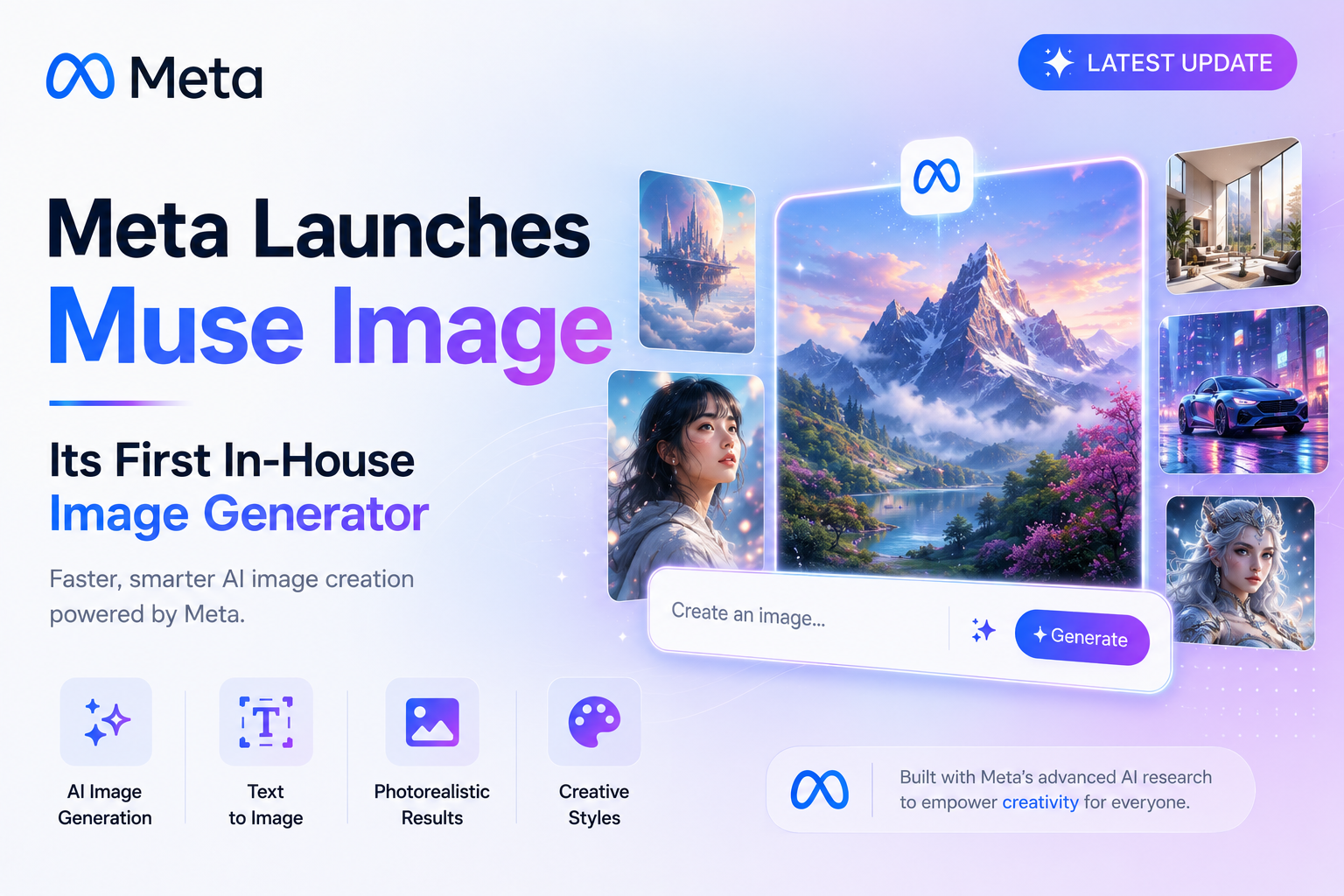
Muse Image is Meta's first in-house image generator — and it thinks before it draws. Instead of mapping a prompt straight to pixels, it works with the Muse Spark language model to reason through the request, pull in real-time web context, and blend multiple reference photos first. It ends Meta's reliance on outside tools like Midjourney, and by Meta's own benchmarks it beats Google's Nano Banana 2 on editing while still trailing OpenAI's GPT Image 2 overall.
Meta has released Muse Image, the first image-generation model built entirely by Meta Superintelligence Labs (MSL) — the division Mark Zuckerberg stood up after Meta fell behind rivals like OpenAI, Google, and Anthropic. It's the lab's second major model after Muse Spark, the language model that began replacing Meta's Llama family in April. In short: Meta is now building its own creative stack instead of renting one. Here's a clear, practical breakdown of what shipped.
A model that reasons before it renders
The headline design choice is that Muse Image doesn't map your words straight to an image. It uses an intermediate reasoning layer, pairing with the Muse Spark language model to plan the composition, search the web for real-time context, and combine several reference photos before a single pixel is generated. Meta's chief AI officer Alexandr Wang describes the model as “agentic” — it effectively writes its own internal plan for the image first, then executes it.
In practice, that means you can ask Meta AI to create images from scratch, edit existing photos, remove objects, generate infographics, or place legible text inside a visual — the kind of instruction-following that trips up simpler text-to-image systems. You can also sketch changes directly onto an image and let the model interpret your annotations.
Where Muse Image lands
Meta's own internal benchmark framing at launch. Independent testing is still worth watching.
The positioning is telling: Meta is competitive but not leading. It closed enough ground to beat Google's Nano Banana 2 on editing tasks, while conceding that OpenAI's latest image tool still edges it on overall quality. For a company that was, not long ago, absent from the frontier conversation entirely, shipping a credible in-house model is the point.
What you can actually do with it
Muse Image isn't a standalone app. Meta is embedding it into products already used by billions, so the features show up inside apps you likely already have.
Suggested prompts to spark ideas
A new presets panel offers ready-made starting points — restore old family photos, try trending hairstyles, or reimagine yourself in styles like claymation or a 16-bit video game. It lowers the blank-canvas problem for casual users who don't want to write elaborate prompts.
Pull public Instagram photos into creations
You can @mention public Instagram accounts to bring their photos into your generated images. Meta also lets you snap a photo of a room and generate a redesigned version using real products from the web or Facebook Marketplace — a clear nod to commerce.
Baked into the apps you already use
Instagram Stories gains more than 30 new AI-powered effects, and WhatsApp users in select countries can generate images directly inside chats with Meta AI. Facebook, Messenger, and advertiser tools through Meta Advantage+ are coming soon.
Availability and what's next
Muse Image is live today across the Meta AI app and meta.ai on the web, Instagram Stories in the US, and WhatsApp in a limited set of countries, with Facebook and Messenger following. Meta also previewed Muse Video, a video-generation model built on the same pretraining base with native audio support, expected to reach creators and Meta AI within months. Wang has separately hinted at a larger flagship model, internally called “Watermelon,” aimed at matching OpenAI's best.
| Surface | Status | Notes |
|---|---|---|
| Meta AI app & meta.ai | Live | Full creation and editing |
| Instagram Stories | Live (US) | 30+ new AI effects |
| Live (limited) | Generate images in chat | |
| Facebook & Messenger | Coming soon | Rollout announced |
| Muse Video | Preview | Native audio; creators soon |
According to reporting from Axios, the feature that lets people tag public Instagram accounts to pull their photos into AI creations is on by default. Instagram users can opt out through a setting, but the default-on posture — combined with a recent security incident in which a flaw in Meta's AI customer-service software reportedly exposed tens of thousands of Instagram accounts — is a reminder to review your privacy settings before this rolls out widely.
The bottom line
Muse Image matters less for topping a leaderboard and more for what it signals: Meta now owns the model powering image creation across apps with more than three billion daily users, ending its dependence on Midjourney and Black Forest Labs. The reasoning-first approach is the genuinely interesting bet — planning an image before generating it is closer to how the newest frontier tools work. Whether it holds up under independent testing, and how the default-on tagging plays out, are the two things worth watching next.
Frequently asked questions
What is Meta Muse Image?
It's Meta's first in-house image-generation model, built by Meta Superintelligence Labs and announced on July 7, 2026. It creates and edits images inside Meta AI, Instagram, and WhatsApp, and was originally codenamed “Mango.”
How is it different from other image generators?
Muse Image reasons before it renders. It works with the Muse Spark language model to plan the composition, pull real-time web context, and blend multiple reference photos before generating — an “agentic,” reasoning-first pipeline rather than a direct prompt-to-pixel mapping.
Is Muse Image better than Google Nano Banana 2 or OpenAI's model?
By Meta's own internal benchmarks, Muse Image beats Google's Nano Banana 2 on single- and multi-image editing but still trails OpenAI's GPT Image 2 on overall quality. These are Meta's figures, so independent tests are worth waiting for.
Where can I use it?
It's live in the Meta AI app, on meta.ai, in Instagram Stories in the US, and in WhatsApp in a limited set of countries. Facebook, Messenger, and advertiser tools via Meta Advantage+ are coming soon.
What's the privacy concern?
The ability to @mention public Instagram accounts and pull their photos into AI creations is reportedly on by default. Instagram users can opt out in settings, so it's worth checking your preferences.
Is there a video version?
Yes — Meta previewed Muse Video, built on the same pretraining base with native audio support. It's expected to reach creators and Meta AI within months.
Stay on top of every major AI release
New models, features, and pricing shifts are landing fast. Bookmark AISetApp for clear, practical breakdowns as they ship.
Explore more on AISetApp →