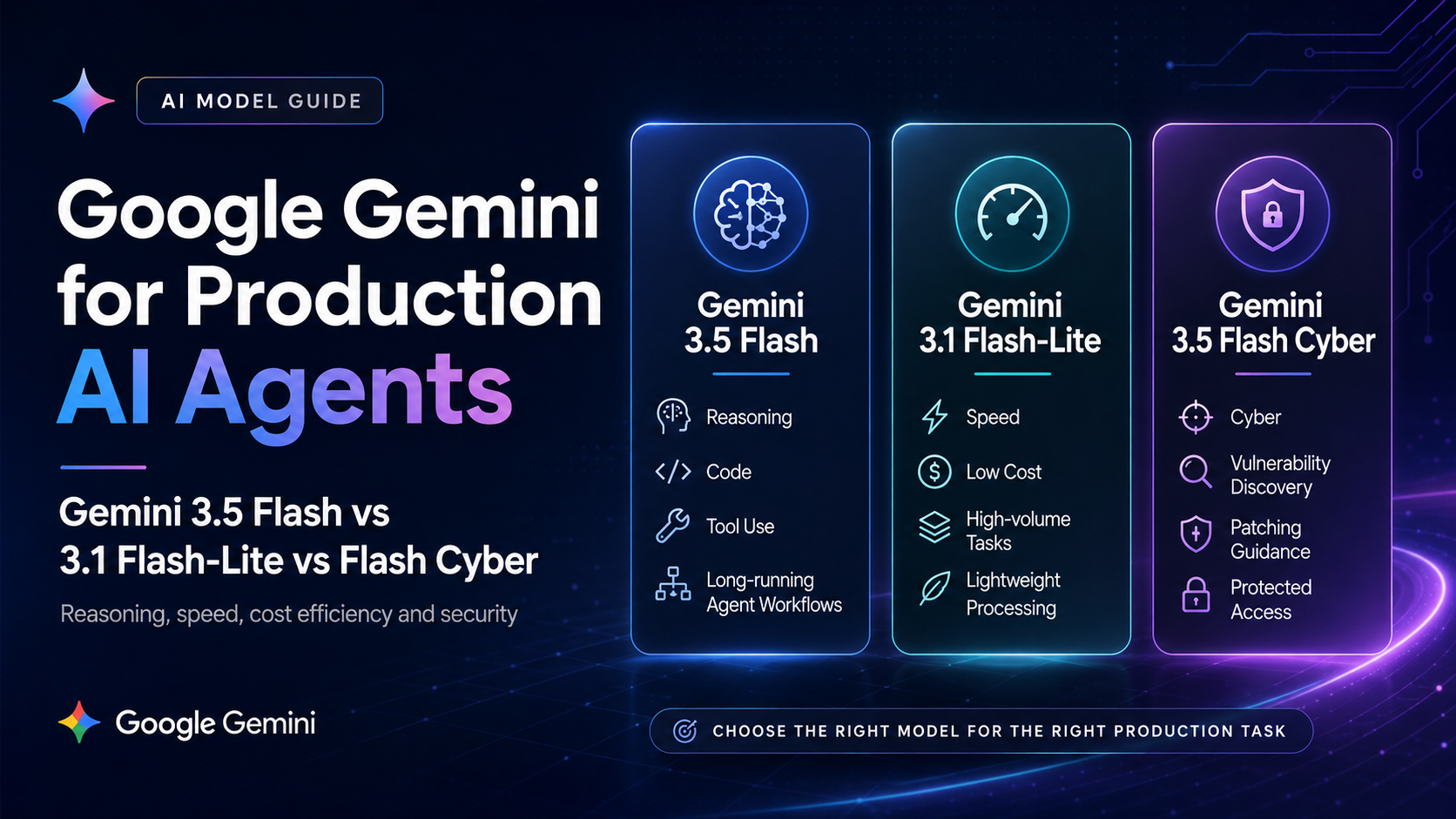
Google is building a more specialized Gemini stack for production AI agents. Gemini 3.5 Flash is the higher-capability option for coding, reasoning and long-running agentic workflows. Gemini 3.1 Flash-Lite is designed for high-volume tasks where latency and cost matter most. Gemini 3.5 Flash Cyber is a security-focused model for vulnerability discovery and remediation, but access is initially limited to governments and trusted partners through CodeMender.
Google’s Gemini strategy is becoming less about finding one model that does everything and more about matching each workload with the right balance of intelligence, speed, cost and risk. That matters for companies building production AI agents, because an agent may need to reason through a difficult problem, call tools repeatedly, process thousands of routine requests and handle security-sensitive code within the same broader system.
The latest Gemini lineup reflects that reality. Gemini 3.5 Flash targets demanding agentic and coding workflows. Gemini 3.1 Flash-Lite handles lighter work at scale. Gemini 3.5 Flash Cyber focuses on a narrow but critical problem: helping defenders find, validate and patch software vulnerabilities more efficiently.
The result is not simply a faster model release. It is a clearer production architecture in which developers can route different tasks to different models instead of paying frontier-model prices for every request.
First, a correction to the viral announcement
The social post circulating online contains two naming errors. Google has not officially announced a model called Gemini 3.6 Flash in the sources reviewed for this article. The stable production model is Gemini 3.5 Flash. The low-cost model is Gemini 3.1 Flash-Lite, not Gemini 3.5 Flash-Lite.
| Claim in the shared post | Official Google model name | Status |
|---|---|---|
| Gemini 3.6 Flash | Gemini 3.5 Flash | Generally available and stable |
| Gemini 3.5 Flash-Lite | Gemini 3.1 Flash-Lite | Generally available and stable |
| Gemini 3.5 Flash Cyber | Gemini 3.5 Flash Cyber | Limited-access pilot through CodeMender |
The broader message is still directionally correct: Google is giving developers more options for building faster, more economical and more reliable production agents. The details, however, matter when teams are choosing APIs, estimating cost or planning a migration.
Gemini 3.5 Flash: the main model for advanced production agents
Gemini 3.5 Flash is Google’s most capable stable Flash model for sustained agentic execution, coding and long-horizon tasks. It is designed for workflows in which the model must do more than answer a single prompt. It can plan, call tools, inspect results, revise its approach and continue across multiple steps.
Agentic coding and multi-step execution
Gemini 3.5 Flash is positioned for rapid coding loops, sub-agent deployment and tasks that require the model to maintain direction over a longer sequence of actions.
Text, image, video, audio and PDF support
The model can accept multiple input formats while producing text output, making it suitable for agents that need to interpret documents, screenshots, recordings or mixed project files.
Function calling, code execution, search grounding and computer use
Google lists support for structured outputs, file search, URL context, code execution, function calling and search grounding. Computer use is also supported in preview for agents that interact with browser, mobile or desktop interfaces.
A 1 million-token input window
The model supports up to 1,048,576 input tokens and 65,536 output tokens, allowing developers to provide large codebases, long documents or substantial working context when the task requires it.
Where Gemini 3.5 Flash fits best
Gemini 3.5 Flash makes the most sense when the cost of a weak answer is higher than the cost of additional inference. Typical examples include complex coding agents, research assistants, multi-step enterprise workflows, document-heavy analysis, tool-using support systems and applications that must reason across several sources before acting.
Gemini 3.5 Flash is not the cheapest Flash option. Google currently lists standard paid API pricing at $1.50 per million input tokens and $9 per million output tokens, including thinking tokens. For simple repetitive work, Flash-Lite may be far more economical.
Gemini 3.1 Flash-Lite: speed and cost efficiency at scale
Gemini 3.1 Flash-Lite is the production workhorse for high-frequency tasks where low latency and predictable cost are the main priorities. It is not intended to replace the deeper reasoning of Gemini 3.5 Flash. Its purpose is to make large-volume AI workloads practical.
Google describes the model as suitable for high-volume agentic workflows, translation, simple data extraction and lightweight processing. It supports the same broad input types as Gemini 3.5 Flash, including text, images, video, audio and PDFs, with a 1 million-token input window and a 65,536-token output limit.
| Flash-Lite advantage | Why it matters |
|---|---|
| Lower API cost | Google lists $0.25 per million input tokens and $1.50 per million output tokens for standard paid usage. |
| High output speed | Google reports approximately 363 output tokens per second in its published evaluation. |
| Multimodal inputs | Applications can process text, images, video, audio and PDF files without moving every task to a larger model. |
| Production tool support | It supports function calling, structured outputs, code execution, file search, URL context and search grounding. |
| Stable model ID | Developers can use gemini-3.1-flash-lite rather than the discontinued preview model. |
Good use cases for Flash-Lite
Flash-Lite is a strong choice for translation pipelines, moderation, classification, metadata generation, ticket routing, short summaries, structured extraction, repetitive tool calls and customer-facing features where response time matters. It can also serve as a first-stage model that filters or prepares information before sending only the difficult cases to Gemini 3.5 Flash.
Gemini 3.5 Flash Cyber: a specialized model for software defense
Gemini 3.5 Flash Cyber is the genuinely new announcement in this group. Google DeepMind describes it as a lightweight cybersecurity model built on Gemini 3.5 Flash and fine-tuned to find, validate and patch software vulnerabilities quickly and efficiently.
The model is designed to operate inside CodeMender, Google’s code security agent. Instead of relying on one expensive model call, CodeMender can invoke Flash Cyber repeatedly to explore more code paths, validate findings and produce a consolidated report. That architecture is particularly useful in vulnerability research because important flaws may be hidden across very large execution spaces.
Finding and validating vulnerabilities
Flash Cyber is optimized for scanning codebases, exploring execution paths and identifying security weaknesses that general-purpose models may miss.
Supporting patches, not only reports
The model is intended to help defenders move from discovery to validation and remediation, reducing the gap between finding an issue and fixing it.
Limited access because cybersecurity is dual-use
Google plans an initial pilot for governments and trusted partners through CodeMender. It is not being released as an unrestricted public Gemini API model at launch.
What Google’s early results suggest
Google reports that Flash Cyber outperformed its mainline Flash models on internal security evaluations and found more unique confirmed vulnerabilities in testing against the V8 JavaScript engine. The company also says the model is already being used to help identify and fix issues across internal codebases including Chrome, Android, Cloud, Ads and YouTube.
These are provider-reported results, so independent validation will still matter. Even so, the release shows how AI model development is moving toward domain-specific systems that combine a general foundation model with specialized training, tools, safety controls and deployment restrictions.
Gemini 3.5 Flash vs 3.1 Flash-Lite vs 3.5 Flash Cyber
| Model | Best for | Availability | Key trade-off |
|---|---|---|---|
| Gemini 3.5 Flash | Complex agents, coding, reasoning and long-running workflows | Stable through the Gemini API, Google AI Studio and other Google platforms | Higher cost than Flash-Lite |
| Gemini 3.1 Flash-Lite | High-volume lightweight tasks, translation and simple data processing | Stable through the Gemini API and Google AI Studio | Less suitable for the hardest reasoning tasks |
| Gemini 3.5 Flash Cyber | Vulnerability discovery, validation and patching through CodeMender | Limited pilot for governments and trusted partners | Not generally available and intentionally restricted |
What this means for production AI agent architecture
The most important lesson is that production agents should not automatically send every task to the most capable model. A well-designed system can use model routing to control cost and reliability.
Use Gemini 3.1 Flash-Lite for classification, extraction, translation, routing and other repeatable high-volume operations.
Escalate difficult cases to Gemini 3.5 Flash when deeper reasoning, complex tool use or long-horizon execution is required.
Keep highly specialized and sensitive security work inside controlled systems such as CodeMender with Flash Cyber.
Measure total task cost, failure rate, latency and human review time rather than comparing model prices in isolation.
This approach can make an agent faster and cheaper while preserving stronger models for the parts of the workflow where their additional reasoning creates real value.
Where the models are available
| Platform | Gemini 3.5 Flash | Gemini 3.1 Flash-Lite | Gemini 3.5 Flash Cyber |
|---|---|---|---|
| Gemini API | Available | Available | Not generally available |
| Google AI Studio | Available | Available | Not generally available |
| Gemini app | Available | Primarily positioned for developers and enterprise workloads | Not available |
| CodeMender | Underlying general model family | Not the specialized security model | Limited pilot access |
What developers should verify before migrating
Do not migrate based on the model name alone
Flash models can have very different pricing and reasoning profiles. Test the complete workflow with real inputs before replacing an existing production model.
Count thinking and agent-loop tokens
Agent costs include intermediate reasoning and repeated model calls. A model that looks affordable per request can become expensive when an agent loops many times.
Measure correction time
Cheaper inference does not create savings if the output requires more human review, repeated retries or manual repair.
Confirm tool support
Gemini 3.1 Flash-Lite supports many production tools but does not support computer use. Applications that depend on visual interface interaction may need Gemini 3.5 Flash instead.
Do not treat Flash Cyber as a public offensive-security API
Google is deploying it gradually under controlled access because advanced vulnerability discovery is dual-use. Public availability should not be assumed.
The bottom line
Google’s current Gemini lineup gives developers three distinct paths. Gemini 3.5 Flash brings stronger reasoning and agentic execution to demanding production applications. Gemini 3.1 Flash-Lite offers the speed and cost structure needed for high-volume workloads. Gemini 3.5 Flash Cyber applies the Flash architecture to defensive software security under restricted access.
The bigger shift is architectural. The future of production AI is unlikely to be one model handling every request. It will be systems that route work intelligently, combine general and specialized models, control tool access and apply human review where the consequences are highest.
For developers, the right question is no longer simply which Gemini model is best. It is which model is best for each step of the workflow.
Frequently asked questions
Did Google release Gemini 3.6 Flash?
No official Google source reviewed for this article lists a Gemini 3.6 Flash model. Google’s stable advanced Flash model is Gemini 3.5 Flash.
Is there a Gemini 3.5 Flash-Lite?
Google’s current stable low-cost model is Gemini 3.1 Flash-Lite. It is optimized for high-volume lightweight tasks and low API cost.
What is Gemini 3.5 Flash best used for?
It is best suited to complex coding, agentic execution, multimodal analysis, long-context tasks and workflows that require repeated tool use or deeper reasoning.
How fast is Gemini 3.1 Flash-Lite?
Google reports approximately 363 output tokens per second in its published model evaluation. Real application speed will still depend on prompt size, reasoning settings, tools, network conditions and workload design.
Can developers access Gemini 3.5 Flash Cyber through the public API?
Not at launch. Google says the model will be available through a limited CodeMender pilot for governments and trusted partners, with access expanding over time.
Which model is cheapest for production workloads?
Gemini 3.1 Flash-Lite is the lower-cost option among these models. The best economic choice still depends on output quality, retry rate, token consumption, tool calls and human review time.
Should an AI agent use only one Gemini model?
Not necessarily. Many systems can reduce cost by using Flash-Lite for routine operations and escalating only complex tasks to Gemini 3.5 Flash.
Find the right AI model for every task
Explore AISetApp to compare AI tools, understand their strengths and choose the solution that fits your real workflow, budget and risk level.
Explore AI tools- Google DeepMind: Introducing Gemini 3.5 Flash Cyber
- Google AI for Developers: Gemini 3.5 Flash model documentation
- Google AI for Developers: Gemini 3.1 Flash-Lite model documentation
- Google AI for Developers: Gemini API pricing
- Google: Gemini 3.1 Flash-Lite built for intelligence at scale
- Google AI for Developers: Gemini API release notes