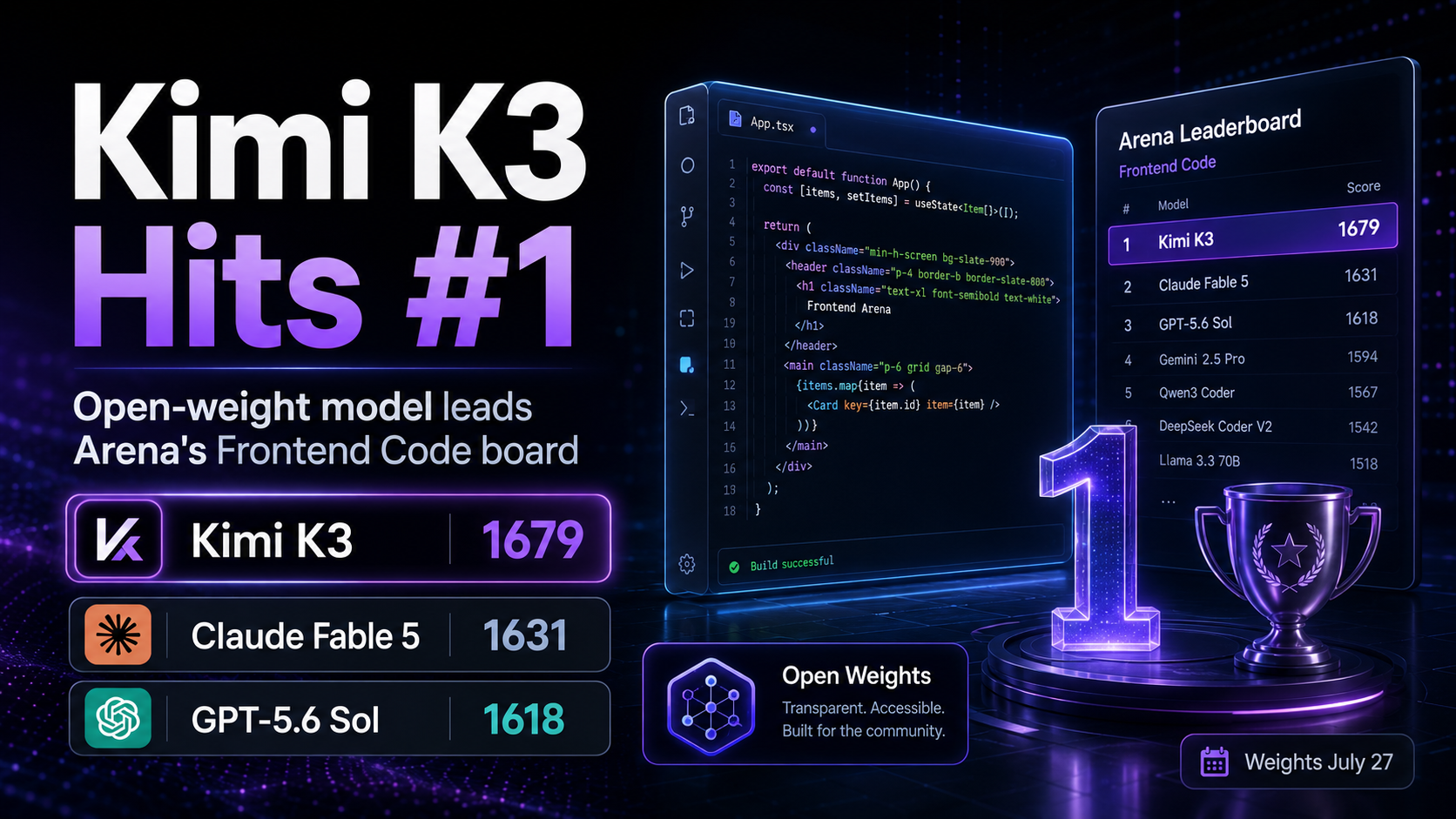
An open-weight model just took first place on a blind human-preference coding board, and that hasn't happened before. Kimi K3 leads Arena's Frontend Code leaderboard by 48 points, nearly four times the gap between the two models behind it. The caveats matter: the vote count is early, the weights don't land until July 27, and Moonshot itself concedes K3 trails Fable 5 and Sol on overall performance. The result is narrow and still real.
For the first time since Arena.ai started running its Frontend Code leaderboard, the model sitting at number one is one anyone will soon be able to download. Kimi K3, released this week by Moonshot AI, debuted at the top on July 16 with 1,679 Elo. Anthropic's Claude Fable 5 follows at 1,631, OpenAI's GPT-5.6 Sol at 1,618, and GLM-5.2 rounds out the top four at 1,587.
Why this leaderboard is harder to wave away
Arena's Frontend Code board isn't a self-reported benchmark. Developers get two anonymized outputs for the same task and vote on which one is better, Elo-style. The web coding board has accumulated roughly 470,000 votes across 96 models. K3's own Elo, though, rests on a much younger sample of about 1,757 votes at the time of writing, which is worth holding onto before treating the gap as settled.
The margin isn't a photo finish. K3's 48-point lead over Fable 5 is nearly four times the 13 points separating Fable 5 from GPT-5.6 Sol.
Pairwise win rate on Arena's Frontend Code board
How often each model's output was preferred in head-to-head matchups. K3's figure draws on roughly 1,757 votes.
| Model | Elo | Win rate | Weights |
|---|---|---|---|
| Kimi K3 (Moonshot AI) | 1,679 | 76% | Open, from July 27 |
| Claude Fable 5 (Anthropic) | 1,631 | 63% | Closed |
| GPT-5.6 Sol (OpenAI) | 1,618 | 58% | Closed |
| GLM-5.2 | 1,587 | Not listed | Open |
K3 also took first in six of seven frontend sub-domains: Brand and Marketing, Reference-Based Design, Data and Analytics, Consumer Product, Simulations, and Content Creation Tools. Anthropic held onto Gaming.
The jump is the story
Moonshot's previous flagship, Kimi K2.6, sat at rank 18 on the same board with a score of 1,515. Moving to first place in a single release cycle is a 17-place climb. That's an unusually large swing even by the standards of a company that has made leaderboard leaps something of a habit.
The model behind it is large: 2.8 trillion total parameters, a sparse mixture-of-experts design activating 16 of 896 experts, a 1-million-token context window, and native visual understanding. Moonshot calls it the first open model in the 3T class.
Kimi Delta Attention
A hybrid linear attention scheme that Moonshot says enables up to 6.3x faster decoding at million-token contexts. Claims like this come from the company rather than an independent test, so they're worth revisiting after the weights land.
Attention Residuals
A replacement for standard residual connections that Moonshot claims delivers roughly 25% more training efficiency at under 2% additional cost. If it holds up, the interesting part isn't this model. It's what the technique does for the next one.
The context window probably isn't incidental
Design and layout work means juggling a lot of visual and structural context at once, not just long documents. A million-token window plus native visual understanding maps onto that problem more directly than it maps onto, say, terminal work.
What it doesn't prove
Moonshot itself is direct about this. K3's overall performance still trails Claude Fable 5 and GPT-5.6 Sol. Artificial Analysis scores it at 57.11 on its Intelligence Index and 50.07 on its Agentic Index. It leads on Terminal Bench, Program Bench and SWE Marathon, trails on FrontierSWE and DeepSWE, and sits behind Sol on the Coding Agent Index overall, 76 against 80.
K3 is currently the model developers most often prefer for frontend generation, on one community board, on early votes. That's a real result. It isn't a claim that the model is better across every task, and Anthropic still places nine of the top 20 models on the very leaderboard it just lost.
The economics are the sharper edge
Moonshot lists K3 at $3 per million input tokens and $15 per million output, against Arena's listed $10 and $50 for Fable 5. That's roughly a 3:1 input advantage, and it gives teams a structural reason to move workloads regardless of how the Elo shakes out.
Two caveats cut against the "cheap Chinese model" framing, though. At around $12 per million tokens blended, K3 is priced closer to Anthropic's mid-tier than to the deep discounts Moonshot's earlier releases offered. This isn't a DeepSeek-style price shock. And access is gated: using K3 today means a paid plan, with the larger context budgets reserved for higher tiers.
The bigger lever arrives July 27, when Moonshot says it will publish full model weights. Until then, nobody outside the company can independently inspect, modify or self-host the model, which means the current leaderboard position rests on an endpoint rather than on something the community has verified for itself. After the 27th, running the top-ranked frontend coding model becomes a question of hardware rather than an API bill, assuming you have 64-plus accelerators lying around.
Context
The timing isn't accidental. The release lands just ahead of the 2026 World Artificial Intelligence Conference in Shanghai, and Moonshot's domestic rival DeepSeek is expected to ship an updated model soon. Bank of America analysts, in a note led by Alex Liu, framed the result as evidence that pre-training scaling paired with architectural innovation can still produce step-change gains for Chinese labs despite persistent compute constraints.
The bottom line
Whether this is another DeepSeek moment depends on the next two weeks: whether K3 holds its lead as vote counts mature, and what the open weights actually look like in the wild on July 27. What's already true is narrower and still notable. An open-weight model from China took first place on a blind human-preference coding board, and the price gap underneath it isn't going away.
Frequently asked questions
What is Kimi K3?
It's Moonshot AI's new flagship model, released July 16, 2026. It uses a sparse mixture-of-experts design with 2.8 trillion total parameters, activating 16 of 896 experts, and offers a 1-million-token context window plus native visual understanding. Moonshot describes it as the first open model in the 3T class.
Is Kimi K3 actually better than Claude or GPT-5.6?
For frontend code generation, on this particular board, developers preferred it more often. Everywhere else the picture is mixed, and Moonshot says so itself: K3's overall performance still trails Fable 5 and Sol. It leads on some benchmarks and trails on others.
Can I download the weights?
Not yet. Moonshot says full model weights arrive July 27, 2026. Until then the model is only reachable through a paid endpoint, which is why the leaderboard result hasn't been independently verified by anyone outside the company.
How reliable is the number one ranking?
Treat it as early. Arena's web coding board has roughly 470,000 votes across 96 models, but K3's own score rests on about 1,757 votes. The 48-point margin is wide enough to be interesting. It isn't wide enough to be settled.
What does it cost?
Moonshot lists $3 per million input tokens and $15 per million output, against Arena's listed $10 and $50 for Fable 5. Blended, that's around $12 per million, which puts K3 nearer Anthropic's mid-tier than the steep discounts Moonshot's earlier models offered.
Will I be able to self-host it?
In principle, after July 27. In practice it depends on your hardware, since a model this size needs something in the range of 64-plus accelerators. For most teams the weights matter less as a deployment option than as a check: independent researchers will finally be able to inspect what's actually going on.
Track the models that matter
Leaderboards move weekly and most of the movement is noise. Browse curated, tested AI tools on AISetApp and see which models are worth your workflow.
Explore more on AISetApp- Arena.ai, Frontend Code leaderboard
- Moonshot AI, Kimi K3 release materials
- Artificial Analysis, Intelligence and Agentic Index scores
- CNBC, VentureBeat and Axios coverage of the release
- Bank of America research note led by Alex Liu
Figures as of July 17, 2026.