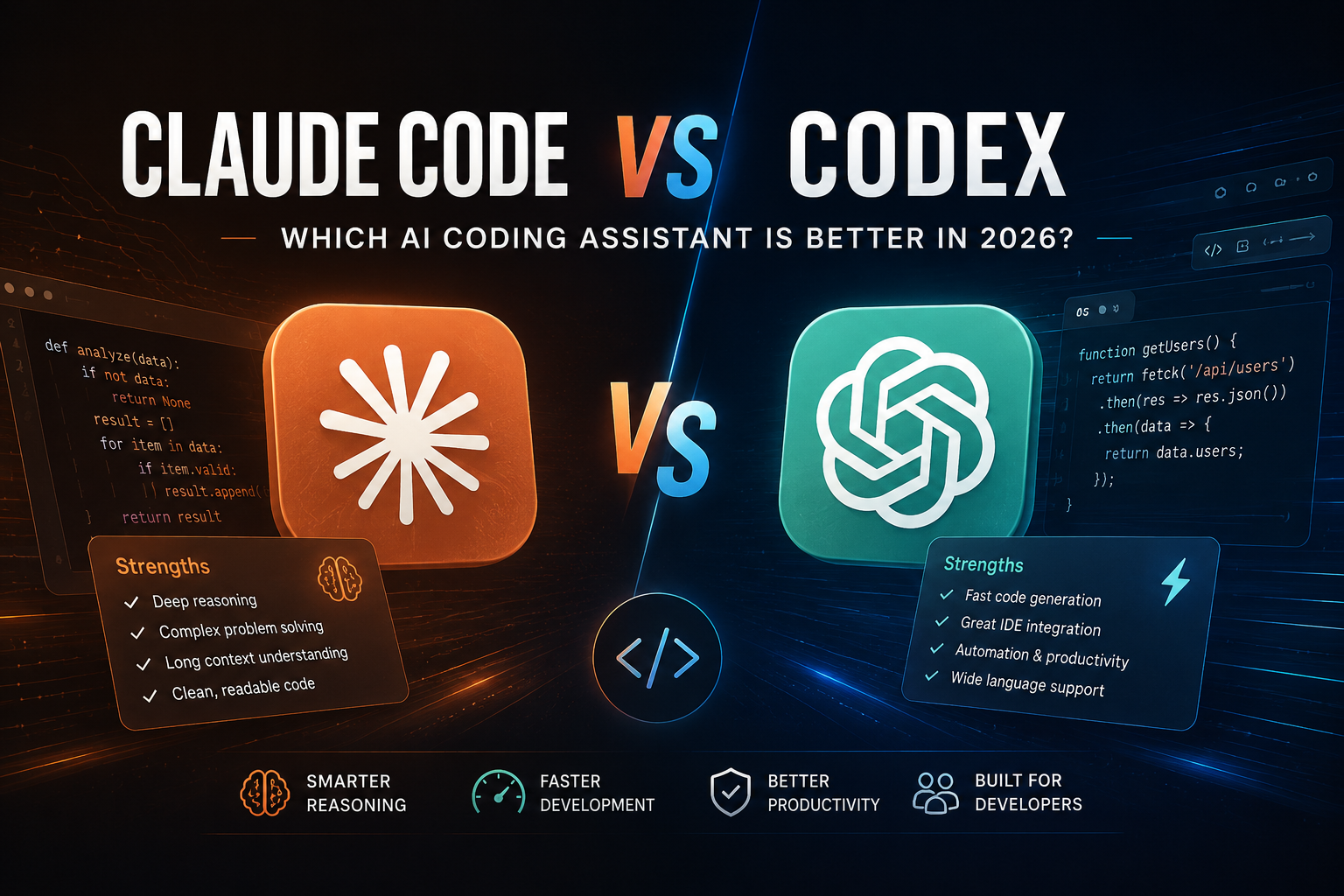
Neither tool wins outright — it depends on your workflow. Codex is usually faster and more practical for daily coding, while Claude Code tends to produce cleaner, more thoughtful results on complex projects. Many developers now use both together.
Artificial intelligence is changing how software is built. Developers can now use AI tools to write code, fix bugs, explain programming concepts, and even build full applications faster than ever before.
Two of the biggest AI coding tools right now are Anthropic’s Claude Code and OpenAI’s Codex. Both are powerful, but they’re designed differently. Some developers prefer Claude Code because it “thinks” better, while others prefer Codex because it moves faster on everyday development tasks.
So which one is actually better? Let’s break it down in a simple, data-driven way.
What is Claude Code?
Claude Code is an AI coding assistant created by Anthropic. It’s known for understanding large amounts of information at once, which makes it especially useful for big projects and complicated codebases. Developers mainly use it for:
- Debugging difficult problems
- Understanding large software projects
- Writing cleaner code
- Explaining code in simple language
- Generating technical documentation
Many programmers describe Claude as a strong “thinking partner” because it performs well when projects become complex.
What is Codex?
Codex is OpenAI’s AI coding model. It powers many coding tools used inside development environments and coding platforms, and it focuses heavily on speed and productivity — helping developers write code quickly and automate repetitive tasks. Developers often use Codex for:
- Fast code generation
- Autocomplete suggestions
- Building apps quickly
- Writing scripts
- Front-end and API development
- Automating workflows
For many developers, Codex feels faster and more practical during daily work.
What do the numbers say?
Several benchmarks and developer studies compared both tools across 2025 and 2026. One of the most important coding benchmarks is SWE-bench, which measures how well AI tools solve real software engineering problems.
| Test | Claude Code | Codex |
|---|---|---|
| SWE-bench Verified | 87.6% | 88.7% |
| Terminal tasks | 65.4% | 82.0% |
| Code quality reviews | 67% preference | 25% preference |
The results reveal a clear pattern: Codex performs better in speed and execution tasks, while Claude performs better in code quality and reasoning. In plain terms — Codex is usually faster, and Claude is usually smarter on complex tasks.
What do developers prefer?
Preference split from community surveys
Two different questions, two different winners.
Developers often reach for Codex because it saves time, and reach for Claude when they need better explanations or cleaner architecture.
Which tool is better for different people?
Better if you…
- Work on large projects
- Need deep debugging help
- Want cleaner, easier-to-maintain code
- Need detailed explanations
- Handle enterprise-level software
Better if you…
- Want faster coding
- Build apps quickly
- Need automation tools
- Prefer strong IDE integration
- Focus on productivity and speed
Final verdict
For most developers and companies in 2026, Codex currently has the overall edge. Why? Because most software teams prioritize faster development, higher productivity, better automation, and lower operational costs — and Codex performs extremely well across all of these, which explains why a larger share of developers prefer it day to day.
That said, Claude Code still holds a major advantage in reasoning and code quality. For complicated systems and large-scale engineering projects, many developers believe Claude produces more thoughtful and maintainable results.
There’s no perfect winner for everyone. If speed matters most → choose Codex. If deeper thinking and cleaner architecture matter most → choose Claude Code. In practice, many professional developers now use both: Codex for fast coding, and Claude for reviewing, debugging, and improving the final result. That combination is becoming one of the most common AI development workflows in modern software engineering.
Compare more AI coding tools
Benchmarks, pricing, and model rankings shift fast. Bookmark AISetApp to keep up with the latest head-to-head breakdowns.
Explore more on AISetApp →