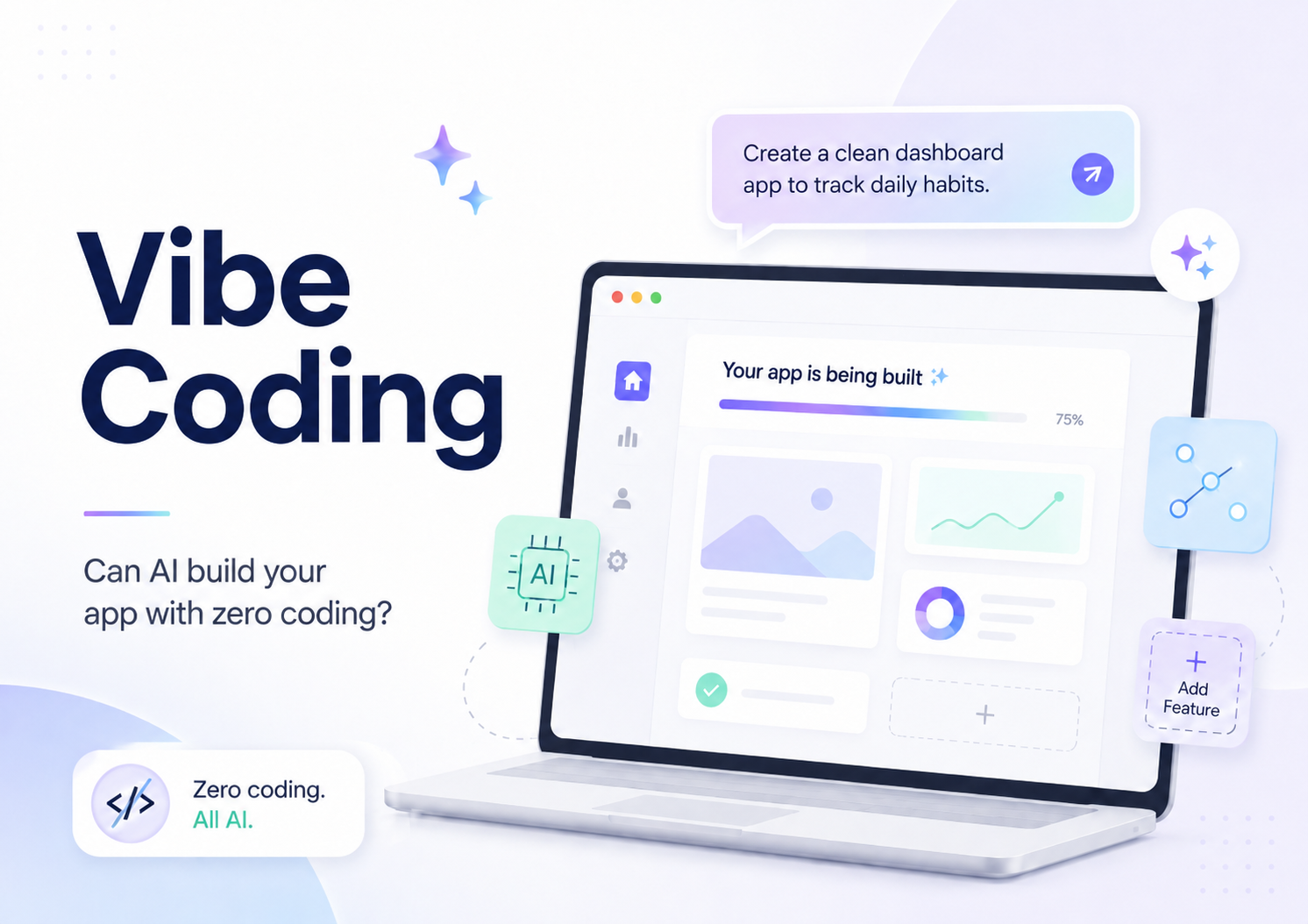
For most of computing history, turning an idea into working software meant either learning to code or paying someone who could. That barrier is falling fast. A new generation of AI app builders lets you describe the app you want in plain language and watch a working version appear, frontend, backend, database and all. The practice has a name now, vibe coding, and it has become the fastest-growing corner of the entire AI tools market. This guide explains what these tools actually do, which ones matter, where the zero coding promise is real, and where it quietly breaks down.
The appeal is obvious to anyone who has ever had an idea and no way to build it. You do not need to hire a developer, learn a framework, or spend months on a prototype. You type what you want, the AI generates it, you refine it in conversation, and you ship. But like the faceless-video boom and every other AI gold rush, the honest story is more useful than the hype, so this guide covers both what these tools genuinely deliver and the limits worth knowing before you bet a business on one.
What vibe coding actually means
Vibe coding is the practice of building software by describing intent rather than writing syntax. Instead of typing out functions and fixing semicolons, you tell an AI what the app should do, in ordinary sentences, and it produces the code. You then guide it, try this, change that, add a login page, in a back-and-forth conversation, the way you would brief a developer. The term captures a real shift: for a growing class of applications, the skill that matters is knowing clearly what you want and being able to describe and evaluate it, not memorising a programming language.
The related phrase zero coding describes the promise from the user's side: build a functioning app while writing no code yourself at all. For simple and moderately complex apps in 2026, that promise is now substantially real, which was not true even two years ago. The quality of generated applications has improved dramatically, and the gap between an AI-built app and a hand-coded one is genuinely shrinking for a large set of use cases.
The AI app builders that matter in 2026
The category is crowded, but a handful of names come up again and again. Each has a slightly different centre of gravity, and the right one depends on what you are building and how much control you want over the result.
Lovable
The name most associated with the vibe coding wave, and its commercial poster child: Lovable reached 20 million dollars in annual recurring revenue within two months of launch, one of the fastest growth stories the software world has seen. It is built for non-developers who want to describe an app in conversation and get a working, deployable result, with the emphasis firmly on speed and accessibility rather than on giving you low-level control.
v0
Vercel's app builder, v0, leans toward polished interfaces and clean frontend output. It is a strong fit if the look and feel of what you are building matters as much as the function, and it sits naturally in a modern web-deployment workflow. Developers often reach for it as an accelerator, using it to generate a strong starting point they then extend.
Bolt.new
Bolt.new (often searched as bolt new) generates full-stack applications in the browser and lets you run and iterate on them immediately, without setting up a local environment. It is aimed at people who want to go from prompt to running app in a single session, and it has become a common starting point for rapid prototyping.
NxCode
NxCode positions itself on a point the others often gloss over: complete code ownership. Every line it generates is yours to export, modify, and host anywhere, with no vendor lock-in, and it produces true full-stack apps with real frontend, backend, database and API layers rather than just a UI mockup. For founders who want to move fast now but keep the option to take the code elsewhere later, that ownership matters.
These are not the whole field, and the category shifts quickly, a leader today can lose ground within a year. The practical move is to compare the current options against what you actually need rather than committing to the first name you recognise. You can browse and compare the tools in the app and web builder category on AISetApp, which is kept current as the space moves.
What these tools are genuinely good at
The zero coding promise holds up best for a specific and large set of projects, and knowing where it shines saves you from disappointment. AI app builders are excellent for prototypes and minimum viable products, letting you test an idea with real users in days instead of months. They are strong for internal tools, the dashboards, trackers, and small utilities a team needs but could never justify a developer's time to build. They work well for simple customer-facing apps, landing pages with logic, booking systems, calculators, directories. And they are a genuine accelerator even for skilled developers, who use them to generate a solid first version and then take over.
The quality gap is shrinking, but it has not closed, and pretending otherwise will cost you. As an app grows complex, needs to scale to many users, handles sensitive data, or requires security and compliance guarantees, human engineering judgment becomes essential again. Vibe coding gets you a working app fast; it does not yet replace the expertise needed to make a complex app robust, secure, and maintainable at scale. The smart pattern is to use these tools for what they are brilliant at, speed and prototyping, and to bring in real engineering when the stakes and the complexity rise.
How to start, sensibly
If you have an idea, the fastest honest path looks like this. Start by describing the smallest useful version of your app, not the finished dream, because a tight scope is where these tools perform best. Pick one builder and learn its rhythm rather than hopping between all of them, since the skill of guiding the AI transfers but each tool has its own feel. Expect to iterate in conversation; the first generation is a starting point, not the destination. Test with real users early, because a working prototype in front of people teaches you more than another round of refinement. And be honest with yourself about when you have outgrown the tool: if your app is becoming genuinely complex or handling real users' sensitive data, that is the signal to bring in engineering help rather than pushing the builder past what it does well.
The bigger point is that vibe coding has permanently lowered the barrier between having an idea and testing it. That is a real and empowering shift, especially for founders, small teams, and anyone who was locked out of building software before. Used with clear eyes about its limits, an AI app builder is one of the most leveraged tools available in 2026.
Frequently asked questions
What is vibe coding?
Vibe coding is building software by describing what you want in plain language and letting an AI generate the code, then refining it in conversation rather than writing syntax yourself. It shifts the key skill from knowing a programming language to knowing clearly what you want and being able to describe and evaluate it.
Can you really build an app with zero coding?
For simple to moderately complex apps in 2026, yes, substantially. AI app builders like Lovable, v0, Bolt.new, and NxCode can produce working full-stack applications from plain-language descriptions. The zero coding promise holds well for prototypes, internal tools, and simple customer-facing apps. It weakens as complexity, scale, and security requirements rise, where human engineering is still needed.
Which AI app builder is best?
It depends on your goal. Lovable is built for non-developers who want speed and accessibility. v0 excels at polished interfaces. Bolt.new is strong for full-stack apps you can run instantly in the browser. NxCode emphasises complete code ownership and no lock-in. The best move is to compare current options against your specific needs rather than assuming one winner.
Is vibe coding going to replace developers?
Not for complex, high-stakes software. It removes the barrier for prototypes, simple apps, and internal tools, and it accelerates skilled developers. But apps that must scale, stay secure, and handle sensitive data still need engineering judgment. The realistic near future is developers using these tools to work faster, and non-developers finally able to build simple things themselves.
Are AI-built apps production-ready?
Sometimes, for simple apps. For anything complex or sensitive, treat the generated app as a strong starting point rather than a finished product. Review the code, test thoroughly, and bring in engineering expertise for security, scale, and maintainability before relying on it in production. Tools that give you full code ownership make that handover easier.
Find the right app builder for your idea
The tool you pick shapes how far and how fast you can go. Browse and compare the current AI app and web builders on AISetApp, organised and tested, so you can start building with the one that fits what you are making.
Explore app and web builders- NxCode, "Best AI Tools 2026: Complete Ranking Across Every Category," on app building as the fastest-growing category
- Reporting on Lovable's growth to 20 million dollars ARR within two months of launch
- One Little Web, "Inside the AI Tools Market 2026," 24-month study of AI tool categories
- DataCamp and DataNorth 2026 AI tool guides, on app builders and vibe coding
Reviewed August 2026. The category moves quickly; confirm current tool features before committing.