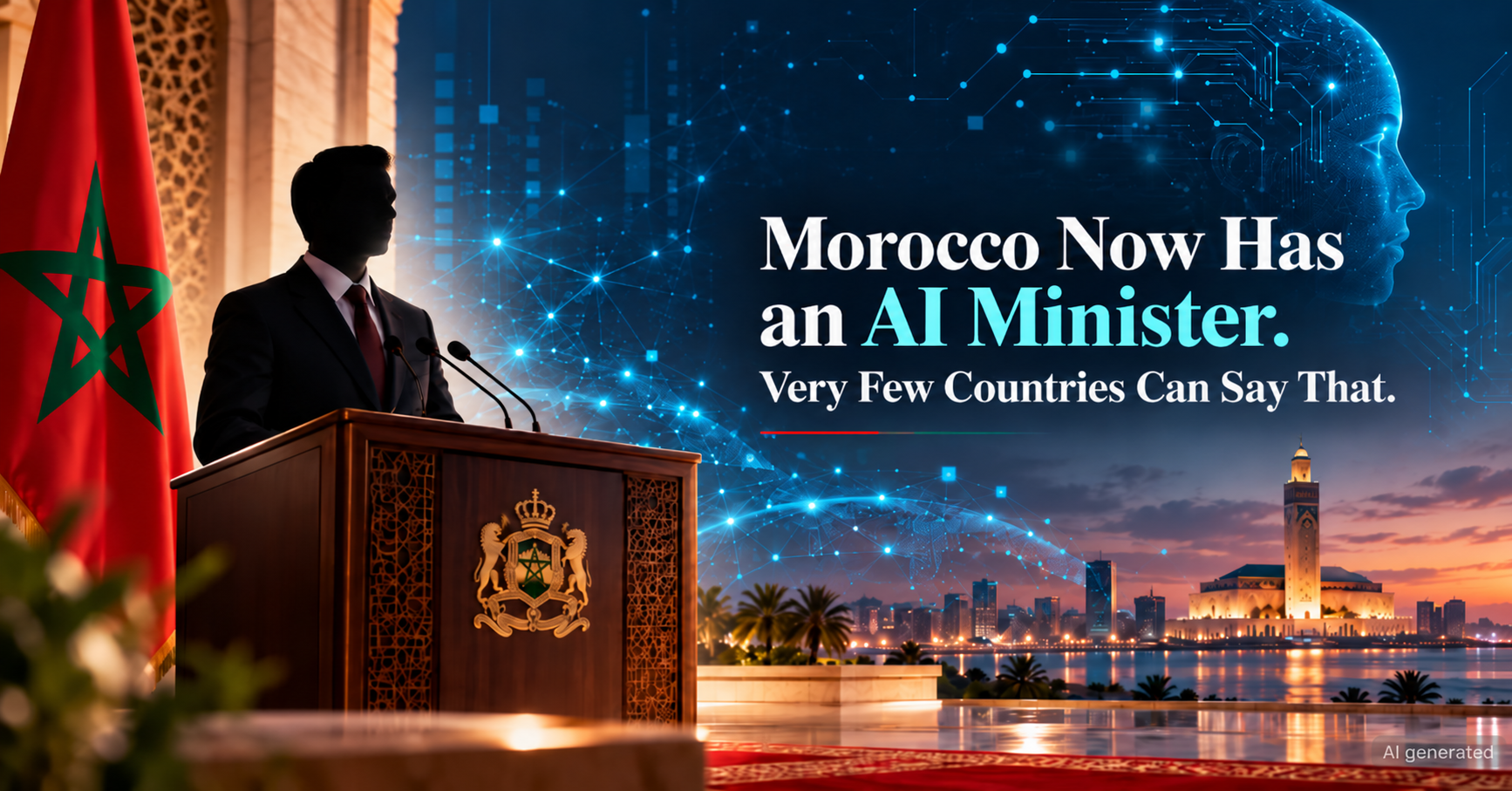
Morocco now has a minister with "Artificial Intelligence" in the job title. In the new government, AI was added to the existing digital-transformation ministry, and Ahmed Rahhou, a former banker, was named to lead it. It is a symbolic and practical step: it signals that Morocco is treating AI as a national priority, not just a tech trend. Behind it sits a 2030 plan, "AI Made in Morocco", aiming for around $10 billion in added GDP, 50,000 jobs, and 200,000 people trained in AI skills.
Most of our news coverage looks outward, at what is happening in the US, Europe, or the Gulf. This one is closer to home. On October 16, as King Mohammed VI appointed the new government led by Prime Minister Fatima Zahra El Mansouri, Morocco quietly did something only a handful of countries have done: it put artificial intelligence directly into a minister's title.
What actually happened
The existing Ministry of Digital Transition and Administrative Reform was renamed to include artificial intelligence, becoming the Ministry of Artificial Intelligence, Digital Transformation and Administrative Reform. Ahmed Rahhou, a figure from the banking and business world, was appointed to lead it. In plain terms, AI is no longer tucked inside a broader "digital" brief; it is named, visible, and owned by someone at cabinet level.
That naming matters more than it might seem. When a government writes a topic into a minister's title, it is making it a stated priority, something with a budget line, an accountable official, and a place on the national agenda. Morocco now joins the small group of countries that have given AI that kind of formal standing.
The plan behind the title
A title alone is just a signal; what gives it weight is the plan behind it. Morocco's move sits on top of a national AI roadmap toward 2030, framed around the idea of "AI Made in Morocco", building local capability rather than only importing tools. The stated targets are concrete: roughly 100 billion dirhams (about $10 billion) in additional GDP by 2030, around 50,000 direct and indirect jobs in the AI sector, and 200,000 people trained and certified in AI-related skills.
Those are ambitions, not guarantees, and it is fair to treat them as goals to be judged over time rather than results. But they give the new ministry a clear direction: grow the economy, create jobs, and build a skilled workforce, with AI as the engine.
Why this matters for Morocco
For a business owner, a student, or a professional in Morocco, the practical takeaway is that AI is becoming official national policy, with money and targets attached. That usually brings real downstream effects over the coming years: training programs, support for local startups, a push to get AI into public services, and incentives for companies that build or adopt it. The training target in particular, 200,000 people, is a signal that skills are meant to reach well beyond a small tech elite.
It also places Morocco more visibly on the regional map. The Gulf states have made AI a headline national project; Morocco adding AI to a ministry is a sign that the ambition is spreading across the wider Arab world and North Africa, not concentrated in a few capitals. For anyone building an AI-related skill set or business here, the direction of travel just became clearer.
Frequently asked questions
Who is Morocco's new AI minister?
Ahmed Rahhou, appointed on October 16, 2026 by King Mohammed VI as Minister of Artificial Intelligence, Digital Transformation and Administrative Reform, in the government led by Prime Minister Fatima Zahra El Mansouri. He comes from a banking and business background.
Did Morocco create a brand-new AI ministry?
Not from scratch. Artificial intelligence was added to the name and mandate of the existing digital-transformation and administrative-reform ministry. The significant change is that AI now appears explicitly in the ministry's title, giving it named, cabinet-level ownership for the first time.
What are Morocco's AI goals?
They sit within a national AI roadmap toward 2030, framed as "AI Made in Morocco." The stated targets include roughly 100 billion dirhams (about $10 billion) in additional GDP by 2030, around 50,000 direct and indirect jobs, and 200,000 people trained and certified in AI skills. These are goals to watch over time, not guaranteed outcomes.
What does this mean for businesses and workers in Morocco?
It signals that AI is now official national policy with budget and targets behind it. Over the coming years that typically means more training programs, support for local startups, AI in public services, and incentives to adopt AI. The large training target suggests skills are meant to reach a broad population, not just a tech elite.
Is Morocco unusual in doing this?
Relatively, yes. Only a small number of countries put artificial intelligence directly into a minister's title. The Gulf states have made AI a flagship national priority, and Morocco's move is a sign that this level of ambition is spreading across the wider Arab world and North Africa.
Build your AI skills with AISetApp
As AI becomes national policy, the people who learn it early will benefit most. Explore clear, practical guides and tools on AISetApp to build your own AI skills, whatever your background.
Explore more on AISetApp- Morocco World News, Ecofin Agency, Hespress, and Tech Review Africa reporting on the appointment of Ahmed Rahhou and the new ministry, October 2026
- Coverage of Morocco's national AI roadmap toward 2030 ("AI Made in Morocco") and its GDP, jobs, and training targets, 2026
- Reporting on the new government led by Prime Minister Fatima Zahra El Mansouri, appointed October 16, 2026
Reviewed October 2026. Details and targets may evolve; confirm current information with official Moroccan government sources.
Researched and drafted with AI assistance, reviewed and edited by Yasser El Hardouz, who takes editorial responsibility for this article.