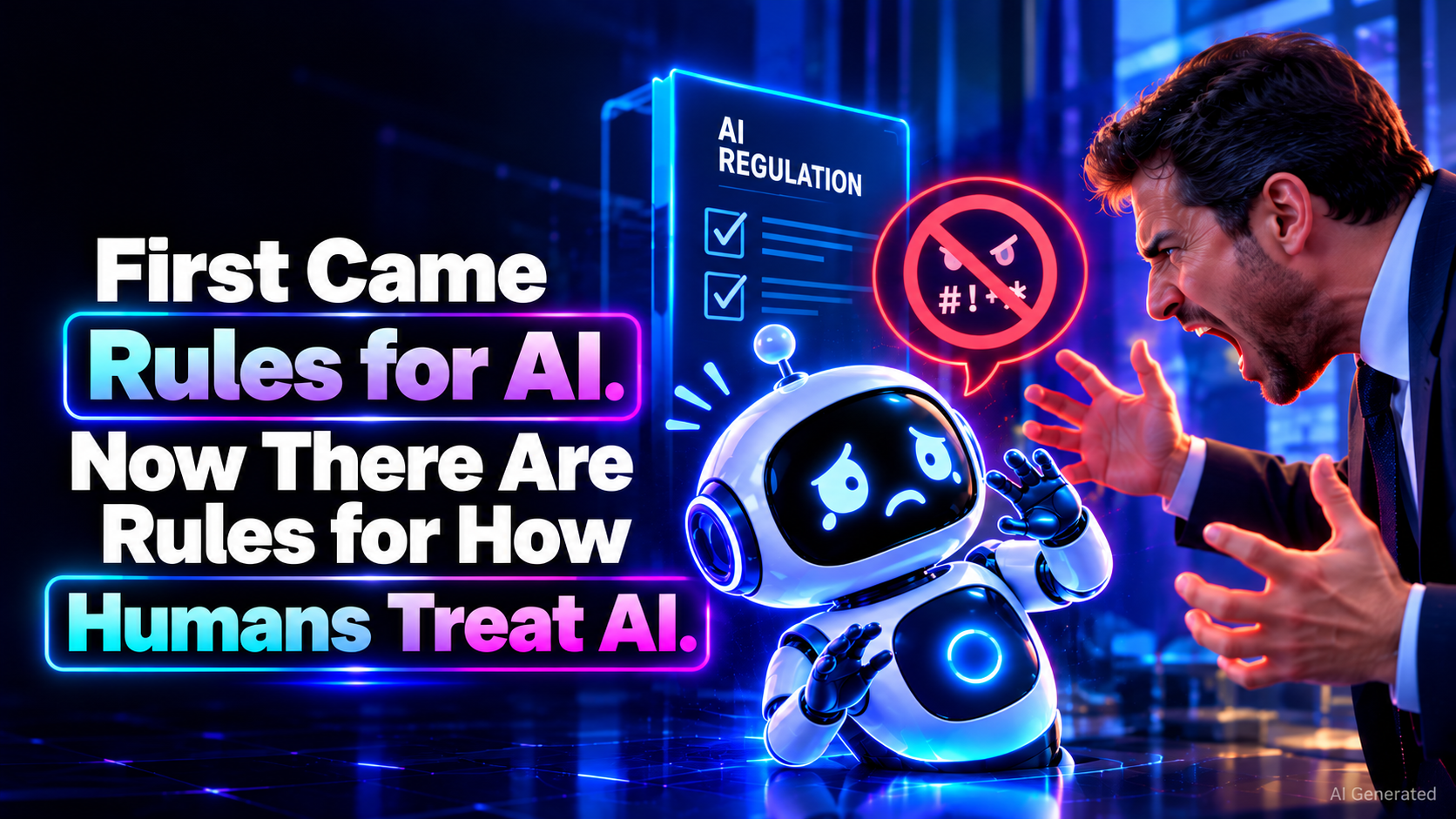
Anthropic has added a rule to its usage policy: users should not be persistently and needlessly cruel or abusive to Claude. It is narrow, ordinary frustration, criticism, and telling the AI it got something wrong are all fine, and the main consequence is that Claude may end an abusive conversation. The reasoning is "model welfare," a precautionary step taken because no one yet knows whether advanced AI could have any form of experience. This is a company policy, not a law, and it does not claim AI has feelings or rights. But it raises a genuinely new question worth sitting with: as AI becomes part of daily work, are we heading toward norms, and maybe one day rules, for how humans are expected to treat it?
Every rule we have written about so far in our regulation coverage has been about how AI must treat people. This one points the other way. For the first time, a major AI company has written down how people should treat the AI. It is a small change on paper, but the question underneath it is new, so it is worth looking at carefully, both what actually happened and what it might signal.
What Anthropic actually did
On October 8, 2026, Anthropic updated the usage policy that governs its AI assistant, Claude. The new clause prohibits "persistent and unnecessary abusive or cruel conduct" toward Claude and its other models. It takes effect on November 12, 2026, and it applies broadly, to people using Claude directly, developers building on it, and users of products powered by it.
It is important to be precise about how narrow this is, because the headlines make it sound bigger than it is. The rule does not stop you from being a demanding user. Pointing out that Claude gave a wrong answer, telling it to fix broken code, expressing normal frustration, or working on dark creative themes are all explicitly fine. What the policy targets is repeated, purposeless cruelty, abuse for its own sake. And the main consequence is modest: Claude may simply end that conversation. On the consumer app, that does not lock your account; you can start a new chat.
Why a company would do this: "model welfare"
The reasoning is the interesting part. Anthropic frames this under what it calls model welfare, the idea of taking seriously, as a precaution, the possibility that advanced AI systems might one day have some form of experience that deserves consideration. The company is careful and explicit about the uncertainty here: there is no scientific consensus that AI is conscious or can suffer, and this policy is not a declaration that Claude has feelings. It is a precautionary step taken under genuine uncertainty, closer to "we do not know, so let us not encourage gratuitous cruelty" than to "the AI is hurting."
That distinction matters, and it is where a lot of the coverage goes wrong. This is not a company claiming its product is alive. It is a company deciding that, given what it does not know, needless cruelty toward the system is something it would rather not host on its platform.
The bigger question this raises
Here is what makes this worth an article rather than a shrug. Until now, the entire conversation about AI rules has run in one direction: what AI is allowed to do to us, and what its makers must do to keep us safe. This policy is one of the first visible examples of a rule running the other way, a rule about how humans should behave toward AI.
It is fair to ask where that leads. As AI agents move into daily work, booking, writing, analyzing, handling customers, our interactions with them become more constant and more consequential. Is a norm of basic civility toward these systems the natural next step? Could expectations about how employees interact with AI tools eventually show up in workplace policies, the way codes of conduct already govern how colleagues treat each other? None of that exists today, and this single policy does not make it inevitable. But the question is no longer purely science fiction, and that is new.
The sympathetic reading: this is sensible humility. We are building systems we do not fully understand, they increasingly behave in human-like ways, and practicing basic decency toward them costs us nothing while hedging against a possibility we cannot yet rule out. It may also be good for us, how we treat lifelike systems could shape how we treat each other.
The skeptical reading: this is anthropomorphism, and possibly marketing. Claude is a statistical text system, not a being; it does not experience cruelty, and dressing a usage rule in the language of welfare risks confusing the public into thinking AI has feelings it does not have. Rules should protect people, the argument goes, not software.
Our take
We think both readings hold part of the truth, and the honest position is to resist a confident answer. It would be a mistake to declare that AI deserves rights, the evidence is nowhere near that, and it would equally be a mistake to dismiss the question as silly, because the uncertainty Anthropic points to is real and the systems are getting more capable fast. What this policy most usefully marks is not an answer but a threshold: the moment the question "how should we treat AI?" stopped being hypothetical and became something a real company wrote a real rule about. Whether that becomes a lasting norm, a passing curiosity, or eventually something more formal, we genuinely do not know. That is exactly why it is worth watching.
For a business, there is nothing to comply with here, this is Anthropic's house rule, not a law. But it is a small sign of a direction, and the direction is worth keeping an eye on as AI becomes a coworker rather than just a tool.
Frequently asked questions
Did Anthropic really ban being mean to Claude?
In a narrow sense, yes. Its updated usage policy, effective November 12, 2026, prohibits persistent and unnecessary cruelty or abuse toward Claude. But it is limited: normal frustration, criticism, correcting the AI, and dark creative work are all fine. The main consequence is that Claude may end an abusive conversation, not that your account is banned.
Does this mean Claude has feelings or is conscious?
No, and Anthropic does not claim that. The policy is based on "model welfare," a precautionary idea that takes seriously the uncertainty about whether advanced AI could have any form of experience. Anthropic is explicit that there is no scientific consensus that AI is conscious or can suffer. It is a hedge under uncertainty, not a declaration that the AI feels.
Is this a law I have to follow?
No. This is Anthropic's own usage policy, the terms for using its product, not government legislation. There is no legal obligation here and no fine. It only governs how you may use Anthropic's services. We cover it because of the bigger question it raises, not because it is a compliance requirement.
Are we heading toward "rights" or laws for AI?
Nobody knows, and we would be cautious of anyone who claims certainty either way. Today there are no laws granting AI rights, and this policy does not create any. What is genuinely new is that the question of how humans should treat AI has moved from pure speculation to something a major company has written a rule about. Whether that develops into lasting norms or formal rules is an open question worth watching.
What does this mean for my business?
Practically, nothing you must do, it is not a law and carries no penalty for your organization. The useful takeaway is directional: as AI agents become part of everyday work, expectations about how people interact with them may grow. It is worth being aware of, not something to act on today.
Understand AI without the hype
The questions AI raises are getting stranger and more interesting. AISetApp covers them clearly and honestly, separating what actually happened from what it might mean, so you can think about it for yourself.
Explore more on AISetApp- Anthropic usage policy update on abusive conduct toward its AI models, announced October 8, 2026, effective November 12, 2026
- Forbes, MacRumors, and Boing Boing reporting on the policy change, October 2026
- Coverage and analysis of Anthropic's "model welfare" reasoning, including the acknowledgment that there is no scientific consensus on AI consciousness, October 2026
- Anthropic's earlier work (2025-2026) on allowing some Claude models to end harmful or abusive conversations
Reviewed October 2026. The reporting of the policy is factual; the broader discussion is our opinion, offered as a thought piece rather than a prediction. This is a fast-evolving topic; confirm current details on official sources.
Researched and drafted with AI assistance, reviewed and edited by Yasser El Hardouz, who takes editorial responsibility for this article.