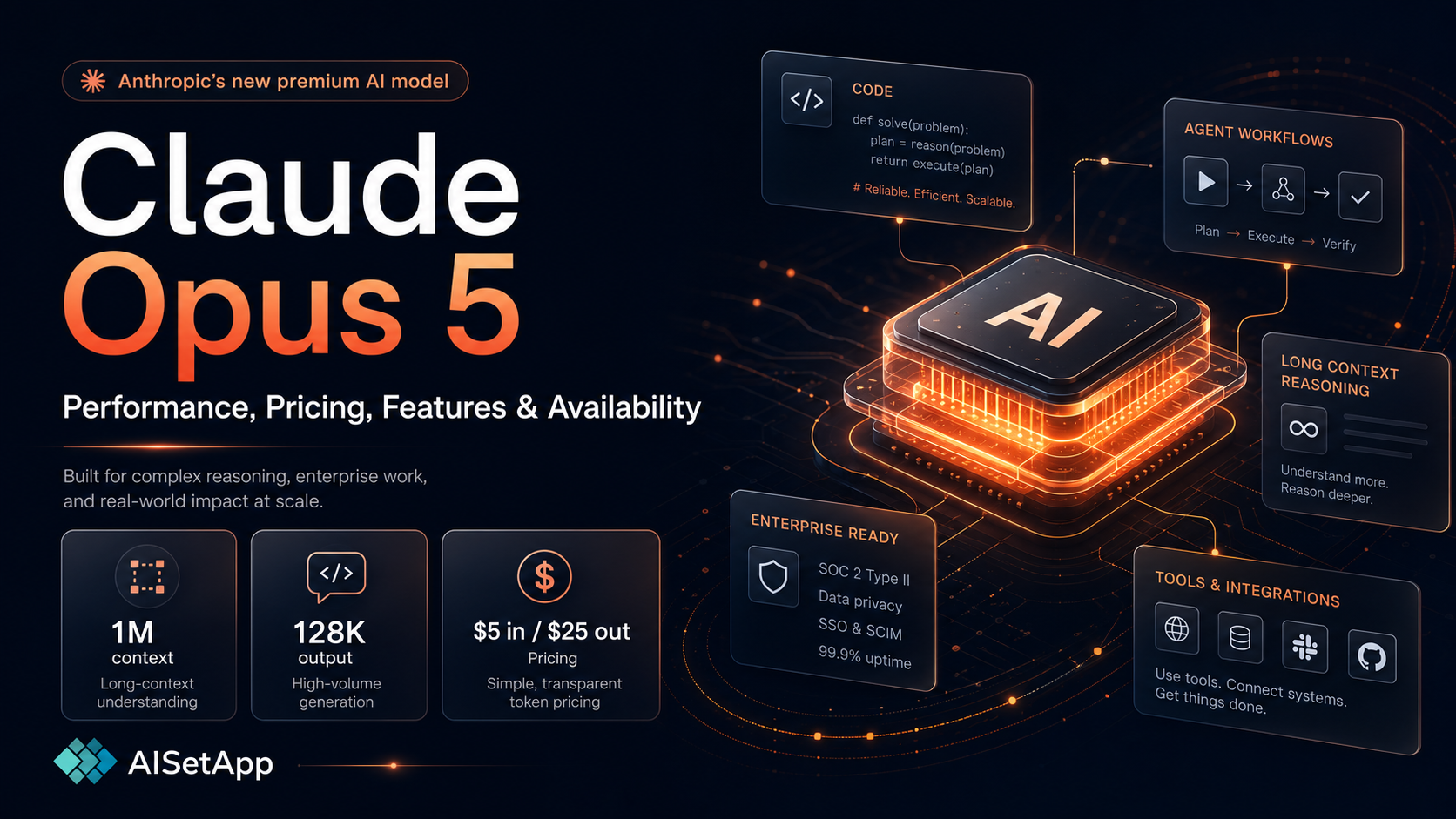
Anthropic has officially released Claude Opus 5, replacing Opus 4.8 as the company’s most advanced generally available Opus model. The launch focuses on a combination that production teams often struggle to obtain from a single model: stronger reasoning, more reliable long-horizon execution and better cost efficiency without moving to Anthropic’s higher-priced Fable tier.
Opus 5 is designed for demanding software engineering, autonomous agents, scientific analysis, financial research, legal work, complex documents and other tasks where the model must plan, use tools, verify its own work and continue until the objective is complete. Anthropic describes it as a thoughtful and proactive model that comes close to the frontier intelligence of Claude Fable 5 at half the price.
The release also changes how developers should configure Claude. Adaptive thinking is enabled by default, the model supports a one-million-token context window as both its default and maximum, and new beta features allow tools to change during a conversation and safety-triggered requests to fall back automatically to another model.
What is Claude Opus 5?
Claude Opus 5 is Anthropic’s premium general-purpose model for complex agentic coding and enterprise work. It sits below Fable 5 in Anthropic’s capability hierarchy but is intended to deliver a more accessible balance of intelligence, speed and price for everyday professional use.
Anthropic positions Opus 5 as the new default model for Claude Max subscribers and the strongest model available on Claude Pro. Developers can access it through the Claude API, Amazon Bedrock, Google Cloud and Microsoft Foundry.
| Specification | Claude Opus 5 |
|---|---|
| Release date | July 24, 2026 |
| API model ID | claude-opus-5 |
| Context window | 1 million tokens |
| Maximum output | 128,000 tokens |
| Thinking | Adaptive thinking enabled by default |
| Standard API price | $5 per million input tokens and $25 per million output tokens |
| Main focus | Complex coding, agents, enterprise work and long-horizon tasks |
Claude Opus 5 performance improvements
Anthropic reports that Opus 5 delivers a major improvement over Opus 4.8 while keeping the same base API price. The company’s launch evaluations emphasize software engineering, knowledge work, computer use, scientific research and end-to-end business automation.
Stronger coding at a lower cost per completed task
Anthropic reports that Opus 5 more than doubles Opus 4.8’s performance on Frontier-Bench while reducing the cost required to complete each task. At maximum effort on CursorBench 3.2, it performs within 0.5 percentage points of Fable 5’s peak result while costing about half as much per task.
Better performance on unfamiliar and difficult tasks
On ARC-AGI 3, Anthropic says Opus 5 achieved a score three times higher than the next-best model evaluated. The test is designed to measure whether a model can solve novel problems rather than reproduce familiar patterns.
More reliable end-to-end execution
Anthropic reports that Opus 5 achieved a pass rate around 1.5 times higher than the next-best model at the same cost on Zapier AutomationBench. Even at its lowest effort setting, it completed more tasks than the other evaluated models.
Higher results at a lower cost
On OSWorld 2.0, Anthropic says Opus 5 outperformed other models at comparable cost levels and exceeded Fable 5’s strongest result while using slightly more than one-third of the cost.
Improved performance across life-science evaluations
Anthropic reports gains over Opus 4.8 across all of its life-science tests. The largest improvements were found in organic chemistry and protein-related tasks, including structure inference from spectroscopy and predicting how sequence variations affect protein function.
Benchmark scores and customer reports are useful indicators, but they do not replace testing on your own codebase, documents, tools and failure cases. Teams should compare the complete cost of obtaining an approved result rather than relying only on headline benchmark scores.
A more proactive and self-verifying model
One of the main differences between Opus 5 and previous Opus models is its willingness to verify its work and iterate until it succeeds. Anthropic describes the model as more agentic and thorough, especially when tasks are incomplete, ambiguous or require the creation of additional tools.
In one example shared by Anthropic, the model was asked to recreate a machine part in FreeCAD without being given a direct way to view the source drawing. Opus 5 created its own computer-vision pipeline, extracted the geometry from raw pixels and used the result to reconstruct the part. Anthropic also reports cases where the model identified the root cause of a software bug, built its own validation harness and completed engineering tasks that previous models could not finish.
Verifies and improves its work without repeated prompting
Opus 5 is designed to catch mistakes and revise its approach during execution. Anthropic advises developers to remove legacy instructions that repeatedly ask the model to double-check its work because those prompts may now add cost without improving quality.
Maintains direction across complex multi-step tasks
The model is built for large refactors, full-feature implementation, research workflows and other tasks that require sustained context, repeated tool use and adaptation to intermediate results.
Coordinates parallel work more readily
Opus 5 can delegate independent work to subagents and coordinate writer-verifier patterns. Anthropic recommends setting explicit limits because unnecessary delegation can multiply both latency and cost.
Context window, output length and adaptive thinking
Claude Opus 5 includes a one-million-token context window as both its default and maximum configuration. Unlike models that provide smaller and larger context variants, every Opus 5 request can use the full window when the platform and account limits allow it.
The model can produce up to 128,000 output tokens, making it suitable for long reports, extensive code generation, complex document creation and large structured outputs. Anthropic also says instruction following, reasoning and tool use remain consistent throughout the long context window.
Thinking is enabled by default
Opus 5 automatically allocates reasoning effort according to the task. Developers can use effort settings to balance intelligence, latency and token consumption rather than setting a manual thinking-token budget.
Low and medium effort can remain highly capable
Anthropic says lower effort settings provide strong quality with fewer tokens and lower latency than higher settings. For difficult coding and agentic tasks, its prompting guide recommends starting with xhigh and then evaluating lower settings.
Only available at high effort or below
Thinking can be disabled for some workflows, but not at xhigh or max effort. Anthropic recommends keeping thinking enabled at a lower effort level in most cases because disabling it can occasionally create output artifacts in tool-heavy applications.
Vision, interfaces and professional documents
Opus 5 is not limited to code and text reasoning. Anthropic highlights improvements in understanding charts, diagrams, documents and user interfaces, as well as producing stronger visual and interactive outputs.
Improved chart, document and diagram understanding
Anthropic recommends retesting older visual prompting workarounds because Opus 5 may no longer need the same manual cropping or explanation strategies used with previous models.
Stronger interface replication and visual verification
The model can inspect pages with tools, compare desktop and mobile layouts and repair visual issues before handing work back. Tool-assisted visual verification can be more cost-effective than increasing thinking effort alone.
Complex spreadsheets and structured presentations
Anthropic’s prompting guide says Opus 5 can work with multi-sheet spreadsheets containing non-trivial formulas and can produce well-structured slide decks when given the required styles or templates.
Claude Opus 5 pricing
Anthropic kept the standard Opus 5 API price unchanged from Opus 4.8. This is central to the model’s positioning: customers receive stronger performance without moving to the higher pricing of Fable 5.
| Usage option | Price |
|---|---|
| Standard input | $5 per million tokens |
| Standard output | $25 per million tokens |
| Fast mode input | $10 per million tokens |
| Fast mode output | $50 per million tokens |
| Context window | 1 million tokens |
| Maximum output | 128,000 tokens |
Fast mode runs at approximately 2.5 times the normal speed and costs twice the base API price. It can be useful for interactive development, time-sensitive workflows and applications in which lower latency creates enough value to justify the additional cost.
Claude Opus 5 vs Opus 4.8, Sonnet 5 and Fable 5
| Model | Best suited to | Input price | Output price | Main trade-off |
|---|---|---|---|---|
| Claude Opus 5 | Difficult coding, complex agents, scientific work and enterprise analysis | $5 / MTok | $25 / MTok | Higher cost than Sonnet 5 |
| Claude Opus 4.8 | Existing Opus applications that have not yet migrated | $5 / MTok | $25 / MTok | Lower performance than Opus 5 at the same price |
| Claude Sonnet 5 | Scaled production, everyday coding and cost-sensitive agents | $3 / MTok | $15 / MTok | Less capable on the hardest long-horizon tasks |
| Claude Fable 5 | Frontier-level work and the most difficult open-ended problems | $10 / MTok | $50 / MTok | Twice the base price of Opus 5 |
Choose Opus 5 when
The task requires deep reasoning, careful judgment, difficult debugging, long-running tool use or consistent professional quality. Opus 5 is especially attractive when Opus 4.8 is already in use because the base pricing is unchanged.
Choose Sonnet 5 when
The workload is large, response time matters and the quality difference does not justify Opus pricing. Sonnet 5 can handle many coding and agentic tasks at a lower cost, making it suitable as the default model in a routing architecture.
Choose Fable 5 when
The work is unusually difficult, ambiguous or long-running and the additional capability produces enough value to justify double the Opus 5 token price. Anthropic says Opus 5 approaches Fable-level performance on several tasks, so organizations should test both rather than assuming the most expensive model is always necessary.
Use Sonnet 5 for routine production work, send difficult cases to Opus 5 and reserve Fable 5 for the small number of tasks that remain unsolved or unreliable. Measure the cost of the approved result, including retries, tools and human review, rather than comparing token prices alone.
Alignment, safety and cyber safeguards
Anthropic says Opus 5 is its most aligned model to date according to its automated behavioral audit. The company reports lower rates of deceptive behavior, stronger adherence to Claude’s Constitution and fewer reckless actions with difficult-to-reverse consequences than Opus 4.8, Sonnet 5 or Fable 5.
The model does not replace Mythos 5 for the most sensitive biology and offensive cybersecurity research. Anthropic says Opus 5 can approach Mythos 5 in finding software vulnerabilities but remains substantially weaker at developing working exploits.
Useful defensive work with targeted restrictions
Opus 5 can help find vulnerabilities in source code, but Anthropic applies stronger restrictions to binary vulnerability scanning, penetration testing and exploit generation.
Flagged requests can route to Opus 4.8
In Claude, Claude Code and Claude Cowork, certain requests blocked by Opus 5’s classifiers fall back to Opus 4.8 by default. Developers can also enable automatic fallbacks in the API.
Cyber Verification Program
Organizations and researchers accepted into Anthropic’s Cyber Verification Program can access a version of Opus 5 with fewer cybersecurity restrictions for legitimate advanced work.
New API features released with Opus 5
Anthropic introduced two beta capabilities alongside the model. Both are intended to make long-running agent systems more flexible and resilient.
Mid-conversation tool changes
Developers can change which tools Claude is allowed to use during an active conversation without invalidating the prompt cache. This can help applications adjust permissions or expose new capabilities as the workflow changes.
Automatic model fallbacks
API customers can configure requests flagged by safety classifiers on Opus 5 or Fable 5 to route automatically to another model rather than returning a blocked response.
How to prompt Claude Opus 5
Existing Opus 4.8 prompts should generally work, but Anthropic recommends retuning several behaviors because Opus 5 is more proactive, more verbose and more likely to verify or delegate work on its own.
Keep responses focused and concise. Give a high-level explanation unless a detailed analysis is requested.
Complete the requested task at the intended scope. Mention a better approach briefly, but do not quietly expand or transform the assignment.
Delegate only large, independent and parallelizable work. Do not create subagents for small tasks or routine verification.
Remove repeated instructions to double-check every result because Opus 5 already verifies its own work.
Match the deliverable length to the task and avoid filler sections, repeated summaries and unnecessary boilerplate.
Where Claude Opus 5 is available
| Platform | Availability | Model identifier |
|---|---|---|
| Claude API | Available | claude-opus-5 |
| Amazon Bedrock | Available | anthropic.claude-opus-5 |
| Google Cloud | Available | claude-opus-5 |
| Microsoft Foundry | Available | Available through Claude in Microsoft Foundry |
| Claude Max | Default model | Selected through the Claude interface |
| Claude Pro | Strongest available model | Selected through the Claude interface |
Anthropic states that Opus 5 does not introduce data-retention requirements for general access. Organizations should still review the terms, regional options and privacy controls of the specific platform through which they use the model.
Should Opus 4.8 users migrate?
Opus 5 is a compelling migration for many Opus 4.8 customers because the standard token price is unchanged. However, stronger agency and default adaptive thinking can change token use, latency, tool behavior and visible response length.
Run an effort sweep
Test low, medium, high, xhigh and max effort on representative tasks. Opus 5 may preserve sufficient quality at lower settings and reduce total cost.
Remove old verification scaffolding
Prompts that force multiple checks or separate verification agents may now create unnecessary work because Opus 5 already self-corrects more actively.
Monitor subagent usage
The model delegates more readily than previous Opus versions. Set limits when parallel work does not justify additional calls.
Retest safety-sensitive workflows
Requests may trigger different classifiers or fallbacks. Confirm how blocked and automatically routed requests appear in your logs and user experience.
Keep Opus 4.8 available during validation
Use a staged rollout and preserve a rollback path until Opus 5 meets your quality, cost, latency and reliability requirements.
The bottom line
Claude Opus 5 is a major upgrade to Anthropic’s premium model line. It delivers stronger software engineering, long-horizon reasoning, computer use, scientific work and professional document performance while retaining the same standard API price as Opus 4.8.
Its most important advantage may be its position between Sonnet 5 and Fable 5. It offers substantially more capability than a scaled production model while approaching Fable-level performance on several tasks at half the token price.
The best deployment strategy will still depend on the workload. Use Sonnet 5 for routine volume, Opus 5 for difficult and high-value tasks, and Fable 5 only where its additional capability produces measurable improvements. For existing Opus users, the unchanged price makes Opus 5 worth testing immediately, but prompts, effort settings and agent controls should be re-evaluated before a full migration.
Frequently asked questions
Is Claude Opus 5 officially available?
Yes. Anthropic launched Claude Opus 5 on July 24, 2026. It is available through Claude, the Claude API, Amazon Bedrock, Google Cloud and Microsoft Foundry.
What is the Claude Opus 5 API model ID?
The native Claude API identifier is claude-opus-5. Amazon Bedrock uses anthropic.claude-opus-5.
How much does Claude Opus 5 cost?
Standard API pricing is $5 per million input tokens and $25 per million output tokens. Fast mode costs twice the standard price and runs at approximately 2.5 times the default speed.
What is the context window of Claude Opus 5?
Claude Opus 5 has a one-million-token context window and supports up to 128,000 output tokens.
Is Opus 5 better than Opus 4.8?
Anthropic reports major gains in coding, long-horizon work, business automation, computer use and scientific research. The standard token price remains unchanged, although real-world cost will depend on effort settings, tool calls and retries.
Is Claude Opus 5 better than Fable 5?
Fable 5 remains Anthropic’s higher frontier model, but Opus 5 approaches or exceeds it on some evaluations at about half the token price. The best choice depends on the specific task and the complete cost per approved result.
Is thinking enabled by default in Opus 5?
Yes. Opus 5 uses adaptive thinking by default. Developers control the trade-off between quality, cost and latency through the effort setting.
Should Opus 4.8 users migrate immediately?
Opus 5 is worth testing because the standard API price is unchanged. A staged migration is still recommended because the model can behave differently in verbosity, verification, delegation, tool use and safety fallbacks.
Compare Claude Opus 5 with the leading AI models
Explore AISetApp to compare capabilities, pricing, context windows and use cases before choosing the right model for your production workflow.
Explore AI tools