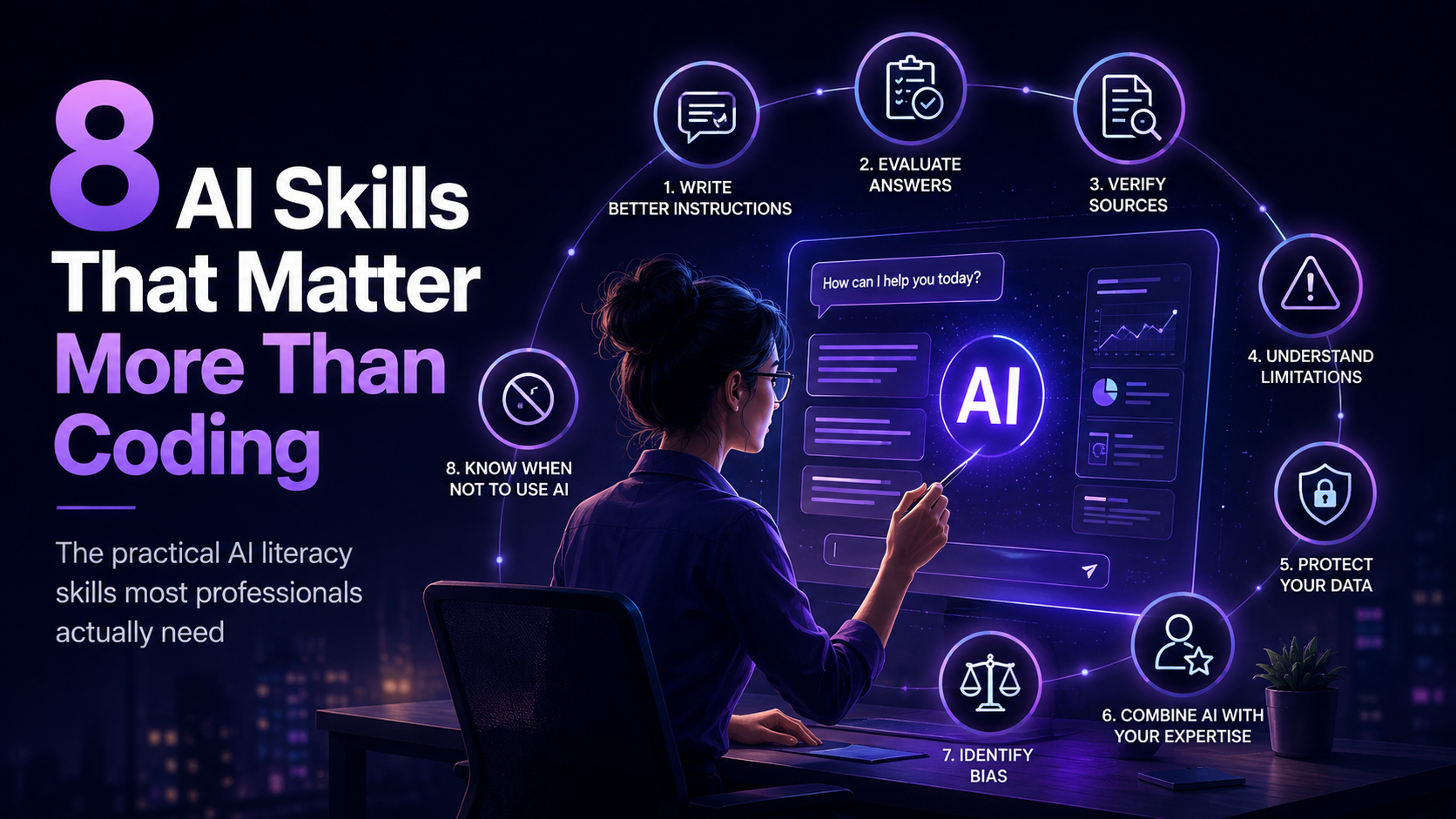
The AI skills most people need are not technical. They are about judgment: how to instruct a model clearly, how to check whether its answer is right, and how to know when not to use it at all. The OECD's research is blunt on this point. Most workers exposed to AI will never need to build a model, but nearly all of them will need to work alongside one, and that is a different skill set entirely. Below are the eight that matter, none of which require you to write a line of code.
There is a common assumption that preparing for an AI-driven economy means learning to program. It is mostly wrong. The OECD, in its 2025 report on the AI skills gap, makes the point directly: the vast majority of workers exposed to AI will not require specialised skills like machine learning. What they will need is general AI literacy, the ability to use and collaborate with these systems effectively. And the supply of that kind of training, the OECD warns, is not keeping up with the demand.
That gap is an opportunity if you get ahead of it. The eight skills below are the practical core of AI literacy. They are not about any one chatbot, and they will not go out of date when the next model ships, because they are about judgment rather than tools. A model changes every few months. Knowing how to verify what it tells you does not.
1. Writing effective instructions
The single highest-leverage skill, and the one most people underrate. A vague request gets a vague answer. The difference between "write something about our product" and a prompt that specifies the audience, the tone, the length, the format, and what to leave out is the difference between output you rewrite from scratch and output you actually use. This is not about memorising magic phrases. It is about learning to say clearly what you want, which turns out to be a skill many people have never had to practise, because other humans fill in the gaps automatically and models do not.
2. Evaluating AI answers
A model will hand you a confident, fluent, well-structured answer whether or not it is correct. Fluency is not accuracy, and the ability to tell them apart is central to using AI safely. That means reading an answer critically rather than accepting it because it sounds authoritative, noticing when something feels too clean, and developing an instinct for the kinds of task a model tends to get wrong. The people who get burned by AI are usually the ones who mistook a polished tone for a reliable one.
3. Verifying sources
Related, but distinct. Models can invent citations, misattribute quotes, and state fabricated facts with total confidence. If a claim matters, you check it against a real source rather than trusting the model as the source. This is an old skill, the same one good journalists and researchers have always used, now applied to a new kind of input. When a model gives you a statistic, a date, or a quotation you intend to rely on, the habit that protects you is simple: find where it actually came from before you use it.
4. Understanding limitations
Knowing what a model cannot reliably do is as important as knowing what it can. Current systems struggle with precise counting, with very recent events beyond their training, with specialised domains where errors are subtle, and with anything requiring genuine access to private or real-time information they were not given. Understanding these boundaries lets you use AI where it is strong and step in where it is weak, instead of being surprised when it fails at something it was never going to handle well.
Every skill on this list is about your relationship to the machine's output, not about the machine itself. That is deliberate. Models are replaced constantly, and any guide built around the quirks of one specific tool is obsolete within a year. Judgment, verification, and knowing the limits transfer to whatever comes next. This is exactly why the OECD frames AI literacy as a foundational capability rather than a technical specialty.
5. Protecting personal data
Everything you type into a consumer AI tool may be stored, and depending on the service and its settings, may be used to train future models. That makes data judgment a core literacy skill. It means knowing not to paste confidential client information, personal identifiers, passwords, or proprietary company material into a public tool, understanding the difference between an enterprise deployment with data protections and a free consumer one without them, and reading the privacy settings before you rely on them. The convenience of these tools makes it easy to forget that a chat box is not a private diary.
6. Combining AI with professional expertise
AI is most powerful in the hands of someone who already knows the domain. A skilled lawyer, doctor, marketer, or engineer can use a model to accelerate work while catching its mistakes, because they have the expertise to know what good looks like. Someone without that grounding cannot tell when the model has quietly gone wrong. The future of most professional work is not AI replacing the expert, but the expert who uses AI outperforming the expert who does not. The literacy skill here is learning to delegate the right parts to the model while keeping your own judgment firmly in the loop.
7. Identifying bias
Models learn from vast amounts of human-generated text, and they absorb the biases in that text along with the information. Outputs can reflect and amplify stereotypes, skew toward dominant perspectives, and underrepresent voices that were underrepresented in the training data. Recognising this, and reading AI output with an awareness that it carries a particular slant rather than a neutral truth, is part of using it responsibly. This matters most in exactly the situations where it is easiest to miss: hiring, evaluation, and any decision about people.
8. Knowing when not to use AI
The most mature AI skill is restraint. Some tasks call for genuine human accountability, some involve information too sensitive to expose to a third-party system, and some depend on a kind of judgment or lived understanding a model does not have. Knowing when to close the tool and do the work yourself, or bring in a person, is not a limitation of your AI skills. It is the highest expression of them. The people who use AI best are not the ones who use it for everything. They are the ones who know precisely where its usefulness ends.
The bigger picture: literacy, not coding
Step back and a pattern is clear. Not one of these eight skills requires programming. They are about communication, critical thinking, judgment, and ethics, applied to a new kind of tool. This is precisely what the OECD's research points to. Alongside basic AI literacy, the skills that rise in value in an AI economy are the broadly human ones: digital fluency, analytical and problem-solving ability, creative and managerial capability, and the adaptive problem solving the OECD singles out as the defining skill of the era, the capacity to navigate a situation where the path to a solution is not laid out for you.
The reassuring implication is that you are probably closer to AI-ready than you think. You do not need a computer science degree. You need to bring your existing professional judgment to a new kind of collaborator, and to practise the specific habits of instruction, verification, and restraint that make that collaboration work. Those are learnable, and they are learnable now.
Frequently asked questions
Do I need to learn coding to work with AI?
For most roles, no. The OECD's research finds that the vast majority of workers exposed to AI will not need specialised technical skills like machine learning. What they need is general AI literacy: the ability to instruct these tools clearly, judge their output, and use them responsibly. Coding is essential for people building AI systems, but not for the far larger group who simply use them.
What is AI literacy?
It is the set of skills that let you use and collaborate with AI effectively, without necessarily understanding how it works under the hood. It includes writing clear instructions, evaluating and verifying answers, understanding a model's limitations, protecting your data, recognising bias, and knowing when not to use AI at all. The OECD treats it as a foundational capability, similar to digital literacy.
Which AI skill is the most important to start with?
Writing effective instructions, because it improves everything else you do with AI immediately, and evaluating answers, because it protects you from the most common and costly mistake, which is trusting a confident but wrong response. Those two together form the practical core, and both can be practised with any tool you already have access to.
Will these skills become outdated as AI improves?
Less than you might expect. Skills tied to a specific tool age quickly, but the skills in this guide are about judgment: how to instruct, verify, and set limits. Those transfer to any model, including ones that do not exist yet. As the underlying technology gets more capable, the human ability to direct and check it becomes more valuable, not less.
How do I actually build these skills?
Through structured practice rather than passive reading. The habits of clear instruction, critical evaluation, and responsible use develop fastest when you apply them to real work with feedback. Guided training that walks you through each skill on real tasks is far more effective than trial and error, which is exactly the gap the OECD identifies in current training supply.
Build these skills, properly
Reading about AI literacy is a start. Practising it with structured guidance is how it sticks. AISetApp's training walks you through each of these skills on real tasks, so you finish able to instruct, evaluate, and use AI with genuine confidence.
Explore AISetApp Training- OECD (2025), "Bridging the AI skills gap: Is training keeping up?", OECD Publishing, Paris
- OECD (2024), "Artificial intelligence and the changing demand for skills in the labour market", OECD Artificial Intelligence Papers No. 14
- OECD Skills Outlook 2025, on adaptive problem solving and 21st-century skills
- OECD (2026), "Skills in the AI age", including national AI-literacy initiatives
Reviewed August 2026.