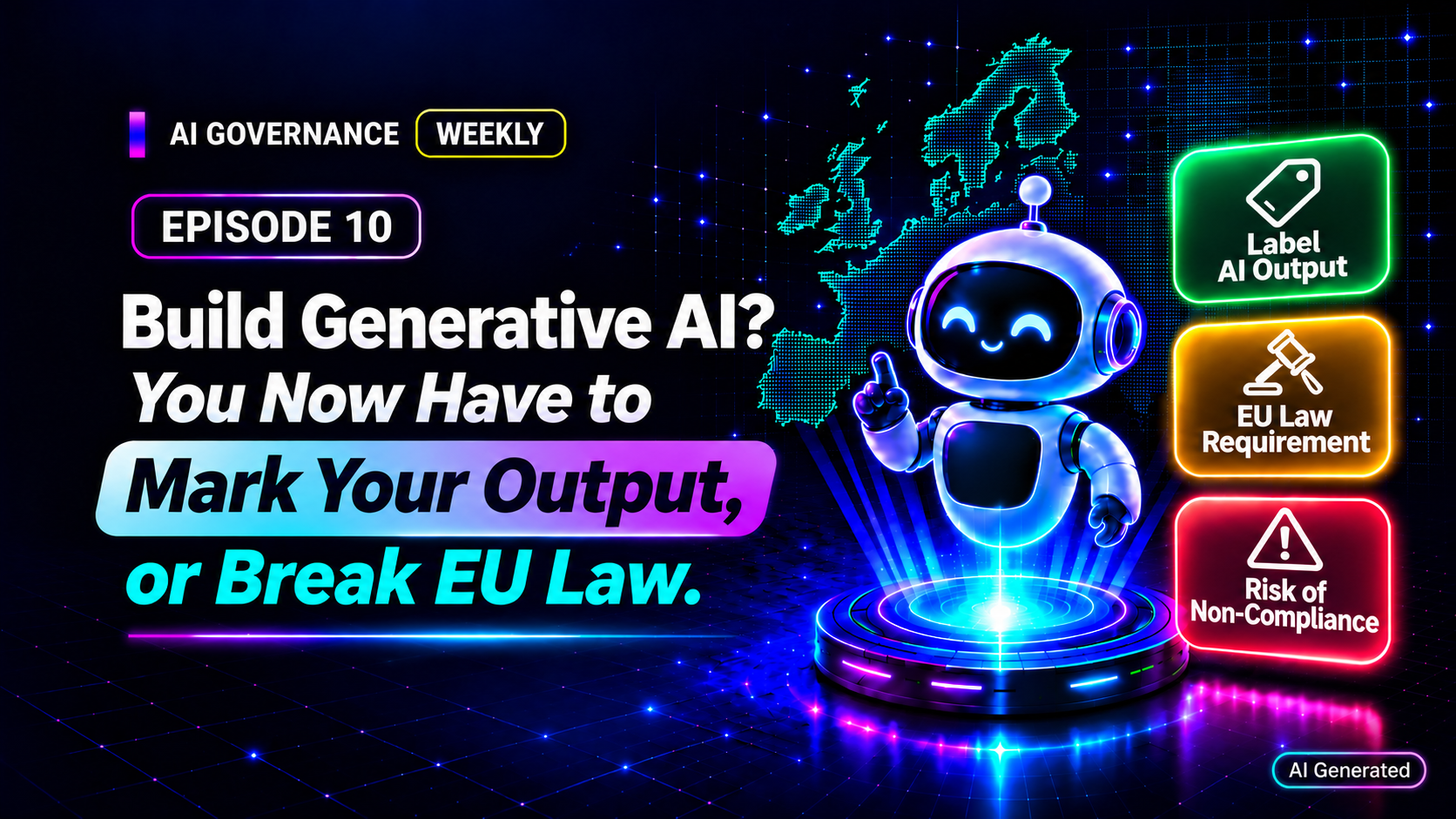
There is a real EU AI Act deadline on 2 December 2026, but it is narrower, and less scary, than many expected, because the EU changed the timeline. Two things actually take effect that day: a new ban on AI systems built to generate child sexual abuse material and non-consensual intimate images, and a transparency rule requiring providers of generative AI to mark AI-generated content so it can be identified as artificial. Meanwhile, the big "high-risk" obligations everyone braced for in August 2026 were pushed back to December 2027 by a reform called the Digital Omnibus. So if you run a business touching the EU, the headline is not panic; it is this: the sweeping rules got more time, and the part that matters most for ordinary companies now is being able to show when content is AI-generated.
For months, the date circulating in AI-compliance conversations was August 2026, when the EU AI Act's heaviest obligations, the ones on "high-risk" systems, were due to apply. That is no longer the case. The EU adjusted its own timeline, and the next real milestone is 2 December 2026. But what happens on that date is not what most people assume. Let us clear it up.
First, the big context: the timeline moved
In 2026 the EU adopted a reform package known as the Digital Omnibus, published in the Official Journal in July 2026. Its most important effect for most businesses is simple: it delayed the AI Act's high-risk rules. The obligations for high-risk AI systems listed in Annex III, things like AI used in hiring, credit, education, or essential services, were scheduled to apply on 2 August 2026. They have now been moved to 2 December 2027. A second category of high-risk systems tied to product safety moved to August 2028.
The reason was practical: the technical standards and guidance companies need in order to comply were not ready, so the EU gave more time rather than enforce rules no one could yet follow cleanly. The takeaway for you: if you heard that the serious high-risk obligations hit in August 2026 and panicked, or relaxed because that date passed, both reactions are now out of date. The high-risk clock runs to December 2027.
What actually takes effect on 2 December 2026
Two specific things land on this date, and they are narrower than the full high-risk regime.
The first is a new prohibition. The AI Act now bans AI systems designed to generate child sexual abuse material and non-consensual intimate imagery. This sits alongside the other banned practices we covered earlier in the series, in the most serious tier of the law, and it applies from 2 December 2026. For the vast majority of legitimate businesses this changes nothing about daily work; it closes a specific, serious abuse.
The second is the one more companies should notice: a transparency obligation for AI-generated content. Under Article 50 of the AI Act, providers of generative AI systems must mark their output, images, audio, video, and text, in a machine-readable way, so that content can be identified as artificially generated. This particular piece was timed to apply from 2 December 2026. It is part of a broader push in the Act toward a simple principle: people should be able to tell when they are looking at AI-generated content.
The part that matters most for you: AI content transparency
For most of our readers, the banned-practice change is not the relevant one; the content-transparency direction is. The EU is steadily building a norm that AI-generated media should be identifiable as such, through machine-readable marks embedded by the tools that create it, and, in related rules that began earlier in 2026, through disclosure when people are shown AI chatbots or deepfakes. If your business creates or publishes AI-generated images, video, audio, or text that reaches the EU, this is the trend to get ahead of. The specific 2 December obligation falls mainly on the providers of the AI tools, to build in the marking, but the overall message for anyone using those tools is clear: AI content transparency is moving from good practice to legal expectation.
Last week we covered the fines. It is worth linking the two. The new prohibition that applies on 2 December sits in the banned-practices tier, the one that carries the heaviest penalty, up to 35 million euros or 7% of worldwide turnover. The transparency obligations sit in the lower tier. The practical reading: the content you must not generate at all is treated most severely, while the content you must label is a serious but lesser duty. Knowing which tier a rule sits in tells you how much is at stake, which is exactly why we spent an episode on penalties before this one.
What to actually do before December
A few concrete steps, depending on what you do. If you build generative AI tools, the 2 December obligation is yours directly: make sure your system marks its output as AI-generated in a machine-readable way, and check the technical guidance for how. If you use AI to create content for an audience that includes the EU, start treating disclosure as the default, label AI-generated media, keep track of what was machine-made, and do not assume you can pass AI content off as human-made without consequence. If you were preparing for the high-risk rules, adjust your calendar: you have until December 2027, not August 2026, but that is time to use, not to waste. And because the details of who must do what, and by when, depend on your exact role and product, this is a good moment to confirm your position with a qualified professional.
The honest summary of this deadline is reassuring and sobering at once. Reassuring, because the heaviest obligations were delayed and the 2 December changes are narrow. Sobering, because the direction has not changed at all: the EU is steadily making AI use more accountable, and content transparency is the next piece to land. The businesses that treat December as a prompt to get their AI-content practices in order, rather than a fire drill, will be the ones already standing where the law is heading.
Not sure what the December deadline means for you?
Working out which AI Act obligations apply to your business, and getting ready before the date rather than after, is exactly the work we help with. A short check now is far cheaper than a scramble later. Explore our AI compliance and deployment services.
Explore our servicesFrequently asked questions
What is the EU AI Act deadline on 2 December 2026?
Two things take effect that day: a new prohibition on AI systems designed to generate child sexual abuse material and non-consensual intimate imagery, and a transparency obligation requiring providers of generative AI to mark AI-generated content (images, audio, video, text) in a machine-readable way so it can be identified as artificial. It is narrower than the full high-risk regime.
Didn't the big high-risk rules apply in August 2026?
That was the original schedule, but it changed. A 2026 reform called the Digital Omnibus moved the high-risk obligations for Annex III systems (such as AI in hiring, credit, or essential services) from 2 August 2026 to 2 December 2027, because the technical standards were not ready. So the heaviest obligations now run to December 2027.
Do I now have to label AI-generated content?
The direction of the law is clearly toward AI-content transparency. The specific 2 December 2026 obligation falls mainly on the providers of generative AI tools, to mark their output in a machine-readable way. But if your business publishes AI-generated media reaching the EU, treating disclosure as the default is the sensible move, because the Act is steadily making AI content identifiable by law, not just good practice.
What is the Digital Omnibus?
It is a 2026 EU reform package, adopted and published in the Official Journal in July 2026, that adjusted the AI Act's timeline. Most importantly, it delayed the high-risk obligations (to December 2027 and August 2028 depending on the category) to give companies more time while technical standards are finalized. It also set the 2 December 2026 dates for the new prohibition and parts of the transparency rules.
How big are the penalties for getting this wrong?
It depends on the rule. The new prohibition that applies on 2 December sits in the banned-practices tier, which carries the heaviest fines, up to 35 million euros or 7% of worldwide turnover. The transparency obligations sit in a lower tier. As we covered in the previous episode, the tier a rule belongs to tells you how much is at stake.
I am outside the EU. Does this deadline still apply to me?
It can. As we covered earlier in the series, the AI Act can reach companies outside the EU whose AI or its output is used in the EU. If you provide generative AI tools or publish AI content that reaches the EU market, the December obligations and the broader transparency direction can apply to you even from outside Europe. Confirm your position with a qualified professional.
Follow the series, get compliant one rule at a time
We are working through the EU AI Act one rule a week, in plain language, with the region in mind. Explore the full series and practical AI guides on AISetApp.
Explore more on AISetApp- EU AI Act (Regulation 2024/1689), Article 5 (prohibited practices) and Article 50 (transparency obligations)
- Future of Privacy Forum, "The AI Act Implementation Timeline: What Changes Under the AI Omnibus," 2026, on the Digital Omnibus and the 2 December 2026 and 2027 deadlines
- Travers Smith and other analyses of the Digital Omnibus delaying high-risk (Annex III) obligations to 2 December 2027, and reporting on the new prohibition and transparency dates, 2026
Reviewed November 2026. This is an explainer, not legal advice. Dates and obligations under the Digital Omnibus are recent and depend on your specifics; verify with a qualified professional and the consolidated legal text before acting.
Researched and drafted with AI assistance, reviewed and edited by Yasser El Hardouz, who takes editorial responsibility for this article.