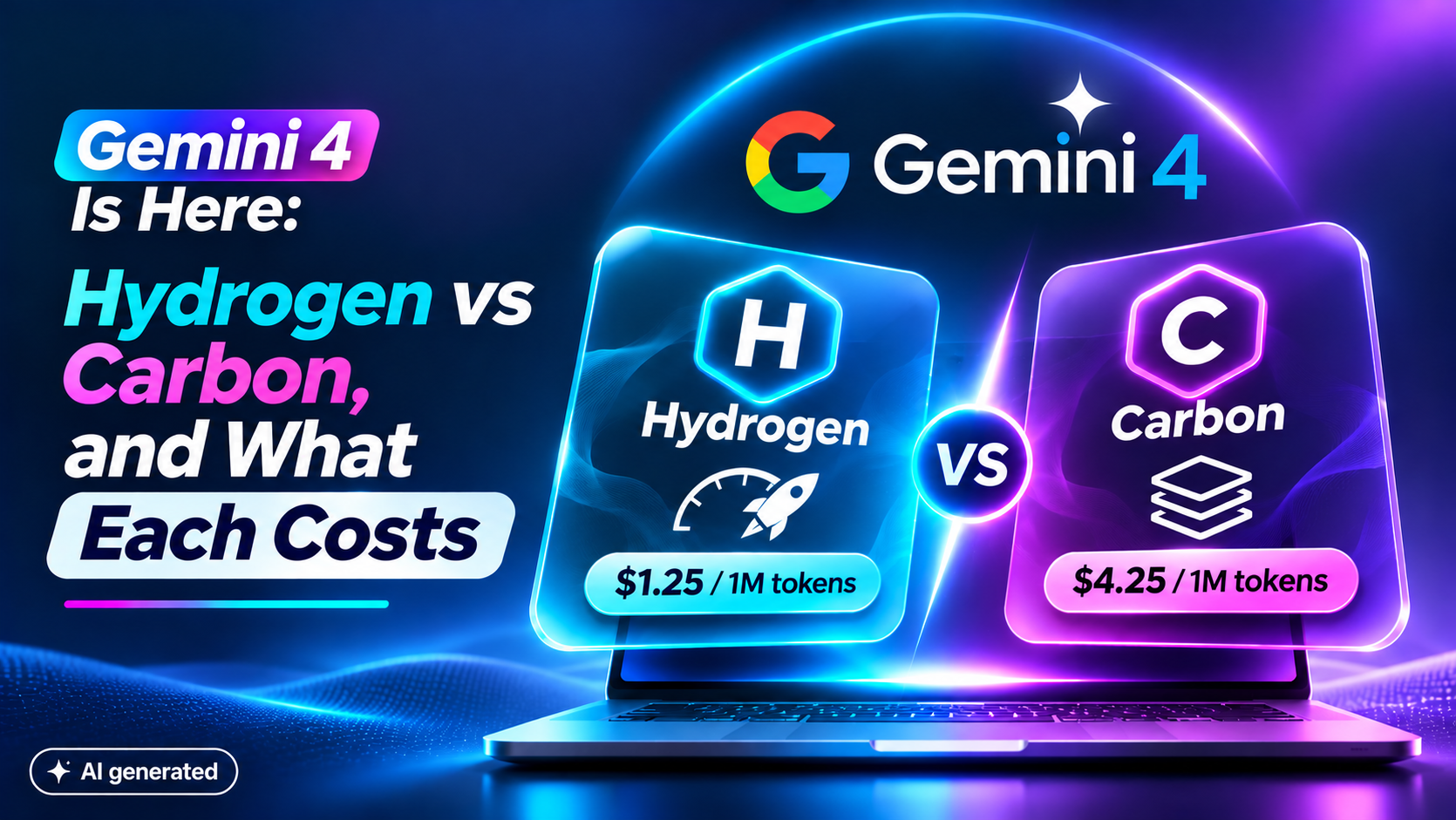
Gemini 4 is Google's new generation of AI models, and it comes as a family named after elements. Gemini 4 Hydrogen is the fast "daily driver" for everyday work — email, documents, research, light agentic tasks. Gemini 4 Carbon is the "strongest" frontier model, built for hard problems like complex coding and open-ended research. Argon sits in between as the default workhorse. Hydrogen reaches even free users inside the Gemini app and Google Search; Carbon is mostly for paying and enterprise users, with introductory API pricing that ends November 30, 2026.
Google Gemini 4 is here — not as a single model, but as a family. Over the past two weeks Google pushed its newest models out of preview and into everyday products, and if you use Google Search, Gmail, or the Gemini app, some of this is already running behind the scenes. The naming is unusual (elements from the periodic table), so the first useful thing is simply to know which Gemini 4 model is which, and when each one is worth reaching for.
What is Gemini 4?
Gemini 4 is Google's latest AI model generation, the successor to the Gemini 3 line. Instead of one model, Google ships several, each tuned for a different job and named after a chemical element. Three matter for most people: Hydrogen for speed, Argon for everyday heavy lifting, and Carbon for the hardest tasks. Google's own framing sums it up neatly: "Carbon and Argon do the deep thinking. Hydrogen gets the everyday work done, fast."
Gemini 4 Hydrogen
Hydrogen is the fast, efficient Gemini 4 model built for everyday agentic work: writing, research, email, documents, and pulling context from Gmail and Google Drive. It handles PDFs, spreadsheets, charts, and audio or video, and lets you pick among four "thinking" levels. Google says it finishes tasks about 2.5× faster than the previous 3.8 Flash model while making over 5× fewer fabricated claims — its figures, not yet independently verified. The important part for you: Hydrogen is the one most people will actually touch, because it reaches free users too.
Gemini 4 Argon
Argon sits between Hydrogen and Carbon, and Google recommends it for most software engineering and knowledge work — the sensible default when a task needs more reasoning than Hydrogen but doesn't justify the frontier model. It isn't one of your target keywords, but it's worth knowing it exists so you don't reach for Carbon when Argon would do.
Gemini 4 Carbon
Carbon is the top of the Gemini 4 range — Google's most capable model, aimed at the hard stuff: complex multi-step coding and open-ended scientific research. It arrived first for a small group of cybersecurity defenders in late October, then opened to all paying customers on November 10. Google is also previewing a "swarm" feature in its Antigravity platform that turns one prompt into a coordinated team of agents. By Google's own benchmarks Carbon ranks among the most powerful models available — though it positions itself against rivals from OpenAI and Anthropic, and those comparisons still need independent testing.
What Gemini 4 Carbon costs — and the November 30 deadline
Carbon is the only one of the three with pricing worth watching closely. Through an introductory period, the Gemini API charges $2 per million input tokens and $10 per million output tokens. After the introductory period ends on November 30, 2026, that rises to $4 and $20. Google and early reviewers frame the introductory rate as notably cheaper than frontier rivals, but per-token price doesn't equal total cost: different models spend different numbers of tokens on the same task, so the honest comparison is cost per completed task, not per token. If you're planning to build on Carbon, it's worth testing before the price steps up.
| Model | Best for | Who gets it | Notes |
|---|---|---|---|
| Gemini 4 Hydrogen | Fast everyday work, email, docs, light agents | Free users (in-app & Search), Pro/Ultra, API, enterprise | The one most people will use |
| Gemini 4 Argon | Most software & knowledge work | Paid & developer tiers | Google's recommended default |
| Gemini 4 Carbon | Hardest tasks: complex coding, deep research | Paying & enterprise; Ultra in the app | Intro API price ends Nov 30, 2026 |
Which Gemini 4 model should you use?
For almost everyone, the answer is Hydrogen — it's fast, it's free in the Gemini app and Google Search, and it's built for the writing, research, and document work most people do all day. Reach for Argon when a task needs real reasoning, like a chunk of code or a knotty analysis. Save Carbon for genuinely hard problems — multi-step engineering, open-ended research — or when you're building a product on the API and need the top model. And if you are building on Carbon, mind the November 30 pricing change.
Every speed and quality number in this piece comes from Google's own benchmarks and partner tests. That's normal for a launch, but it isn't the same as independent verification — vendors pick the benchmarks that flatter them. Treat the "2.5× faster" and "strongest model" claims as the starting point for your own testing, not as settled fact. The right test is always your own workload.
Keep up with the models that matter
New frontier models now ship every few weeks, and the names (Hydrogen, Carbon, and the rest) are only getting stranger. AISetApp tracks the AI tools and models worth your time, in plain language — so you can pick the right one instead of chasing every launch.
Explore AISetAppFrequently asked questions
What is Gemini 4?
Gemini 4 is Google's newest generation of AI models, the successor to Gemini 3. Rather than a single model, Google Gemini 4 ships as a family named after chemical elements: Hydrogen (fast, everyday), Argon (the default workhorse), and Carbon (the strongest, frontier model). Different models suit different jobs.
What is Gemini 4 Hydrogen?
Gemini 4 Hydrogen, released November 12, 2026, is Google's fast "daily driver" model for everyday agentic work — writing, research, email, documents, and pulling context from Gmail and Drive. It's the Gemini 4 model most people will use, because it reaches free users in the Gemini app and powers Google Search globally.
What is Gemini 4 Carbon?
Gemini 4 Carbon, generally available from November 10, 2026, is Google's "strongest model" — a frontier model built for the hardest tasks, such as complex multi-step coding and open-ended scientific research. It's aimed mainly at paying and enterprise users, with introductory API pricing that ends November 30, 2026.
Is Gemini 4 free?
Partly. Gemini 4 Hydrogen reaches free users automatically inside the Gemini app and through Google Search. The frontier model, Gemini 4 Carbon, is mainly for paying (AI Ultra) and enterprise users, and for developers via the API. Argon sits on paid and developer tiers.
How much does Gemini 4 Carbon cost?
On the Gemini API, Carbon's introductory rate is $2 per million input tokens and $10 per million output tokens. After the introductory period ends on November 30, 2026, it rises to $4 and $20. Remember that per-token price isn't the same as total cost — compare cost per completed task on your own workload.
Gemini 4 Hydrogen vs Carbon — what's the difference?
Hydrogen is fast and efficient, built for everyday work and available even to free users. Carbon is the strongest frontier model, built for the hardest problems and aimed at paying and enterprise users. In Google's words: "Carbon and Argon do the deep thinking. Hydrogen gets the everyday work done, fast."
- Digital Trends, "Google's next-gen Gemini 4 Hydrogen AI model is here" (release details, November 2026)
- Let's Data Science, "Google rolls out Gemini 4 Carbon to the general public" (availability and pricing, November 2026)
- The Verge and Axios reporting on the Gemini 4 launch and benchmarks, September–November 2026
Reviewed November 2026. All performance and pricing figures are as reported at launch and reflect Google's own benchmarks unless noted; independent testing is still needed, and prices and availability may change. This is an explainer, not an endorsement.
Researched and drafted with the help of AI, then reviewed and edited by Yasser El Hardouz, who holds editorial responsibility for the content.