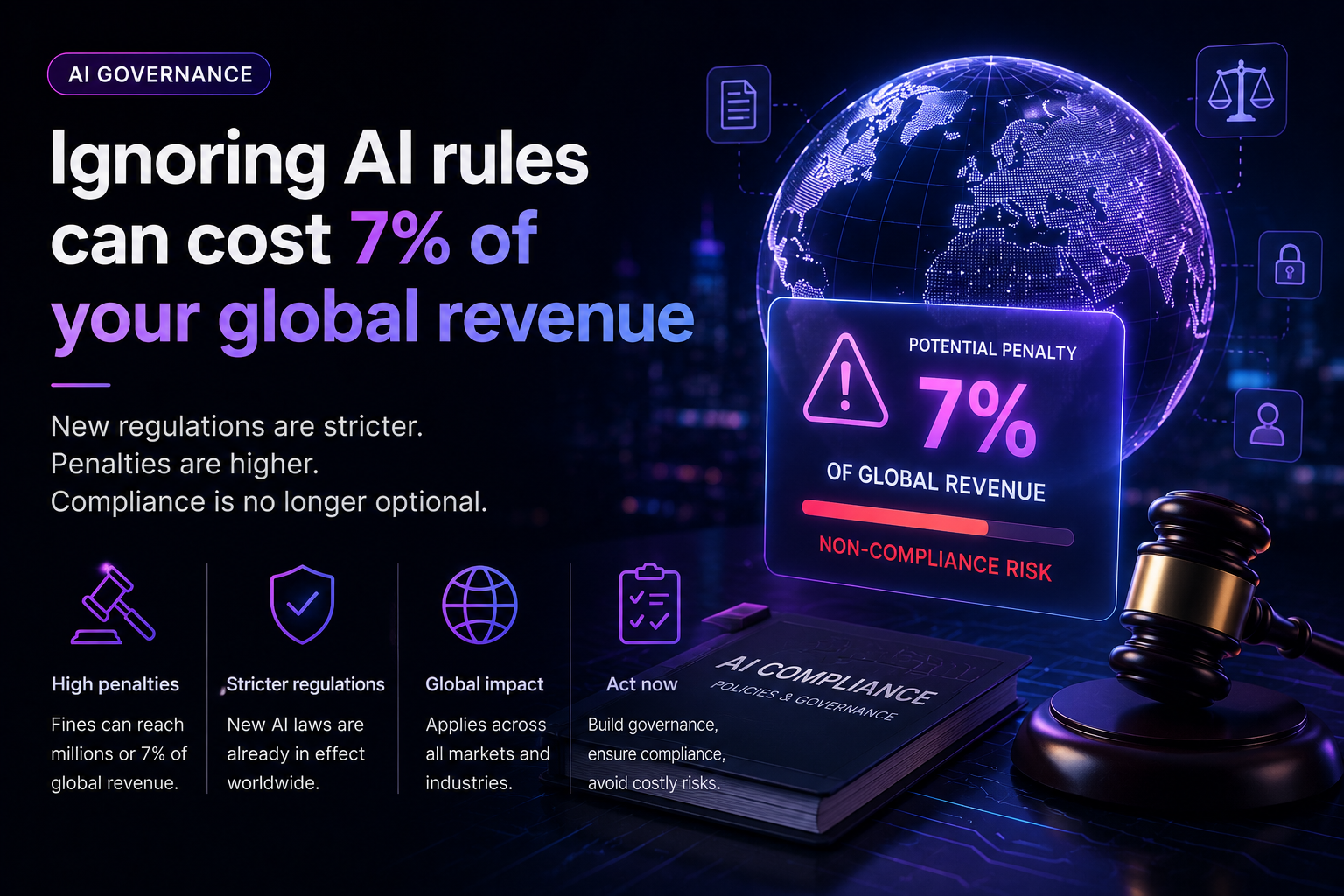
AI governance is the set of rules, standards, and processes that decide how AI can be built and used, who is accountable when it goes wrong, and what rights you have as someone affected by it. For businesses, it is now a legal obligation with real teeth: the EU AI Act carries fines of up to 35 million euros or 7 percent of global turnover, and it reaches any company whose AI touches EU users, wherever that company is based. For everyday users, governance is the thing that gives you a right to know when you are talking to a machine, to challenge an automated decision, and to have your data protected.
For most of the last decade, AI was built and deployed with almost no specific rules. That period is over. As of August 2026, the world's first comprehensive AI law is being actively enforced, a cluster of international standards has matured, and "AI governance" has moved from a boardroom talking point to a operational requirement with legal and financial consequences. This article explains what governance actually is, what happens to organisations that ignore it, what they need to do, and, just as importantly, how these rules are designed to protect the people on the receiving end of AI systems.
What AI governance actually means
Governance is not one law or one tool. It is the whole framework of rules and practices that answers three questions: what is an AI system allowed to do, who is responsible when it causes harm, and how can the people affected by it seek protection or redress. It operates at several levels at once. Governments set binding law. International bodies publish standards that organisations can certify against. And individual companies build internal policies to keep their own use of AI accountable.
The reason it matters now, rather than in some hypothetical future, is that AI has moved into decisions that materially affect people's lives: who gets hired, who gets a loan, how a medical case is triaged, how a student is assessed. When a system makes or shapes those decisions, the stakes are high enough that "trust us" is no longer an acceptable answer. Governance is the structured alternative to "trust us."
The frameworks that matter in 2026
Four frameworks dominate every serious governance conversation this year. They are not competitors so much as layers, and most large organisations now work with more than one at the same time.
The EU AI Act
The only one of the four that is mandatory law with financial penalties. It sorts AI into four risk tiers, from banned practices down to minimal-risk tools, and imposes strict obligations on the high-risk category. It applies to any provider or deployer whose AI is placed on the EU market or whose output is used in the EU, regardless of where the company is headquartered. This extraterritorial reach is why it is shaping AI worldwide, an effect often called the Brussels Effect.
The NIST AI Risk Management Framework
The de facto US standard. It is voluntary, but federal contractors and a growing share of enterprise buyers expect it, which makes it functionally mandatory in many supply chains. Rather than prescribing exact rules, it defines a process through four functions: govern, map, measure, and manage. It tells you how to run a risk program without dictating the specific answers.
ISO/IEC 42001
The world's first certifiable international standard for AI management systems. Being market-driven rather than legal, its teeth are commercial: losing certification can mean losing contracts, even though no regulator fines you for lacking it. For organisations that need to prove good governance to partners and customers, this is the credential.
The OECD AI Principles
The non-binding ethical foundation adopted by dozens of countries and referenced in both EU and US policy. These principles do not enforce anything directly, but they set the shared values, human oversight, transparency, accountability, that the harder frameworks then turn into concrete rules.
What happens if a business ignores it
This is where the abstract becomes very concrete. Non-compliance with the EU AI Act is not a slap on the wrist. The penalties are deliberately severe enough to change corporate behaviour, and they exceed even the GDPR's famously large fines.
| Violation type | Maximum penalty |
|---|---|
| Using a banned AI practice (for example social scoring, or certain biometric surveillance) | Up to 35 million euros or 7% of global annual turnover, whichever is higher |
| Breaching high-risk or GPAI obligations (documentation, oversight, transparency) | Up to 15 million euros or 3% of global annual turnover |
| Supplying incorrect or misleading information to authorities | Up to 7.5 million euros or 1% of global annual turnover |
The financial penalty is only the visible part. The full cost of non-compliance also includes being forced to withdraw a non-conforming system from the EU market, which can destroy a product line overnight. It includes the reputational damage of a public enforcement action. And because the AI Act sits alongside the GDPR rather than replacing it, a single system that mishandles personal data can trigger penalties under both regimes at once, with data protection authorities and AI market surveillance authorities coordinating on the same case.
Surveys in mid-2026 found that more than 60 percent of European SMEs had not yet started their compliance preparations, even as enforcement began. Smaller companies do get proportionally capped fines, but they are not exempt. The gap between the rules being live and most businesses being ready is the single biggest governance risk right now, and it is entirely avoidable.
What a business actually needs to do
Compliance sounds overwhelming until it is broken into steps. For most organisations, the path looks like this, and the first two steps cost almost nothing but attention.
- Inventory your AI. List every AI system you build or use. You cannot govern what you have not mapped, and most organisations underestimate how many AI tools are already in use across their teams.
- Classify by risk. Sort each system into the AI Act's tiers. If a tool is minimal-risk, your obligations are light. If it is high-risk, used in hiring, credit, healthcare, education, or biometrics, the serious requirements apply.
- Close the gaps on high-risk systems. These need risk management, data governance, technical documentation, human oversight, logging, transparency, and demonstrated accuracy and robustness. This is the demanding part, and it takes months, not days.
- Meet the transparency duties now. Since August 2026, you must tell people when they are interacting with an AI system and label AI-generated content. This applies even to existing systems, not just new ones.
- Integrate, do not duplicate. Build one governance program that satisfies GDPR, the AI Act, and your chosen standards together. Treating them as separate projects wastes effort and creates gaps.
- Assign accountability. Name who owns AI governance. Diffuse responsibility is how compliance quietly fails.
How governance actually protects users
It is easy to read all this as a burden on business and miss the point. The entire architecture exists to protect the people affected by AI, and if you use AI-powered services, which almost everyone now does, it gives you concrete rights.
To know when it is AI
The transparency rules mean you have a right to be told when you are talking to a chatbot rather than a person, and when content was generated by AI. No more being quietly handled by a machine that is pretending to be human.
To be protected from the worst uses
Some practices are simply banned. Governments cannot use AI for social scoring of citizens, and manipulative or exploitative AI systems are prohibited outright. These are lines that no amount of corporate convenience is allowed to cross.
To human oversight of decisions that affect you
For high-risk systems, a human must remain meaningfully in the loop. If an AI system is involved in a decision about your job application, your loan, or your medical care, governance requires that a person can review and override it, rather than the machine deciding your fate unchecked.
To have your data protected
Because the AI Act works alongside the GDPR, the personal data fed into AI systems keeps its existing protections, and the two regimes reinforce each other. A system that abuses your data can now be challenged on two fronts at once.
The bottom line
AI governance in 2026 is no longer theoretical. For businesses, it is a live legal obligation where the cost of ignoring it, financial, operational, and reputational, now clearly outweighs the cost of getting it right. For everyone else, it is the reason AI is slowly becoming something you can trust a little more: a system you have the right to understand, to question, and to be protected from when it fails. The organisations that treat governance as a genuine part of how they build, rather than a box to tick, are the ones that will keep the trust of both regulators and the people they serve.
Frequently asked questions
What is AI governance in simple terms?
It is the collection of laws, standards, and internal practices that control how AI can be built and used, decide who is accountable when it causes harm, and protect the people affected by it. Think of it as the rules of the road for AI: it lets the technology move fast while keeping people safe.
Does the EU AI Act apply to companies outside the EU?
Yes. It applies to any provider or deployer whose AI system is placed on the EU market or whose output is used in the EU, regardless of where the company is headquartered. A business in another country that serves EU users is within scope. This global reach is often called the Brussels Effect.
What are the penalties for non-compliance?
Under the EU AI Act, up to 35 million euros or 7 percent of global annual turnover, whichever is higher, for using banned AI practices. Lesser breaches carry lower caps. Beyond fines, non-compliant systems can be forced off the EU market, and because the Act works alongside the GDPR, one system mishandling data can trigger penalties under both.
What are the main AI governance frameworks?
Four dominate in 2026: the EU AI Act, the only binding law with fines; the NIST AI Risk Management Framework, the de facto US standard; ISO/IEC 42001, the first certifiable international standard; and the OECD AI Principles, the non-binding global baseline adopted by dozens of countries. Most large organisations use a combination.
How does AI governance protect ordinary users?
It gives you concrete rights: to be told when you are dealing with an AI rather than a person, to be protected from banned practices like social scoring, to have a human review high-risk decisions about your job, finances, or health, and to keep your personal data protected under existing privacy law. Governance turns "trust us" into enforceable rights.
My business is small. Do these rules still apply to me?
Yes, though more proportionately. SMEs get reduced fees, access to regulatory sandboxes, and lower penalty caps, but they are not exempt. Given that most small businesses have not yet started preparing, the practical first steps, inventorying and classifying your AI systems, are the most valuable things you can do right now.
Understand the AI landscape, clearly
Governance is just one piece of using AI well. Explore more clear, honest explainers on AISetApp, and stay ahead of the tools, rules, and risks shaping how AI actually works.
Explore more on AISetApp- European Commission, EU AI Act (Regulation (EU) 2024/1689) enforcement announcement, August 2026
- Legiscope and informedclearly.com, EU AI Act deadlines, penalty tiers, and GDPR interaction
- GAICC and NeuralTrust, 2026 comparisons of the EU AI Act, NIST AI RMF, ISO/IEC 42001, and OECD AI Principles
- NQA and TrustCloud, ISO/IEC 42001 certification and governance implementation
- Industry surveys on SME compliance readiness, mid-2026
Reviewed August 2026. This is an explainer, not legal advice. Verify specifics with a qualified professional.