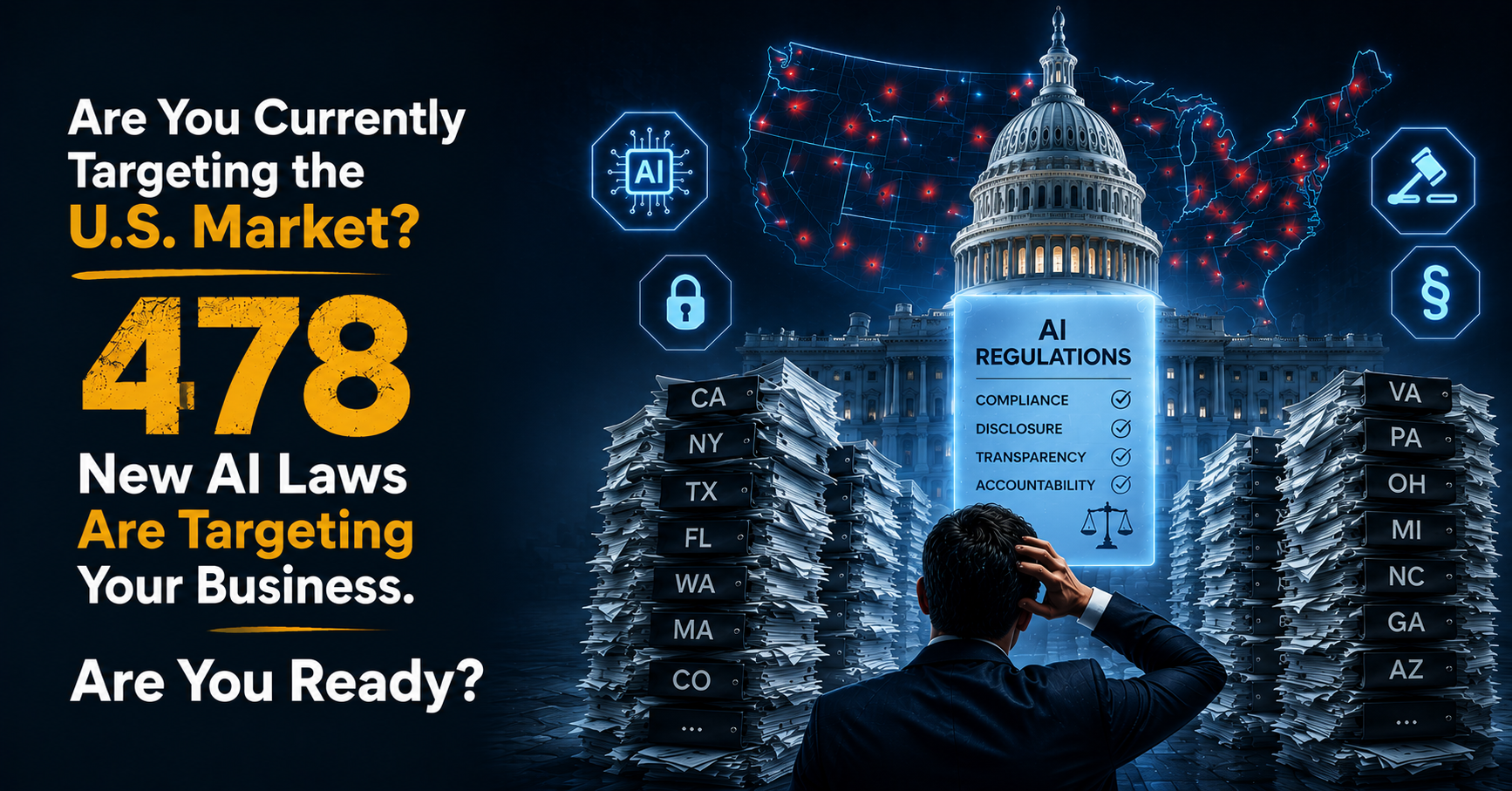
The AI transparency rules we have been explaining through the EU are no longer a European story. Across the United States, a wave of similar laws is arriving fast: by one count, 478 AI transparency bills across 48 states, with around 40 taking effect in 2026 alone. They cover the same themes as the EU rules: telling people when they are dealing with AI, labelling AI-generated content, and watermarking. If you thought the EU AI Act was a distant concern, the same ideas are now landing much closer to home for a great many businesses.
In Episode 1 of this series we covered the rule that a chatbot must tell people it is AI, and in Episode 2 the rule that AI-generated content must be labelled. Both came from the EU AI Act, and a fair question is whether they matter to a business that does not operate in Europe. This update is the answer: the same principles are spreading well beyond the EU, most visibly across individual US states, and the direction of travel is unmistakable.
A wave of state laws, not one headline
The real story is not a single dramatic law but the sheer volume of them. Trackers now count hundreds of AI transparency bills moving through nearly every US state, covering watermarking and provenance, chatbot disclosure, synthetic media labelling, and training-data transparency. Dozens are taking effect during 2026. For a business, this is arguably harder to navigate than one big federal law would be, because it is a patchwork: different states, different rules, different dates. But underneath the variation, the core ideas are strikingly consistent, and they are the same ones this series has been teaching.
Here is a detail that captures the moment. California's AI Transparency Act became operative on August 2, 2026, the very same day the EU AI Act's transparency rules took effect. One is a European regulation, the other a US state law, and they landed on the same date with overlapping goals: making AI-generated content and AI interactions transparent to the people who encounter them. When a European regulation and a Californian statute converge on the same idea at the same moment, it is a strong signal that AI transparency is becoming a global baseline rather than a regional rule.
Chatbot disclosure is going global
The rule from Episode 1, that an AI must disclose it is an AI, is exactly the kind that is spreading. Several US states are advancing bills requiring businesses to tell people when they are communicating with artificial intelligence rather than a human, the same core duty as the EU's. There is also movement at the federal level: proposed legislation would require consumer AI agents to disclose their non-human status nationally. Nothing about this is uniquely European any more. If your chatbot serves customers in multiple markets, the safe assumption is that a disclosure duty either already applies or soon will, wherever they are.
Content labelling and watermarking too
Episode 2's theme, labelling AI-generated content, is following the same path. California's watermarking law, described by trackers as among the most comprehensive, requires generative AI providers to embed hidden disclosures in AI-generated images, the machine-readable marking side we discussed in our watermarking update. Other states are targeting synthetic media in advertising and political content. The specifics vary, but the principle is the one this series keeps returning to: people are entitled to know when what they are seeing or reading was made by AI.
The pattern worth understanding: disclosure survives, bans do not
Here is the most useful insight for anyone trying to read where this is heading. Not every AI law survives contact with the courts, and there is a clear pattern in which ones do. Broad bans on AI content have repeatedly run into trouble: a sweeping California law was permanently blocked in 2025 after a federal judge found it likely unconstitutional on free-speech grounds, and a Hawaii law met a similar fate. But disclosure-based laws, the kind that require transparency rather than prohibition, have generally held up. The lesson is that the durable approach, the one likely to define the landscape, is exactly the transparency-and-labelling model at the heart of the EU rules and this series. Betting on transparency is betting on the version of these rules most likely to last.
What this means for you
Three practical points. First, do not dismiss AI transparency rules as a European issue, the same duties are arriving across the US and elsewhere, and if you serve customers in several places, some version very likely reaches you. Second, because it is a patchwork of overlapping rules rather than one clean law, the simplest safe strategy is to meet the strictest common standard: disclose your AI, label your AI content, and you are broadly covered across jurisdictions at once. Third, this is not slowing down, so the businesses that build transparency in now will find themselves ready as more rules land, rather than scrambling each time. Next week we return to the numbered series with how to classify your AI system into the right risk tier.
Frequently asked questions
Do AI disclosure rules apply outside the EU?
Increasingly, yes. While the EU AI Act is the most comprehensive, a large wave of similar laws is arriving across US states, with hundreds of AI transparency bills and dozens taking effect in 2026. They cover the same themes: disclosing AI interactions, labelling AI content, and watermarking. AI transparency is becoming a global baseline rather than a European rule.
Does my chatbot have to disclose it is AI in the US?
In a growing number of states, either already or soon. Several US states are advancing bills requiring businesses to tell people when they are communicating with AI rather than a human, and there is proposed federal legislation on consumer AI agents disclosing their non-human status. If you serve customers in multiple markets, the safe assumption is that a disclosure duty applies somewhere in your footprint.
Why are there so many different AI laws instead of one?
In the US, individual states are legislating independently, producing a patchwork of hundreds of bills with different rules and dates rather than one federal law. This can be harder to navigate than a single statute. The practical response is to meet the strictest common standard, disclose AI and label AI content, which broadly covers you across jurisdictions at once.
Why do some AI laws get struck down and others survive?
There is a clear pattern. Broad bans on AI content have repeatedly been blocked by courts on free-speech grounds, including a sweeping California law in 2025 and a Hawaii law afterward. Disclosure-based laws, which require transparency rather than prohibition, have generally survived. The durable approach is transparency and labelling, the same model at the heart of the EU rules.
What should my business do about all these rules?
Meet the strictest common standard. If you clearly disclose when people are interacting with AI, and clearly label AI-generated content, you are broadly aligned with both the EU rules and the emerging US ones at the same time. Building this transparency in now means you are ready as more rules take effect, rather than reacting to each one separately. For anything specific, consult a qualified professional.
Follow the series, get compliant one rule at a time
This is a special update in our weekly guide to AI regulation, showing how the rules are spreading beyond Europe. Explore more clear, honest guides on AISetApp and follow the series each week.
Explore more on AISetApp- AI Laws by State trackers on state AI disclosure, watermarking, and chatbot legislation, 2026, including the count of transparency bills and bills effective in 2026
- Reporting on California's AI Transparency Act (SB 942 and AB 853) operative August 2, 2026, and its watermarking provisions
- Legal analyses of Minnesota's 2026 deepfake platform-liability law and of state chatbot-disclosure bills
- Court coverage of enjoined broad AI-content laws in California and Hawaii and the contrast with surviving disclosure-based statutes
Reviewed August 2026. This is an explainer, not legal advice. The state-law landscape changes constantly; verify specifics with a qualified professional before acting.
Researched and drafted with AI assistance, reviewed and edited by Yasser El Hardouz, who takes editorial responsibility for this article.